Craig Stingley’s quest for justice for his son’s death was about restoring the teenager’s humanity.
To do that, he forgave the men who 13 years ago held down his son Corey, which led to the 16-year-old’s death. On Jan. 15, Craig and the Stingley family watched in a Milwaukee courtroom as what eluded them for so long came to fruition – as those same men agreed to guilty pleas to felony murder charges.
The pleas from Robert Beringer, 67, of Menomonee Falls, and Jesse Cole, 39, of Waukesha, came as part of a deferred prosecution agreement, which allows for charges to dropped if certain conditions are met for six months. That agreement was endorsed by the Stingley family, who underwent a series of meetings called restorative justice with the two men, and believed those meetings brought forward a more apt form of justice than what the court system traditionally offers.
“I’m not looking for vengeance, I don’t have vengeance in me today,” Craig Stingley said at the court hearing. “There’s still pain, but after today that will begin to heal too.”

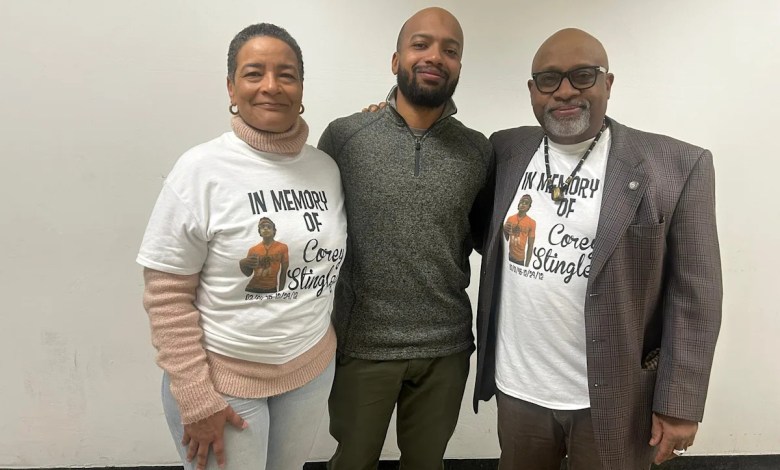
Alicia, Cameron and Craig Stingley pose for a photo following a hearing on charges filed against two men in the death of Corey Stingley, Alicia and Craig’s son.
Corey Stingley died on Dec. 14, 2012, after three men – Beringer, Cole and Mario Laumann – held him down in a West Allis corner store after they believed he shoplifted. Stingley’s death came over two weeks after the three men held him down between six to 10 minutes.
It was ruled he died from positional asphyxia, or a lack of oxygen, that led to brain damage and death.
Beringer’s and Cole’s agreement included the restorative justice process, a forthcoming donation of $500 from each to a charity of the Stingley’s choice and that they remain crime free.
Laumann died in 2022 and would likely not have been offered the same deal, special prosecutor Ismael Ozanne said in court. Court documents filed indicated the attorney believed that man to be most at fault for the boy’s death.
Ozanne was appointed to investigate possible criminal charges after repeated attempts by Craig Stingley to convince the legal system to hold the men accountable for his son’s death. Over a year after his son died, then-Milwaukee County District Attorney John Chisholm declined to file charges, and, in 2020, Racine’s top prosecutor made the same decision, after the father petitioned to have the case reviewed again.
But in 2022, Dane County District Attorney Ozanne received the case and after two years, the office informed Cole and Beringer of its intent to file felony murder charges. In fall of 2024, the Stingley family and the two men began to discuss undergoing restorative justice through Marquette Law School.
The next year that process began. The family and the two men met to discuss what had happened and its impacts on them.
At the court hearing, that process was lauded by the Stingley family and Judge Laura Crivello. With family, friends of Corey’s and Milwaukee activists in attendance, Craig Stingley and his wife Alicia gave emotional testimony.
Craig spoke of not wanting to take away a father from Cole’s family. Alicia spoke of having to bury her own son and finding compassion and forgiveness for the two men.
“I know that he’s in heaven waiting for me,” Alicia Stingley said. “I know I’ll see him again, and so that gives me comfort in the meantime. It gives me peace.”
Both spoke of their faith.
“Do on to others as you would have them do on to you,” Craig Stingley said. “We all know this, but when it comes time to apply it will you apply it? Me and my family we are going to apply it now.”
The hearing was unusual for Milwaukee courts, as it was technically a hearing for the first phase of a typically lengthy court process. Instead, the hearing effectively ended the case against Cole and Beringer in less than two hours.
Crivello called it a “fair and equitable” solution.
Cole’s attorney Jonathan LaVoy told media there were “always major disputes” with some factual issues of the case – which Crivello noted in the hearing – but his client ultimately believed a guilty plea through the unique process was right.
“This provided the healing that everyone needed,” LaVoy said. “In this situation they actually talked to each other and, I think, reached a common ground.”
Crivello said she hoped the Stingley family’s compassion might offer the community a path ahead.
“I have no insight to offer, but your words shed some light,” Crivello told the Stingley family. “Maybe this is the spark that makes others see similarities in others … maybe this is part of the spark that decreases the violence in our community and leads us to finding the path that helps us.”
Cole and Beringer declined to speak with media following the hearing.
Original decision not to charge angered many
Stingley’s death, and the decision by Chisholm to not press charges, prompted protests in the city at the time. That decision was made in 2014, because Chisholm said the three men had no intent to harm Stingley nor were aware their actions created a substantial and unreasonable risk of great bodily harm.
Afterward it became a regular criticism of Chisholm and was evoked as a comparison in the death of D’vontaye Mitchell, who died under similar circumstances in 2024 at the Hyatt Regency in downtown Milwaukee.
That death also prompted protests. At one, Craig Stingley spoke in support of the family and to call for criminal charges. Felony murder charges were ultimately filed against the men charged in that case, where no one ultimately received a prison sentence.
After the hearing, he said Milwaukee’s activist and faith communities and others had stood by the family in the 13 years since Corey died.
Craig spoke standing alongside his wife and son Cameron, while more family waited for the three to join them in a court conference room. He said his grandchildren were an inspiration for him through the process.
“When he got taken, the community lost. Now, we got this next generation,” Craig said. “That strengthened your resolve to do the right thing. Because this is priceless what we get to pass on to them.”
David Clarey is a public safety reporter at the Milwaukee Journal Sentinel. He can be reached at dclarey@gannett.com.
This article originally appeared on Milwaukee Journal Sentinel: Corey Stingley’s family receives justice through unique court process


