Contributor: Trump’s Russia and Ukraine summits show he can push for peace

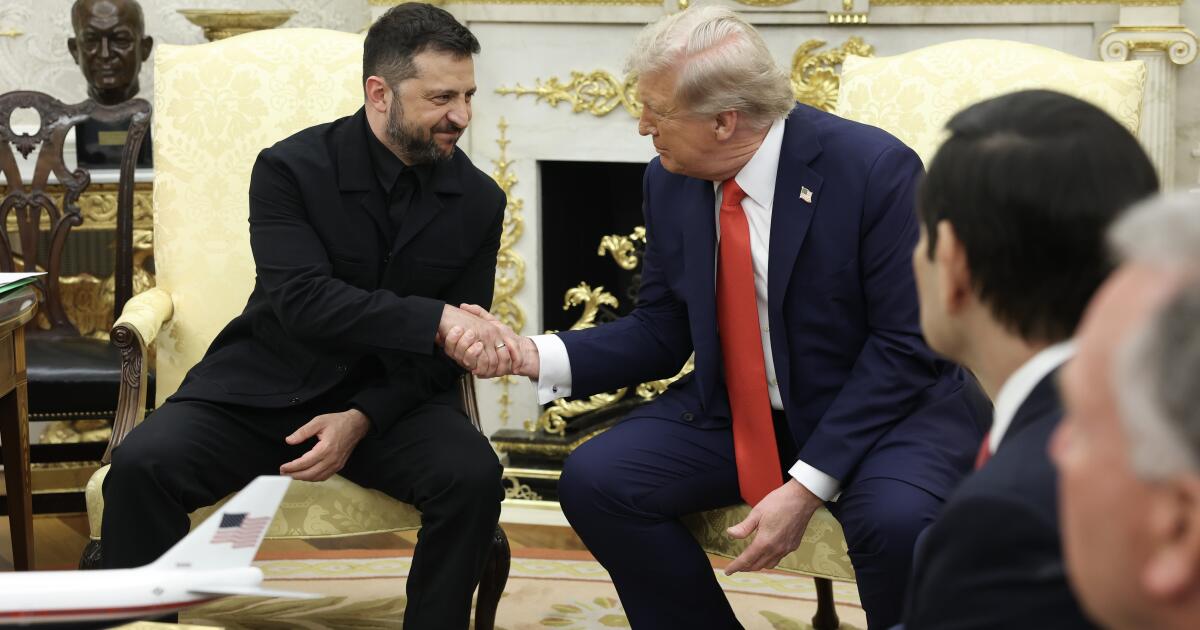
By organizing an unprecedented short -term summit with Ukrainian President Volodymyr Zelensky and the main European leaders on Monday, President Trump considerably raised the prospects for the implementation of the Russian three and a half years war against Ukraine. The atmosphere at the opening was affable and positive. The participants seemed really determined to develop compromises which, only a few weeks ago, seemed illusory. It was a good sign for the long-term cooperation of Euro-Atlantic security in the face of challenges that, in Trump’s words, we have not been confronted since the Second World War. Towards the end, Trump’s call in Moscow brought a follow-up to the US-Ukraine-Russia summit at hand.
But growing expectations also reveal great obstacles on the path of peace. While the leaders of the world were heading for Washington, Putin forces sparked 182 infantry assaults, 152 massive sliding bombs, more than 5,100 artillery rounds and 5000 Kamikaze drones on the defenses of Ukraine and 140 long -range drones and four ISKANDER ballist missiles on the cities of Ukraine. The attacks have made at least 10 civil lives, including a small child. This is how Russia attacks Ukraine daily, reporting a lack of respect for Trump’s diplomacy.
The Monday summit also revealed that the ostensible concession of Putin at the top of Alaska to accept international security guarantees for Ukraine is a poisoned chalice. On the surface, it seemed to be a breakthrough towards the compromise. Participants at the top of the White House jumped on it and put the guarantees at the discussion center.
And yet there has been no agreement, and the world has more questions than answers. How to strengthen the Ukrainian armed forces to dissuade Russia? Who would pay? How could Russia be prevented from rebuilding its Black Sea fleet and blocking exports of Ukrainian cereals? What deployments of troops would be necessary? Who would put boots in the field in Ukraine? What type of guarantees should correspond what type of territorial concessions?
These questions are responsible for complex debates. Between the United States and Europe. In Europe. In the Trump administration. In Ukraine. And all this before even having to negotiate the question with the Kremlin. The net profit of the diplomatic sieve last week will be Putin’s purchase time for his assault while Washington refrains from sanctions hoping for peace.
Disinstantly, in exchange for this chalice poisoned with a concession, Putin demanded that Ukraine should yield not only the land currently under the illegal military occupation of Russia, but also a large piece of the province of Donetsk still under the control of kyiv. This area is home to 300,000 people and is a major defense bastion. Controlling it would give Russia a springboard to deeper attacks targeting major cities and threatening to put Ukraine on my knees.
Putin’s offer also threatens to tear Ukrainian society. In my follow -up survey with the Sociology Institute of the Academy of Sciences of Ukraine completed in early August, almost half of 567 respondents want Ukraine to reaffirm control over all of its internationally recognized territories, including the Crimea peninsula annexed in 2014. Only 20% would be satisfied with freezing the in progress. The option of giving in the territories in Russia still under the control of kyiv is so scandalous that it was not included in the investigation. Eighty percent of Ukrainians continue to trust Ukraine’s victory and to see democracy and freedom of expression – the fundamental values that Putin would take away – as a vital for the future of Ukraine.
It is important to obtain a good Ukrainian society so that Trump’s peace effort succeeds. The acquisition of the commitment of the Ukrainians towards freedom and independence has a lot to do with the place where we are now. Putin launched the total invasion in February 2022, expecting the Ukrainians to adopt Russian domination. The president of the time, Biden, assessed that the Ukrainians would bend quickly and delay major military assistance in Kyiv.
The erroneous Ukrainians would now most likely lead to a rejection of the peace proposals and perhaps a political crisis there, inviting more assault of Moscow while allowing more obstinate resistance to the invasion, with a long and bloody war.
Fortunately, Trump has the ability to maintain the peace process on the right track. First of all, he can amplify two messages of critical importance which he articulated at the Monday summit: the will of the United States to support the security guarantees of Ukraine and to continue to sell weapons to Ukraine if no peace agreement is concluded. Second, he can use his superb skills in strategic ambiguity and push threats to take advantage of our underwater power and impose secondary sanctions on commercial countries with Russia. Thirdly, he can leave an index that he supported the Bipartite Law of the Senate to support Ukraine in 2025, which would provide military assistance to Ukraine for two years from confiscated Russian assets, US-UKRAINE-UKRAINE minerals deal with profits and investments in American military modernization.
The Monday summit makes the urgency of these movements and similarly clear.
Mikhail Alexseev, professor of international relations at the San Diego State University, is the author of “Without Warning: Threat Assessment, Intelligence and World Watch” and principal researcher of the multi -wing investigation “War, Democracy and Society” in Ukraine.
Knowledge
Times Insights Provides an analysis generated by AI-AI on the content of the voices to offer all points of view. Insights does not appear on any press article.
Point of view
Prospects
The content generated by AI-AI is powered by perplexity. The editorial staff of Los Angeles Times do not create or modify the content.
Ideas expressed in the play
-
The recent summit between Trump, Zelenskyy and European leaders represents an important breakthrough which has considerably raised the prospects for implementing the prolonged war of Russia against Ukraine. The author stresses that the participants seemed really determined to develop compromises which seemed impossible a few weeks earlier, marking a positive development for the cooperation of Euro-Atlantic security in the face of the challenges that we have not seen since the Second World War.
-
Putin’s offer of international security guarantees for Ukraine is a “poisoned chalice” which seems promising on the surface but creates more problems than solutions. The author argues that this ostensible concession has generated complex debates on the strengthening of soldiers, funding, territorial deployments and guarantee structures without providing clear answers, ultimately allowing Putin to buy time for continuous assault while Washington abstains from sanctions.
-
Putin’s territorial requirements are fundamentally scandalous and threaten the social fabric of Ukraine, because the author notes that surveys show that almost half of Ukrainians want a complete territorial catering while only 20% would accept the current first line frost. The author maintains that the famous additional territories currently under the control of kyiv would provide Russia with strategic springboard for deeper attacks and potentially put Ukraine on his knees.
-
Trump has the strategic ability to maintain a dynamic in the peace process by amplifying American commitments to Ukraine security guarantees, using strategic ambiguity concerning military threats and by supporting bipartite legislation which would provide military assistance supported by confiscated Russian assets and defense modernization investments.
Different views on the subject
-
Trump’s approach to Putin diplomacy was criticized as counterproductive, fearing that his warm reception of the Russian leader was a major public relations victory for the Kremlin dictator who was particularly painful for Ukrainians to see[1]. Critics argue that Trump’s treatment gave Putin unwanted legitimacy on the international scene during the continuous aggression.
-
The analysis suggests that Trump’s negotiation strategy fundamentally understands Putin’s objectives, observers noting that if Trump seems to consider peace negotiations as a geopolitical real estate transaction, Putin does not just fight for Ukrainian land but for Ukraine itself[1]. This perspective calls into question the hypothesis that territorial concessions could satisfy Russian ambitions.
-
Military and diplomatic experts recommend increased pressure on Russia rather than adaptation, arguing that the Russian rejection of NATO troop deployments in Ukraine and resistance to agreed political measures demonstrate the need to make Putin war more expensive thanks to additional sanctions on the Russian economy and advanced weapons supplies to Ukraine.[1]. These voices argue that Putin’s opposition to current proposals underlines the need to make war continues more difficult to maintain for Russia.


