Artemis II moon rocket hauled off launch pad for repairs

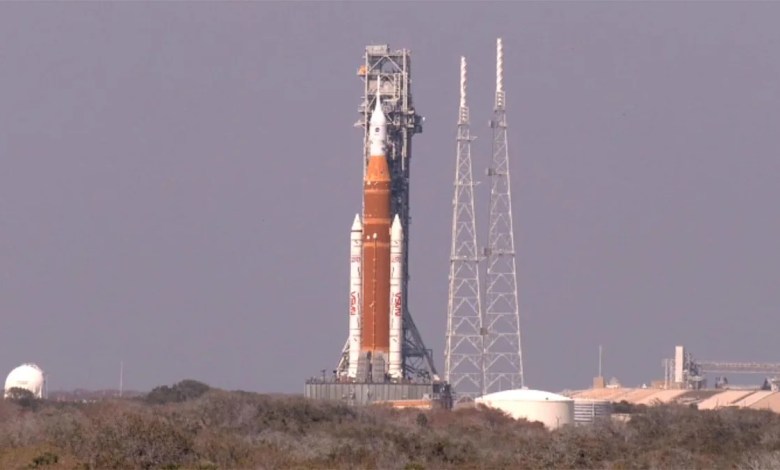
NASA carried its Artemis II moon rocket from its shoreline on Wednesday for a slow journey back to a processing facility to locate and fix a helium pressurization problem that delayed the launch of four astronauts on a flight around the moon from this month until at least April 1.
On Tuesday, a 6.6 million pound Apollo-era tracked transporter rolled up the ramp to Pad 38B and was positioned directly beneath the 3.5 million pound Space Launch System rocket and its 11.3 million pound mobile launch platform.

The Artemis II Space Launch System rocket and its mobile launch platform were transported from Pad 39B at the Kennedy Space Center early Wednesday for a slow journey back to NASA’s Vehicle Assembly Building for work to repair a helium pressurization problem with the rocket’s upper stage. The rollback delayed the launch of four astronauts for a flight around the Moon until at least April 1. / Credit: NASA
After checking weather conditions to ensure winds would be within safe limits, engineers used the track’s hydraulics to lift the SLS rocket and its launch platform from its support pedestals, then began moving back toward the cavernous Kennedy Space Center Vehicle Assembly Building at 9:38 a.m. EST.
The 4-mile journey of the caterpillar and its imposing load, tipping the scales at a total of 23.6 million pounds, was expected to take 10 to 12 hours, with several stops and starts expected along the way.
Once inside the VAB, engineers plan to deploy service platforms to access the rocket’s upper stage, known as the intermediate cryogenic propulsion stage, or ICPS.
Following a successful refueling test last weekengineers were unable to repressurize the upper stage helium system.
Pressurized helium is used to push the propellants toward the ICPS engine, to dry and drain the propellant tanks and lines, and to “purge” other cavities with the inert gas to minimize the risk of fire. During two refueling tests of the Artemis II SLS rocket, the system operated normally. The issue was discovered after the countdown for the second “wet outfit” rep had finished.
A similar problem occurred during the Artemis I mission in 2022, when a helium valve did not work properly. NASA Administrator Jared Isaacman said the valve may be to blame this time, “although corrective measures have been taken to minimize a repeat of the phenomenon on Artemis II.”
Other possible causes include a problem with a filter in an umbilical connected to the ICPS or problems with a quick disconnect fitting.
The return to the VAB was ordered because engineers did not have access to the ICPS and its connections to the gantry on the launch pad. In the assembly building, multiple platforms can be deployed around the SLS to provide access to almost the entire 322-foot-tall vehicle.
In addition to repairing the helium pressurization system, engineers also plan to replace the life-limited batteries in the SLS’s self-destruct system and other ICPS batteries.
NASA launched the Artemis II rocket to the launch pad in mid-January, initially targeting a launch of Commander Reid Wiseman, Victor Glover, Christina Koch and Canadian astronaut Jeremy Hansen around February 6.
But during the initial wet hold countdown needed to clear the way for launch, hydrogen leaks were detectedrequiring replacement of suspect joints of an umbilical where the fuel lines are attached to the base of the rocket. The replacement seals functioned normally during a second fueling test last week, and no problems were detected.
NASA then tentatively targeted the launch for March 6, but discovered the helium pressurization problem, which pushed the launch out of the March window to April 1 at the earliest.
Only a handful of launch opportunities are available each month due to trajectory constraints based on the constantly changing positions of the Earth and Moon, lighting conditions, and other mission-specific variables.
Watch: Trump’s full State of the Union address in 2026
Rep. Al Green expelled from House during State of the Union
New poll shows Trump’s low approval rating and gloomy view of economy


