1,600-Year-Old Tomb of Maya King Wearing a Jade Death Mask Discovered in Belize


After four decades, the researchers discovered the grave of a Maya King in Belize. The king, known as Te K’ab Chaak, was the first sovereign of the politically significant city of Caracol and began a royal dynasty which lasted more than 450 years.
The details of the discovery will be presented later this summer Santa Fe Institute And will present additional additional results from the largest Maya archaeological site in Belize, including two other tombs and a plethora of artifacts found in these burials.
The tomb helps archaeologists to reconstruct the crucial, but mysterious relationship between the Mayans and the Meso-American, showing that these two cultures can have interacted much earlier than we thought.
“A question that has perplexed Mayan archaeologists since the 1960s is whether a new political order has been presented in the Maya region by the Mexicans of Teotihuacan,” said Diane Z. Chase, archaeologist and main vice-president for academic affairs and provost at the University of Houston, in a press release. “Maya carved stone monuments, hieroglyphic dates, iconography and archaeological data all suggest that generalized pan-American connections occurred after an event in 387 after JC”
“… Caracol’s archaeological data suggest that the situation was much more complicated,” added Chase in the press release.
Learn more:: The ancient Mayans have appeased their gods with sacred offerings
The tomb of Te K’ab Chaak
Caana, the Caracol central architectural complex, Belize, discovered by Diane and Arlen Chase in the 1980s (graceful image of: Caracol Archaological Project / University of Houston)
The research team revealed that the tomb of Te K’ab Chaak at the base of a sanctuary of the royal family. At the time of his death, he measured 5’7 ”and was not a young man, especially the fact that he lacked all his teeth.
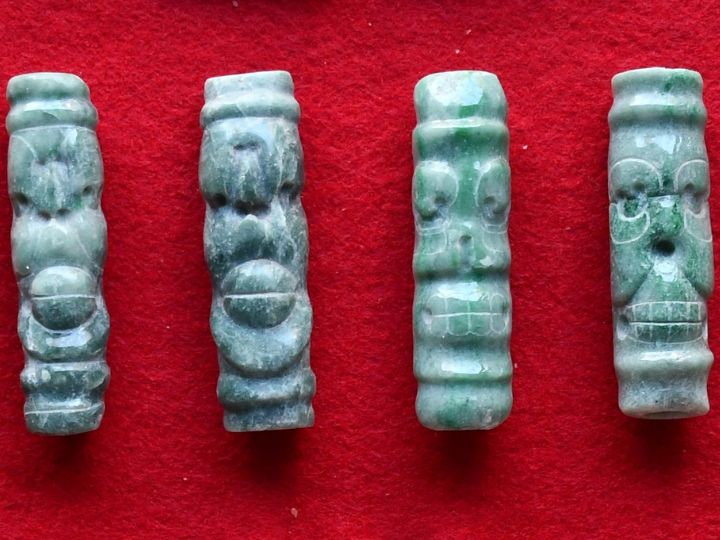
In the tombHis body was accompanied by a large selection of artefacts, including pottery ships, jewelry, shells and even a death mask in jadeite. The pottery found is particularly interesting, with a collection of artistic scenes that depict Maya leaders, the gods and the linked captives.
There were also two other important burials found in Caracol dating roughly at the same time as you k’ab chaak. The first burial was a cremation found in the center of a residential place. This practice of burial recalls the Meso-American traditions of the time rather than those of the Mayans. Archaeologists believe that the cremal remains belonged to a member of the royal family of Caracol who decided to practice the Meso-American rituals.
The second burial was another tomb, this time by holding a woman, also located in the same residential place as cremation. The woman was covered with hematite and, similar to Te K’ab Chaak, was buried with pottery vessels, a necklace and shells.
Rewriting Maya-Mesoamerica relations
The three burials discovered in Caracol date from around 350 AD, decades before the Meso-American Teotihuacan We think we have visited the Belize. However, since two of the three burials have Meso-American ritual practices, these results prove that the high-ranking members of Maya society were in contact with people from Teotihuacan earlier than the Mayan monuments suggest. This relationship is quite fascinating, especially given the fact that it would take 153 days to walk from Caracol to Teotihuacan, or vice versa.
“Center of Mexico and the Mayan region were clearly aware of each person’s ritual practices, as evidenced by the cremation of Caracol. – Like you K’ab Chaak in Caracol – have been engaged in official diplomatic relations with Teotihuancan, “said Arlen F. Chase, professor and president of the Department of Comparative Cultural Studies at the University of Houston, in the press release.
The team continues their research on the elements found in the grave and hopes to use old DNA and a stable isotopic analysis of the king’s skeletal material to discover more of its history.
Learn more:: Who built Teotihuacán, one of the largest ancient cities in Meso-American?
Article Sources
Our writers at Discovermagazine.com Use studies evaluated by high -quality peers and sources for our articles, and our publishers examine scientific precision and editorial standards. Review the sources used below for this article:
As a Marketing Coordinator of Discover magazine, Stephanie Edwards interacts with readers through the social networks of Discover and writes digital content. Offline, she is responsible for courses in English and cultural studies at Lakehead University, by teaching lessons on everything, from professional communication to Taylor Swift, and obtained her graduate diplomas in the same department of McMaster University. You can find more of its scientific writing in the laboratory and its short fiction in anthologies and the literary magazine through the kind of horror.


