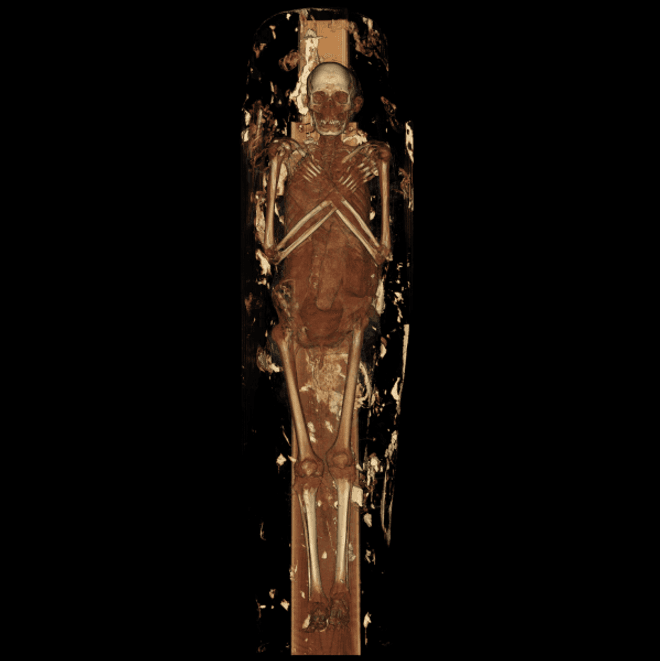
It’s not every day that you can put a sarcophagus full of mummy through the scanner. That’s exactly what a research team from the University of Southern California (USC) did to help uncover ancient Egypt’s linen-wrapped past.
Using hospital-grade CT scanners, the Keck Medicine of USC team examined two ancient Egyptian mummies, providing an unusually intimate look at how these men lived, aged and felt pain more than 2,000 years ago.
What the analyzes revealed went far beyond what the researchers expected and humanized the mummies in a surprisingly modern way.
“[One of the mummies] had a hip problem that certainly would have been visible. It would have been a handicap for him. So it’s really interesting to relate to that because modern humans have back and hip problems. […] and it makes us understand what he went through,” said Summer Decker, Ph.D., 3D imaging lead for Keck Medicine of USC and director of the USC Center for Medical Visualization Innovation. Discover.
3D digital model of Nes-Min.
(Image courtesy of Keck Medicine of USC)
What the analyzes revealed about the lives of the ancient Egyptians
Radiologists performed full-body CT scans of two Egyptian priests: Nes-Min, who lived around 330 BCE, and Nes-Hor, dating to around 190 BCE. High-resolution 320-slice CT imaging revealed fine anatomical details, including eyelids, lips and bone wear.
As Decker explained to Discoverthe energy in the room during the scans was filled with enthusiasm and respect: “We had people from the California Science Center there and they had visions of the type of imaging that had been done in the past. But it’s hard to explain what a 325 CT scanner can do. So when they saw the models come off, they could immediately see the eyelids and the eyes and very fine details in the bodies of the mummies. I remember a moment when their mouths were wide open, and I had to keep reminding them that this is what we do every day for our patients.
The oldest mummy, Nes-Min, showed signs of sagging of the lumbar vertebra, suggesting chronic lower back pain, consistent with natural aging and physical exertion. He was also buried with beetles and fish-shaped artifacts that the research team was able to recreate using 3D printing.
“I was showing some people the beetles that we found. We 3D printed them and they are high-resolution individual replicas,” Decker explained. “This is the first time in over 2,000 years that anyone has held them.”
Nes-Hor, on the other hand, appeared to have lived longer than Nes-Min but had endured significant physical hardship. Her scans revealed dental disease and a severely deteriorated hip that would have been visible and debilitating while she was alive.
Learn more: 1,000-year-old Mesoamerican mummy reveals ancient man’s microbiome
How CT scanning and 3D printing brought mummies to life
Nes-Hor’s skull and facial structure seen in a 3D model.
(Image courtesy of Keck Medicine of USC)
The technology behind these findings is the same technology used in hospitals every day. CT scanners generate hundreds of cross-sectional “slices” of the body, which are digitally stacked to create detailed 3D models. In this case, these models were not only analyzed on screen, but also physically reproduced using 3D printers.
These prints are safe to handle and accurate to the nearest millimeter, allowing researchers and the general public to get an up-close, personal look at a piece of history without destroying the original specimens.
Where to see mummies and 3D prints?
Decker and her team are actively working on analyzes and reconstructions, so much so that she was in the middle of a printing project while Discover spoke to him: “We’re working on it right now. We’re 3D printing Nes-Min’s ribs because he had healed fractures that were probably from an injury he had when he was much younger. They healed in a dislocated fashion.”
Beyond the lab findings, the mummies, scans and 3D prints will be on display at the “Mummies of the World: Exhibition,” which opens Feb. 7 at the California Science Center.
“This whole thing was a collaborative effort,” Decker concluded with Discover. “This type of scientific progress happens when people work together, not just in silos. So being able to display them for the general public to see is a great example of public science.”
Learn more: First-ever complete genome from an ancient Egyptian reveals what life was like 4,800 years ago
Article sources
Our Discovermagazine.com editors use peer-reviewed research and high-quality sources for our articles, and our editors review the articles for scientific accuracy and editorial standards. See the sources used below for this article: