Researcher discovers shortcut to Mars that could cut travel time in half — if we build the right spacecraft


Astronauts could one day complete a round trip to Mars in less than a year, potentially cutting the current mission schedule in half, according to a new study inspired by asteroid trajectories.
According to current mission profiles, achieve Marchwhich is located approximately 50% further from the sun than Earth, takes approximately seven to 10 months. Since Earth and Mars only align for fuel-efficient transfers every 26 months, astronauts must wait for a return window, which extends a full round trip to almost three years.
However, the new findings, published online in the journal Acta Astronautique in April, suggest that early imprecise orbital estimates of near-Earth asteroids – which were historically used to assess impact risks, before being abandoned in favor of more precise data – could hold valuable geometric clues for designing faster interplanetary routes.
“Maybe this could change the idea that it takes us more than two years to go to Mars and back,” said the study author. Marcelo de Oliveira Souzacosmologist at the Northern State University of Rio de Janeiro in Brazil, told Live Science.
“I wasn’t looking for that.”
Souza first had the idea in 2015, while studying near-Earth asteroids. A particular object, 2001 CA21caught his attention because early estimates suggested it was following a rare trajectory crossing the orbital zones of Earth and Mars.
Although subsequent measurements refined the asteroid’s true trajectory, its initial geometry during the October 2020 opposition — when Earth and Mars were aligned on the same side of the sun and closest to each other in their orbits — hinted at the possibility of “ultra-short” routes between the two planets, Souza noted in the paper.
“It was a surprise to me – I wasn’t looking for that,” he told Live Science.
As more observations allow astronomers to refine an asteroid’s orbit, these early trajectories change, so someone analyzing it later won’t have seen the same trajectory, Souza added. “Maybe I was in the right place at the right time,” he said.
A round trip to Mars?
For the October 2020 opposition, Souza’s calculations showed that a very fast trip, of about 34 days, from Earth to Mars is geometrically possible if a spacecraft follows a similar trajectory to the asteroid’s first orbital plane.
However, such a trajectory would require departure speeds of about 32.5 kilometers per second, well beyond current rocket capabilities, and a spacecraft would arrive at Mars traveling at about 64,800 mph (108,000 km/h), a speed too fast for existing landing systems to handle safely, Souza noted in the paper.
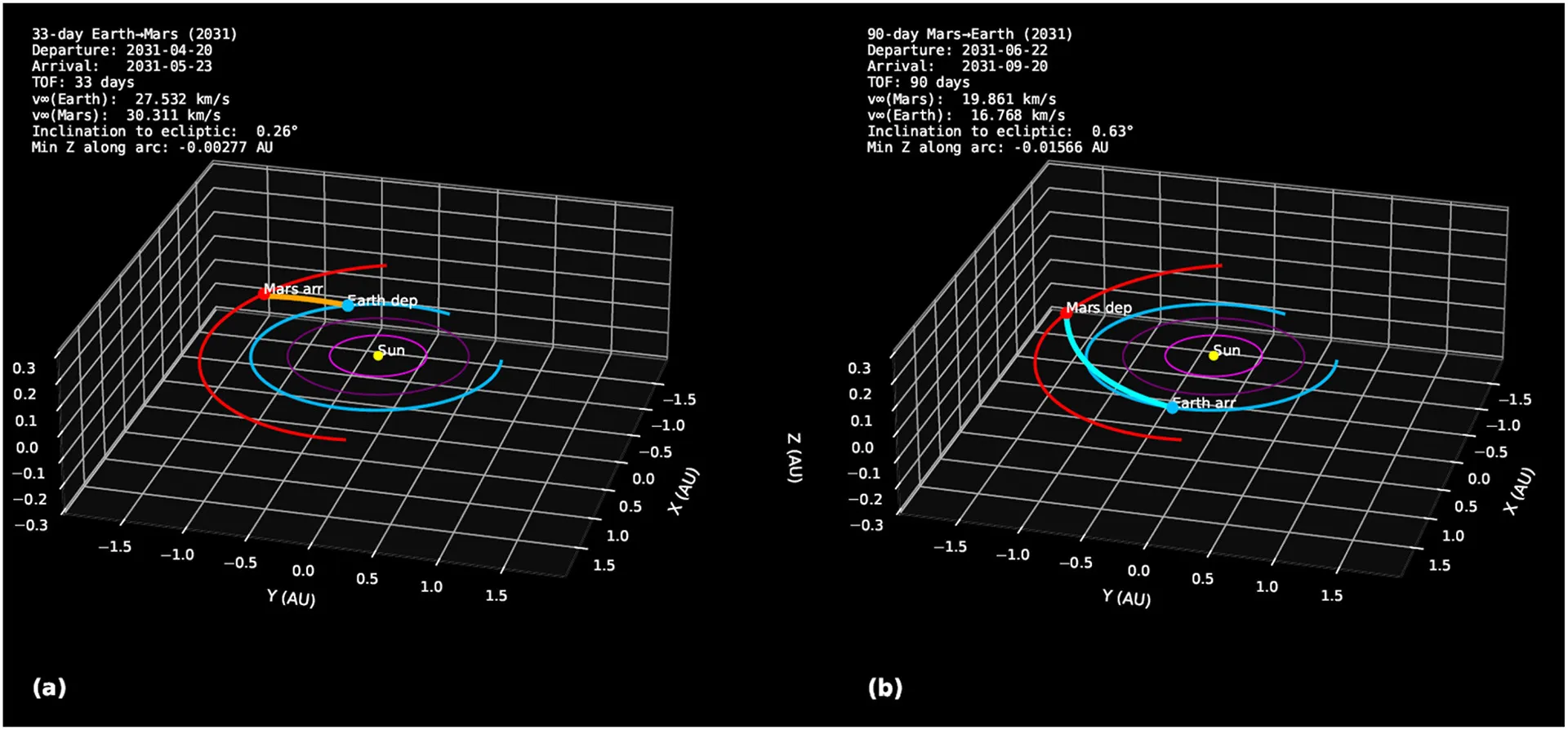
The geometry of a 33-day trip to Mars (left) compared to a 90-day trip (right).
(Image credit: Acta Astronautica / Marcelo de Oliveira Souza)
Instead, Souza used asteroid-inspired geometry to explore possible journeys during Mars’ future oppositions in 2027, 2029, and 2031. Using a standard method for calculating paths between two points in space (called Lambert analysis) and constraining those paths to stay within about 5 degrees of the asteroid’s orbital inclination, Souza found that only the 2031 alignment offered a viable opportunity for a fast travel using short term technology.
In this window, a round-trip mission from Earth to Mars could be completed in just 153 days, or about five months, according to the study.
In this scenario, a spacecraft would leave Earth on April 20, 2031, at about 27 kilometers per second, arrive on Mars on May 23 after a 33-day journey, spend about 30 days on the surface, depart on June 22, and return to Earth on September 20, with the return taking about 90 days.
Souza also identified a lower-power alternative in the same window, requiring a launch at about 16.5 kilometers per second for a mission lasting about 226 days, or about 7.5 months, which is still significantly shorter than current mission timelines.
Yet the concept remains largely theoretical and would depend heavily on mission specifics – including spacecraft design, payload mass and propulsion capabilities – which would determine whether such rapid transfers are feasible in practice.
The method could, however, still prove useful for refining the search for viable trajectories. The required speeds are comparable to those achieved by missions such as New Horizons – the NASA probe which, when launched in 2006 to fly past Pluto at 16.26 kilometers per second, was the fastest man-made object ever launched from Earth.
Such high-speed trajectories could be within the reach of next-generation rockets such as SpaceX’s Starship or Blue Origin’s New Glenn, Souza told Live Science.
What do you know about the red planet? Test your knowledge with our Quiz on Mars!


