Automakers are eating the cost of tariffs — for now : NPR

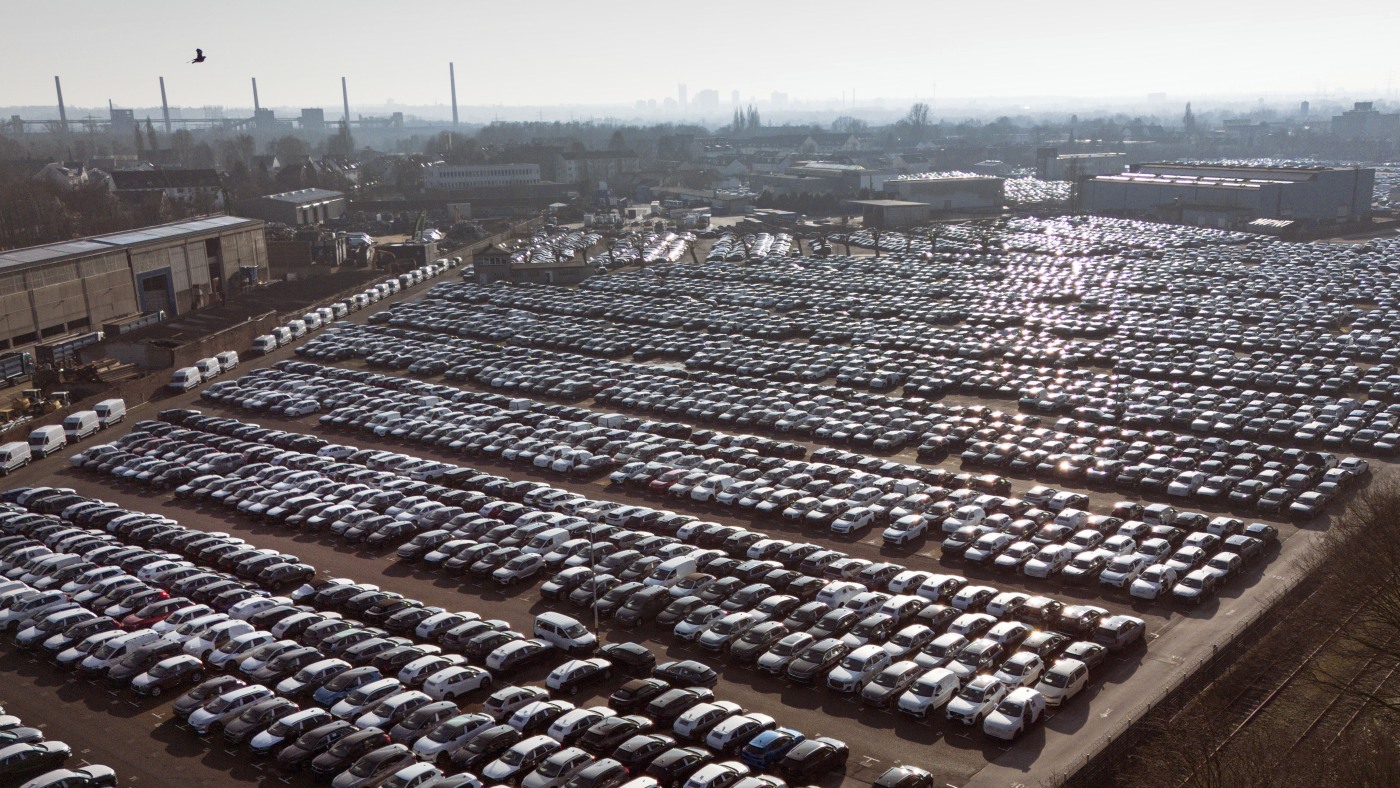

New German cars are parked in a logistics center in Essen, Germany, February 3.
Martin Meissner / AP
hide
tilting legend
Martin Meissner / AP
The prices were expensive for the automotive industry. Higher taxes on imports such as aluminum and steel increase the prices of materials that go to cars, while prices on parts manufactured abroad and imported vehicles have reached 25% since spring. Even after the recent transactions concluded with Japan and the European Union, the prices on imports of these countries are still 15% – much higher than in previous years.


But so far, these costs have not been transmitted to consumers.
Kelley Blue Book’s data show that the prices for transactions from the new vehicle – the amount that buyers really pay – increased by 1.2% from one year to the next in June. It is in fact a lower price increase than the annual increase from the average to 10 years, which means that as the prices have started, the prices of the car have increased less Let them generally do it.
“It was a little surprising but good for the consumer,” said Erin Keating, executive analyst of Cox Automotive, the parent company of Kelley Blue Book.
Part of the reason is that when the prices entered into force this spring, the prizes of the dealers were full of vehicles which had already been imported without a price.
Keating says that another factor is that, while people were rushing to buy cars before the prices, companies have entered the moment as a chance to attract new buyers to their brands. By postponing price increases, they could capture more sales.
In addition, car manufacturers had good reasons to worry that if prices increased, buyers would simply stop buying. “Consumers are already stretched,” explains Ivan Drury, director of information for the EDMUN Automobile Data Company.
The average price of a new car is nearly $ 50,000 – and even used cars are nearly $ 30,000 on average. A record number of new car buyers pay more than $ 1,000 a month on their loans, and an increasing share of car owners owes more on their car than sentence. Interest rates and high insurance costs – which are also exacerbated by prices – also cause pain. At one point, a new car is simply Also Dear.
“So really, the price is almost the last thing [automakers] Touch “to deal with the prices, says Drury.
Instead, so far, large car manufacturers have absorbed the loss.

In calls with investors, car manufacturers have presented their price bills for three months: $ 1.1 billion for General Motors, $ 600 million for Hyundai, more than $ 500 million for Kia, $ 1.5 billion for Volkswagen. Stellantis, the parent company of Chrysler, Dodge, Jeep and Ram, expects its total prices for the year to be around $ 1.7 billion.
“For the majority of car manufacturers, they really take the prices on the chin,” explains Keating. Suppliers, too, take pricing beats, she notes.

This punch at the chin is not a blow to direct elimination. GM, Hyundai, Kia and Volkswagen are all still profitable despite their price bills. (Stellantis is not, but his misfortunes are prior to prices.)
However, companies are under pressure from investors so as not to absorb these costs forever.
Some companies react by moving more production in the United States. In the Volkswagen group call with investors, CEO Oliver Blume alluded to the possibility of making Audis in the United States, saying: “We can think of locating Audi products.” (The company built Volkswagens in Chattanooga, tenn., But currently does not do any audis in the United States.) And GM moves the production of Chevy Blazer from Mexico to Tennessee.
A second option is to tighten the costs, to ensure that suppliers take the burden more or to find savings elsewhere in the supply chain.
And finally, the executives indicated, the costs will be transmitted to consumers.
“I think we can progress on prices,” said Stellantis financial director Doug Ostermann, when he calls his business. And when car leaders speak to investors, “price progress” means higher prices, not discounts.
Keating from Drury and Cox from Edmunds, Keating, says that when vehicles of the 2026 model year start to arrive on lots in the coming months, it will be a natural moment for prices to be increased.
“We have done calculations,” says Keating. “We plan that prices would increase by 4 to 8%, 8% being really the maximum, before really a car hides its competition set.”
In addition to the increase in the prices of stickers, Drury predicts that the costs will be transmitted to consumers in a more subtle way. A 1.9% financing agreement could become a rate of 3.9%; $ 3,500 The money delivery could become $ 1,500 in money back.
“You will see something change,” he said.