
Humans don’t need to blast off into space to find some truly alien-looking wonders. The deepest depths of our ocean are like another planet, teeming with the charismatic “Casper” octopus, the carnivorous Bathyphysa siphonophore (aka the flying spaghetti monster), and even some sharks.
A team from Kumamoto University in Japan recently uncovered a deep-sea anemone that has a tight bond with hermit crabs. These wispy pink invertebrates build shell-like “homes” for the crabs. The discovery highlights an exciting case of biological mutualism–a relationship where both species benefit. Their findings were recently published in the journal Royal Society Open Science.
This newly identified anemone is named Paracalliactis tsukisome, and was found living on the shells inhabited by the hermit crab Oncopagurus monstrosus. The pair lives about 656 to 1,640 feet below the surface of the Pacific Ocean, near Mie and Shizuoka Prefectures in southern Japan. Most sea anemones lack hard skeletons and are instead built with softer tissues. However, this new species secretes a hard shell-like structure called carcinoecium. The carcinoecium then expands to reinforce the hermit crab’s shell.
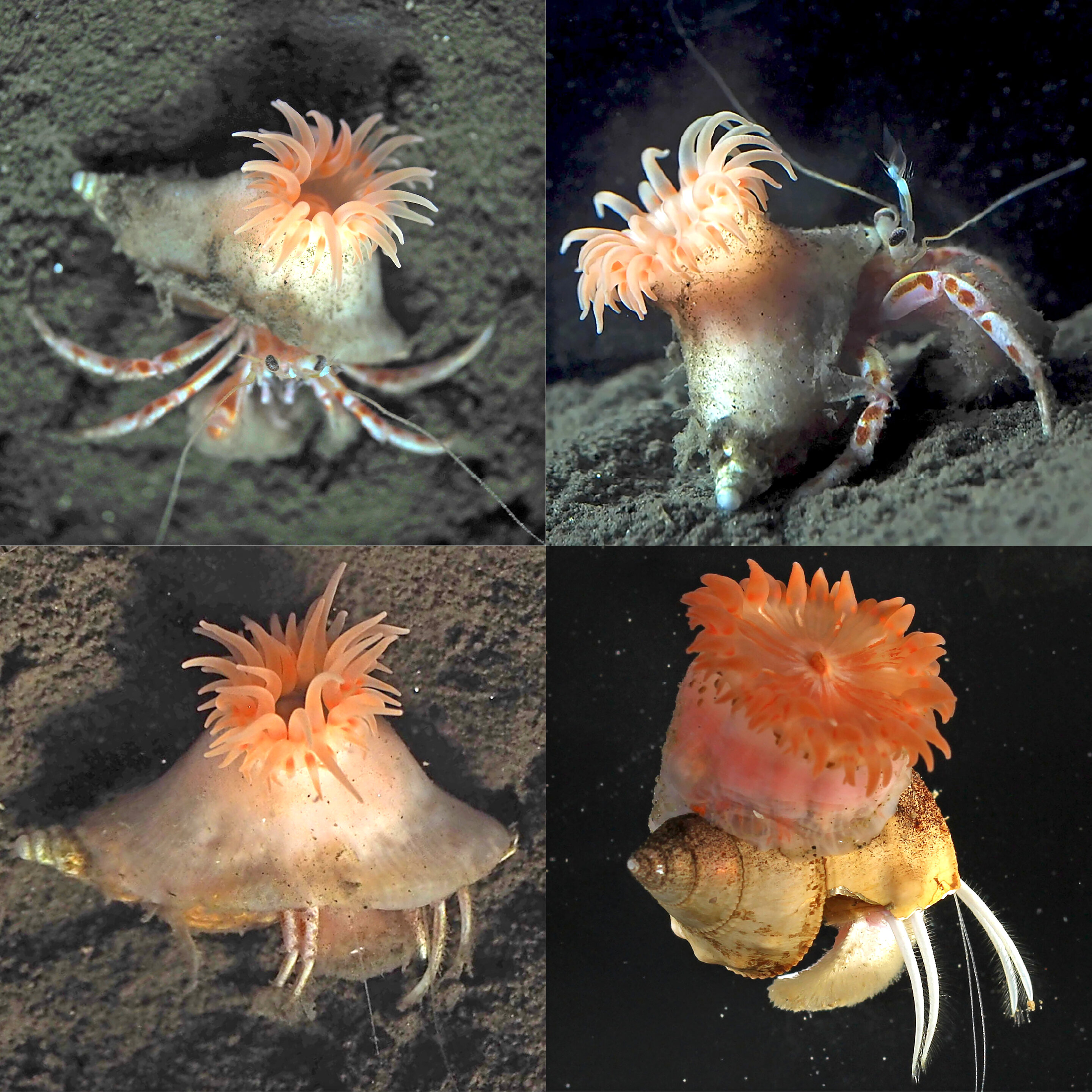
The anemone primarily feeds on organic particles and the crab’s feces. According to the team, this is an unusual but efficient form of recycling food resources on the deep-sea floor. 3D imaging and micro-CT scanning revealed that the anemone attaches to the hermit crab’s shell using a consistent, one-directional pattern that is potentially linked to its feeding and shell-building behavior.
The hermit crab benefits from this partnership with the anemone by achieving a larger body size than its relatives. This growth suggests a mutualistic relationship between these two deep-sea species. Similarly, the Atlantic hermit crab species Pagurus arrosor will carry a single Calliactis anemone on top of the snail shell it lives in.
The soft pink anemone was named tsukisome, which translates to a pale pink color, after an ancient Japanese word found in the Man’yōshū, Japan’s oldest anthology of poetry. The Man’yōshū or “Collection of Ten Thousand Leaves,” is a collection of 4,500 poems, some dating back to the 7th century or earlier. In this ancient poetry, a tsukisome-dyed kimono symbolized gentle yet sincere affection. The team believes that this name honors the anemone’s delicate color and its partnership with its hermit crab host.
“This discovery shows how even simple animals like sea anemones can evolve surprisingly sophisticated behaviors,” study co-author and Kumamoto University marine biologist Akihiro Yoshikawa said in a statement. “Their ability to build a shell-like structure is a fascinating clue to understanding how animals perceive space and direction.”

2025 Home of the Future Awards


