Scientists pinpoint the brain’s internal mileage clock


Victoria GillScientific correspondent, BBC News

 Getty images
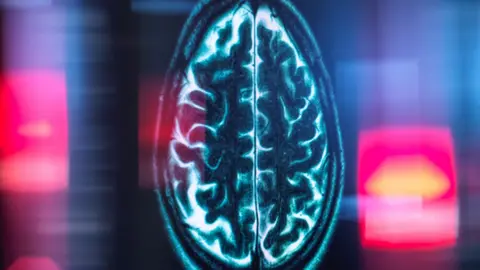
Scientists have for the first time located “the mileage clock” inside a brain – by recording brain activity in the course of execution.
Let them detach inside a small arena the size of a rat, the researchers recorded part of their brain which is known to be important in navigation and memory.
They found that the cells “pulled” in a pattern that looked like a mileage clock – to check everywhere the animal has traveled.
Another experience, where human volunteers have gone through a version at the scale of this rat navigation test, suggested that the human brain had the same clock.
This study, published in the journal Current Biology, is the first to show that the regular “grid cells” ticket, as we know, is directly linked to the possibility of correctly assessing the distance we have traveled.
Brain fog
 Stephen Duncan
“Imagine walking between your kitchen and your living room,” said Professor James Ainge at St Andrews University. “”[These cells] are in the part of the brain which provides this interior card – the ability to put yourself in the environment in your mind. “”
This study gives an overview exactly how this internal card in our brain works – and what happens when it turns badly. If you disrupt the tick-tac from this mileage clock by modifying the environment, rats and humans are starting to make a mistake of their distance from the distance.
In real life, this happens in darkness or when the fog descends when we are hiking. It suddenly becomes much more difficult to estimate how far we have traveled, because our mileage counter ceases to operate reliably.
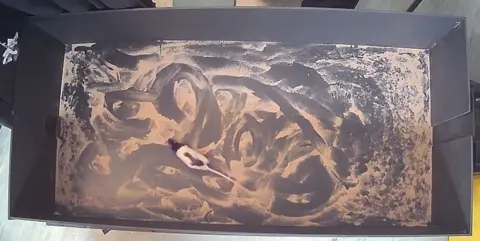
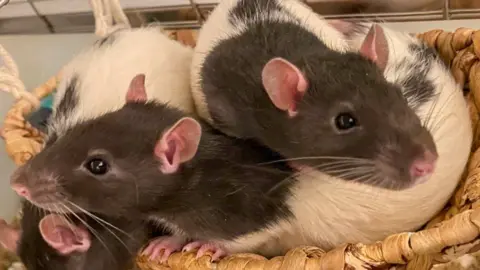
To study this experimentally, the researchers have formed rats to browse a distance fixed in a rectangular arena – rewarding animals with a treat – a piece of chocolate cereals – when they ran the right distance, then returned at the beginning.
When the animals have traveled the right distance, the mileting cells of mileage in their brain regularly pulled – about every 30 cm per rat have traveled.
“The more this shooting scheme was regular, the better the animals were to estimate the distance they had to go to obtain this treat,” said Professor Ainge.
The researchers were able to record the mileage clock of the brain by counting the distance that the rat had mentioned.
Above all, when scientists modified the form of the rats arena, this regular shooting model became irregular and the rats had trouble determining how far they needed to go before returning to the start for their chocolate treat.
“It’s fascinating,” said Professor Ainge. “They seem to show this kind of chronic underestimation. There is something in the fact that the signal is not regular, which means that they stop too early.”
Scientists compared this to the visual benchmarks suddenly disappearing in the fog.
“Obviously, it is more difficult to sail in the fog, but perhaps what we do not appreciate is that it also alters our ability to estimate the distance.”
To test this in humans, researchers have increased their experience in the size of a rat. They built an arena of 12 MX 6M in the university student union and asked volunteers to carry out the same task as rats – walk over a fixed distance, then return to the beginning.
Like rats, human participants were always able to correctly estimate the distance when they were in a symmetrical rectangular box. But when scientists moved the walls of their arena specially designed to change their shape, the participants began to make mistakes.
Prof Ainge explained: “Rats and humans learn the task of estimating the distance, then, when you change the environment of how we know how to distort the signal in rats, you see exactly the same behavioral model in humans.”
 Silvia Ventura
In addition to revealing something fundamental about how our brains allow us to navigate, scientists say that the results could help diagnose Alzheimer’s disease.
“The specific brain cells that we record are in one of the very first areas affected by Alzheimer’s disease,” said Prof Ainge.
“People have already created [diagnostic] Games that you can play on your phone, for example, to test navigation. We would be really interested in trying something similar, but specifically in the estimation of the distance. “”
 Getty images


