
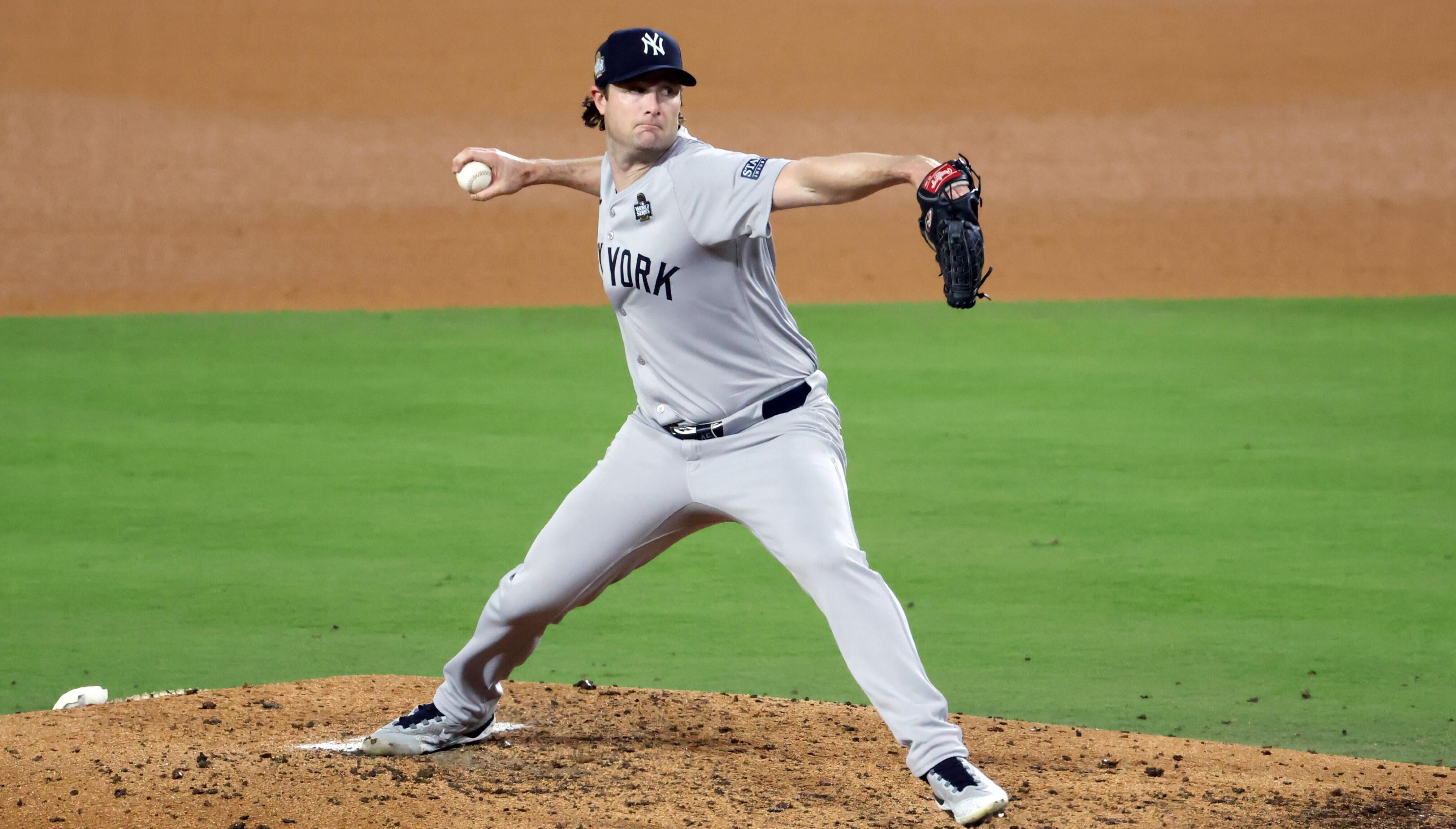
What is it that makes picking pitchers for Fantasy so tricky? In part, it’s the injuries – upwards of 40% of pitchers go on the IL in any given season, and MLB data shows that, while the rate might be slowing down, it isn’t reversing. Throwing a baseball 100 times at max effort once or twice a week just isn’t something our elbows and shoulders are built to handle without bending and eventually breaking.
But it’s not just the injuries. It’s also that identifying pitcher talent is harder than with hitters. Pitchers only have so much control over how many outs they record; the highest qualifying strikeout rate in MLB history was Gerrit Cole’s 39.9% mark in 2019, and he still needed the defense behind him to account for 49% of the outs he recorded. For a typical starter, that number is likely to be closer to 65-70% of their outs. An especially good defense, like the Cubs’, can make their pitchers look a lot better than they actually are; a poor defense like the Nationals can be tough to overcome even for the best pitchers.
And then there’s this: Pitcher talent is almost never static. Velocity fluctuates from one start to the next, and pitchers are constantly tweaking grips and arm angles and everything else to try to find the best way to attack hitters. Sometimes, guys will add a pitch and immediately level up, like when Logan Gilbert added the splitter in 2023 that has since become one of the best putaway pitches in baseball. Other times, pitchers will lose their feel for their best pitch and become less effective; it feels like Framber Valdez goes through this for a month or two every season with his curveball.
The best pitchers are the ones who have shown they can weather the various storms that come with the position for multiple seasons, and those guys tend to be the highest pitchers drafted every year. This season, that includes Garret Crochet, Paul Skenes, and Tarik Skubal, who have spent the past two seasons terrorizing hitters and have pushed their way into the first round in most drafts. Deservedly so.
After that, things get a lot messier. Research I did last spring shows that starting pitcher values tend to drop off at a linear rate for the first three rounds of drafts, and then it’s just chaos; on average pitchers drafted in the fourth round from 2015 through 2024 return $20 or more in value just around 12% of the time; in the 10th round, it’s about 10% of the time. Pitchers drafted in the 40 range of drafts generally offer better returns than those in the 10th round, but not nearly enough to justify the price difference.
This is what I’ve taken to calling “The SP Dead Zone.” That’s not to say you shouldn’t take pitchers in the fourth, fifth, and sixth rounds, but that’s the range of the draft where I need to feel like I’m getting a pretty obvious value to pull the trigger. Because history shows I’m not likely to get a better pitcher there than the ones I’ll take around the 100th pick or later.
Why does that happen? I have some theories, and you can see them at play in this year’s player pool. At the very top, we have those multi-year aces with (relatively) few recent injury question marks. And once Skenes, Crochet, and Skubal are off the board, you’re immediately met with the likes of Yoshinobu Yamamoto, Cristopher Sanchez, and Bryan Woo, according to ADP – all good pitchers, but none of whom have multiple years of true ace production to their name. After them, you get Logan Gilbert (missed time with an elbow injury in 2025), Chris Sale (lengthy injury history), and Cole Ragans (missed significant time in 2025 with a shoulder injury).
Which is to say: None of those guys are perfect pitchers. That’s not to say they don’t deserve to be ranked where they are, but it is to say that there are big questions about all of them. They’re all super talented and might be aces, but we don’t have that multi-year track record of performance and health to bet on. And this year, we have an especially wide second tier, with the gap between SP4 and SP15 looking a lot smaller than ever before.
And that’s also true for the tiers after them. I can probably get close to 50 names deep into the SP pool before I run out of pitchers I really like. Attrition will wreck a lot of that depth, but that’s also a good reason to make sure you aren’t paying a premium over and over. This year, more than ever, I’m content to just take the values at starting pitcher; the tiers are wide and comparable, so I just don’t see much justification in consistently jumping ahead of ADP to get “My Guys” these days.
There’s plenty of talent available as long as you don’t totally neglect the position, so don’t sweat it. You’re gonna deal with injuries, and you’re going to get some stuff wrong; so will your leaguemates. Why pay extra for the privilege?
- Position Previews: C | 1B | 2B | 3B | SS | OF | SP
- Position Tiers (v. 2.0): C | 1B | 2B | 3B | SS | OF | SP | RP
- Position Strategies: C | 1B | 2B | 3B | SS | OF | SP | RP
Sportsline
Sportsline
Sleeper: Kris Bubic, Royals
That Bubic is coming back from a rotator cuff strain that ended his breakout season early is likely what is keeping his price down, and that’s a pretty big red flag … if he costs much at all to draft. However, with his price sitting outside of the top 200, much of the downside risk here is mitigated, and what we’re left with is a pitcher who showed legitimate front-of-rotation upside last season. Bubic threw 116.1 innings with a 2.55 ERA, and while the peripherals don’t quite back it up, they don’t suggest it was some fluke either – you’d still take his 3.16 expected ERA, wouldn’t you? Bubic missed plenty of bats with his four-seamer last season, and when he didn’t, hitters still struggled to do damage against it, putting up a lowly .287 expected wOBA as they often just got under the ball with the barrel. An excellent changeup surely helped in that regard, and overall, as does an overall five-pitch mix without an obvious weak spot. Bubic isn’t an ace when healthy, but he should be a must-start pitcher who isn’t being drafted that way. Even accounting for the injury risk, I think he’s one of the very best values in drafts right now.
Breakout: Chase Burns, Reds
It’s a 70-grade fastball and a 70-grade slider. The changeup is a work in progress, the command can be an issue, and there are real questions about his ability to stay healthy given how hard he throws (and last year’s IL stint with a Grade 1 flexor tendon strain). It’s not hard to see how things go wrong, and Burns isn’t even guaranteed a spot in the rotation as of now, though it seems extremely unlikely he won’t be in the end! But it’s a 70-grade fastball and a 70-grade slider. At the risk of oversimplifying, players with this kind of stuff usually work out. It’s a limited arsenal (he’s working on the changeup and has a curveball, but neither is likely to be much more than show-me pitches), but it’s the kind of limited arsenal that has made stars out of Hunter Greene and Spencer Strider. Turns out, when you can throw like those dudes, nuance matters a lot less.
Bust: Spencer Strider, Braves
I’m at the point where I need to see a real reason to get excited about Strider, and the last time I saw that was roughly in September of 2023. His fastball went from an exemplary weapon to an outright liability in 2025 after his return from the Internal Brace procedure on his right elbow, and nothing we’ve seen so far this spring makes me think he’s solved that issue. Yes, he’s not focusing on velocity this spring, but I can’t give him credit for being the 2023 version of himself without seeing signs of it, and right now, he’s maxing out around the same velocity he used to average. The slider is still a special pitch, but right now, it doesn’t look like he has anything to go with it. Maybe I’ll end up wrong. I hope so – I’m rooting against myself on this one! But Strider looks like someone you can roll the dice on around the 45th-50th pitcher off the board, not a top-30 one.
2026 Draft Prep
Starting Pitcher Top Prospects
Age (on opening day): 23
Where he played in 2025: Triple-A, majors
Minor league stats: 5-6, 4.05 ERA, 1.48 WHIP, 100 IP, 53 BB, 121 K
Major league stats: 4-1, 4.02 ERA, 0.93 WHIP, 31.1 IP, 4 BB, 31 K
The whole world thought Chandler should be promoted when he had a 2.03 ERA and 12.8 K/9 through 11 Triple-A starts, but then, when he wasn’t, frustration mounted, and his control went awry. He was pinpoint accurate when he finally reached the majors, though, blowing hitters away with his A-grade fastball, so it’s easy to get behind him as the top pitching prospect still.
Scott’s 2026 Fantasy impact: pencil him in
Age (on opening day): 22
Where he played in 2025: Low-A, High-A, Double-A, Triple-A, majors
Minor league stats: 5-1, 3.12 ERA, 0.97 WHIP, 98 IP, 41 BB, 160 K
Major league stats: 1-0, 3.21 ERA, 1.43 WHIP, 14 IP, 7 BB, 16 K
Yesavage is the most battle-tested of rookies, having played a starring role in the Blue Jays’ AL championship run, and anyone who came along for that ride knows full well about his over-the-top delivery, his devastating splitter, his reverse-breaking slider, and the unhittable quality found in such an unfamiliar arsenal. He could give some of it back as the league becomes more familiar with him, particularly on those days when he struggles to throw strikes, but he’s been a bat-missing monstrosity everywhere he’s pitched so far.
Scott’s 2026 Fantasy impact: pencil him in
Age (on opening day): 24
Where he played in 2025: Double-A, Triple-A
Minor league stats: 8-5, 2.45 ERA, 1.13 WHIP, 113.2 IP, 50 BB, 127 K
Major league stats: 5-1, 2.06 ERA, 1.04 WHIP, 48 IP, 16 BB, 57 K
McLean’s story is similar to Spencer Schwellenbach’s in that you’d never know by his six-pitch arsenal and wily approach that he only gave up hitting the year before. His dominance down the stretch is a testament to both his stuff and approach, but it probably overstates his strikeout potential and may have papered over some lingering (albeit minor) control issues.
Scott’s 2026 Fantasy impact: pencil him in
Age (on opening day): 21
Where he played in 2025: High-A, Double-A, Triple-A
Minor league stats: 4-3, 2.31 ERA, 1.18 WHIP, 89.2 IP, 51 BB, 145 K
A 19 percent swinging-strike rate is next to impossible for any pitcher and unprecedented for a lefty, but White made it happen with a deceptive delivery and three pitches that rate as plus. The Marlins spent the offseason clearing out rotation space, but he may need to sort out some control issues at Triple-A before getting his shot.
Scott’s 2026 Fantasy impact: fighting this spring
Age (on opening day): 22
Where he played in 2025: Low-A, Triple-A
Minor league stats: 5-8, 5.26 ERA, 1.49 WHIP, 118 IP, 47 BB, 123 K
Much like Spencer Strider, Andrew Painter lost his once-elite fastball shape on the road back from Tommy John surgery and looked nothing like the 19-year-old who put together a 1.56 ERA, 0.89 WHIP, and 13.5 K/9 while climbing to Double-A in 2023. As such, he brings considerable risk, but the scouting reports remain bullish amid whispers of a possible mechanical fix, namely raising his arm slot.
Scott’s 2026 Fantasy impact: fighting this spring
Age (on opening day): 21
Where he played in 2025: did not play — draft year
The third overall pick and consensus top pitcher in the 2025 draft stands out most for his polish and pitchability, featuring a fleshed-out arsenal with a couple of high-spin breakers and strong command of everything. Though some who rank behind him here will turn out better, he’ll move fast and is all but certain to matter.
Scott’s 2026 Fantasy impact: midseason hopeful
Age (on opening day): 27
Where he played in 2025: Japan
NPB stats: 10-5, 1.92 ERA, 0.89 WHIP, 163.2 IP, 45 BB, 178 K
Imai’s low-release fastball and reverse-breaking slider make for an unusual look that led to oodles of success in Japan, but he’s older than conventional prospects and can’t exactly go back to the drawing board if his tricks don’t work in the majors.
Scott’s 2026 Fantasy impact: pencil him in
Age (on opening day): 22
Where he played in 2025: Double-A, Triple-A
Minor league stats: 9-7, 2.51 ERA, 1.11 WHIP, 136 IP, 39 BB, 166 K
Though Thomas White (see above) is implicated as well, the Marlins’ efforts to free up rotation space this offseason likely have more to do with Snelling, who couldn’t break through last September despite a 1.27 ERA, 0.99 WHIP, and 11.5 K/9 in 11 Triple-A starts. The Marlins bought low on the former Padres prospect two years ago and have restored his lost command and velocity.
Scott’s 2026 Fantasy impact: fighting this spring
Age (on opening day): 22
Where he played in 2025: Double-A, Triple-A, majors
Minor league stats: 10-5, 1.43 ERA, 0.92 WHIP, 113.2 IP, 47 BB, 179 K
Major league stats: 2-3, 7.71 ERA, 1.77 WHIP, 18.2 IP, 9 BB, 22 K
Tong’s minor-league dominance had him looking like the game’s top pitching prospect when he arrived in August, but his unique fastball, which has a low release height despite an over-the-top delivery, didn’t baffle major leaguers like it did minor leaguers. If it doesn’t work, neither does he. A legitimate breaking ball would do wonders, though, and he perhaps needed more time at Triple-A to refine his.
Scott’s 2026 Fantasy impact: fighting this spring
Age (on opening day): 19
Where he played in 2025: did not play — draft year
The hit rate on high school pitchers who score big on draft day is embarrassing, so I can’t help but cringe a little in slotting Hernandez this high. But he’s an actual pitching savant, judging by the reports, with a fastball and changeup that both rate near the top of the scales already, two breaking balls that trail close behind, and an aptitude for throwing strikes. Time will tell.
Scott’s 2026 Fantasy impact: don’t count on it


