2,100-year-old skeleton of warrior nicknamed ‘Lord of Sakar,’ buried in a stunning gold wreath, unearthed in Bulgaria


Archaeologists have found a dazzling gold Entreuse in a funeral mound aged 2100 years of a Thrace’s warrior and his horse. The single helmet is part of a set of jewelry in golden golden jewelry from the tomb of the “Lord of Sakar”, named after the mountain range in the south-east of Bulgaria where it was found.
“The golden treasures discovered in our lands bear witness to high craftsmanship, rich spiritual life and prosperous societies”. Evelina SlavchevaPresident of the Bulgarian Academy of Sciences, said in a statement.
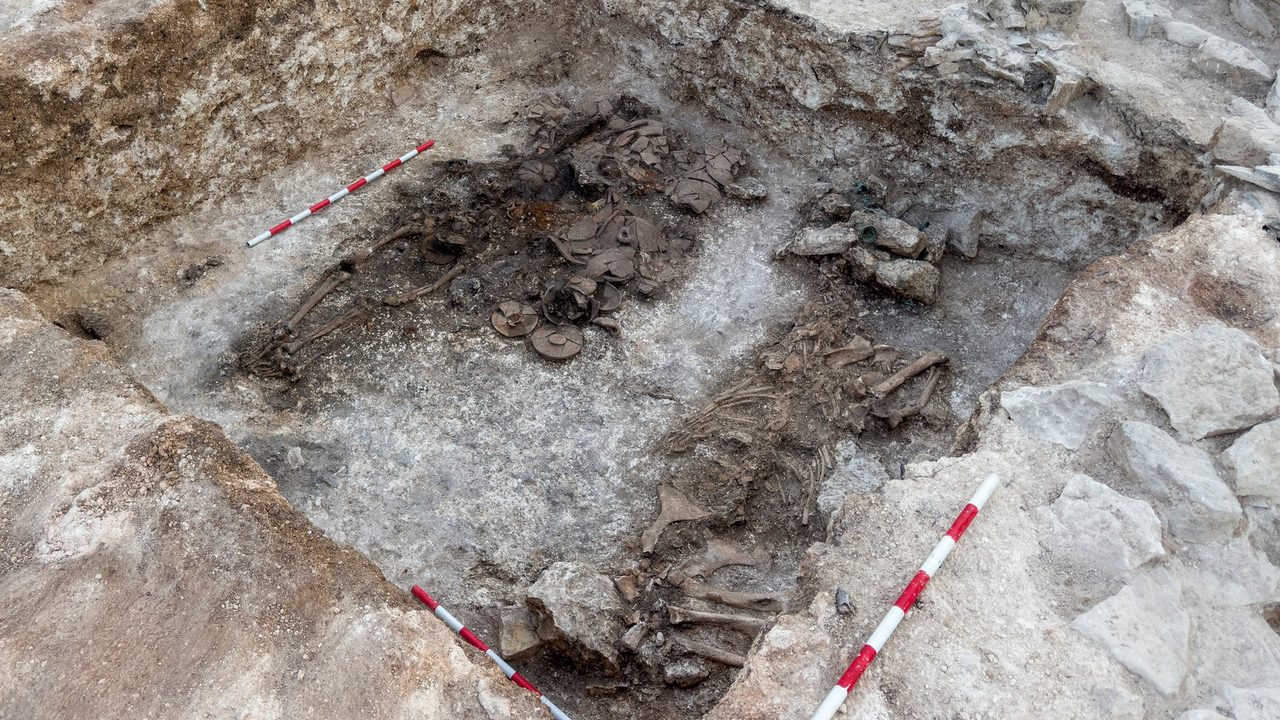
The ancient funeral mounds were discovered during the excavation linked to the installation of a solar park in 2024. A team of archaeologists from the Bulgarian Academy of Sciences searched the burials and found that one contained the bones of a young woman and the other a man of average age.
The two tombs included many golden artefacts, but the tomb of man is the richest ever discovered in Bulgaria, according to a Article translated from social media of the municipality of Topolovgrad, where the site is located.
Due to the opulence of the burial of man, with the bones of his war horse, he was nicknamed the Lord of Sakar. He lived at the end of the Hellenistic period, around 150 to 100 BC, and maybe a warrior aristocrat, according to the press release. At the beginning of the century, the Thrace area was partly under Greek domination, but at the end of the century, the Romans had conquered it as part of their empire.
Preliminary research suggests that the Lord of Sakar was about 35 to 40 years old when he died. The crown – in golden silver – was found surrounding its skull. The other artefacts discovered in his grave included ceramic and glass ships, iron spears and a shield, silver jewelry and a unique knife covered with gems.
In relation: Medieval Knight “Lancelot” and his superb stone tomb found under Ice Cream Shop in Poland
Man’s horse has also been honored by many serious goods, including a decoration in golden bronze on his harness representing the legendary hero Hercules beating a giant. The harness included other bronze representations of animals, probably representing more exploits of Hercules, as well as a gold helmet with the image of a snake.
We know less about the funeral mound of the woman, who lived at the beginning of the second century, the archaeologists of the BC recovered two pairs of well -preserved leather shoes; a wooden chest covered with gold, silver and jewelry; And many gold, glass and bronze items. Near this mound was a small sanctuary dated the second half of the second century BC, where archaeologists found a large number of regional pieces.
The gold objects of the Hellenistic period were revealed to the public on August 12 at Bulgaria National Archaeological Institute with Museum as part of a exposure Called “the glitter of Hellenistic gold. The Lord of Sakar”. The exhibition is open until October 17.


