3.67-Million-Year-Old ‘Little Foot’ Gets New Face Reconstruction, Linking Fossil to East African Hominins


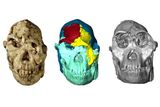
Few ancient human fossils are as remarkable as Little Foot, a 3.67 million year old fossil. Australopithecus skeleton discovered in the Sterkfontein Caves in South Africa – known as the most complete hominid skeleton ever discovered. Now, researchers have reconstructed Little Foot’s face, correcting distortions caused by millions of years of geological pressure and providing one of the most complete reconstructions of a Australopithecus confront.
Reported in Palevol Reportsthe researchers compared facial measurements of the reconstructed fossil with those of others Australopithecus specimens. The results show that Little Foot’s face looks more like fossils from East Africa than a younger South African specimen used for comparison – an unexpected finding given where the fossil was discovered.
“This trend is unexpected, given the geographic origin of Little Foot, and suggests a more dynamic evolutionary history than previously thought,” Amélie Beaudet, who co-led the study, said in a press release.
Reconstruct Little Foot’s face
Although Little Foot’s skeleton is exceptionally complete, the fossil’s face posed a challenge for researchers. Over millions of years, geological pressure has distorted many facial bones, making it difficult to reconstruct the original shape using traditional physical methods.
To overcome this problem, the research team used high-resolution synchrotron scanning, which produces extremely detailed images of the fossils, as well as virtual reconstruction techniques. These tools allowed them to digitally separate, reposition and reassemble the fossil’s deformed bones.
Once reconstructed, the researchers looked at nine measurements of the face – including its overall size, the shape and proportions of the eye sockets, and the structure of the midface – and used 3D shape analysis to compare Little Foot’s facial proportions with those of several living great apes and three others. Australopithecus fossils.
The comparisons included a younger South African specimen and two fossils from Ethiopia. Although it came from South Africa, Little Foot’s facial structure was more similar to fossils from East Africa.
Learn more: Burtele’s foot and other fossils reveal how two hominid species thrived side by side
Clues for a more connected evolutionary history
The analysis highlights that early human ancestors in Africa may not have evolved in isolated regional groups as is often assumed. Instead, populations may have remained connected over great distances while adapting to local environments.
“Rather than viewing early hominid evolution as occurring in isolated regions, the study supports the idea of Africa as a connected evolutionary landscape, with populations adapting to ecological pressures while remaining linked by shared ancestry,” Dominic Stratford, co-leader of the study, said in the press release.
The analysis also highlighted possible evolutionary pressures acting on the orbital region, the part of the skull surrounding the eyes. Changes in this area may reflect changes in visual abilities or ecological behavior during this period of human evolution.
Why Little Foot’s face is important
Complete faces from early hominid fossils are extremely rare, making Little Foot a particularly valuable specimen for studying how our ancestors lived and adapted to their environments. Since very few fossils preserve intact facial anatomy, even small differences in structure can provide important clues about how early hominid populations were related and how they adapted to different ecological conditions.
“Only a handful of Australopithecus the fossils preserve an almost complete face, making Little Foot a rare and valuable reference point. Little Foot’s face preserves key anatomical regions involved in vision, breathing and feeding, and its skull will offer other key elements for understanding our evolutionary history,” Beaudet said.
Researchers say reconstruction is only part of the picture. Other areas of Little Foot’s skull, particularly the skull, remain distorted and may require similar digital techniques to better understand the size and organization of this early hominid’s brain.
Learn more: This 7-million-year-old fossil could reveal when ancient humans began walking upright
Article sources
Our Discovermagazine.com editors use peer-reviewed research and high-quality sources for our articles, and our editors review the articles for scientific accuracy and editorial standards. See the sources used below for this article:


