How the ‘Seven Mountains Mandate’ Is Linked to Political Extremism in the US


This article is part of TPM Cafe, the House of TPM for the opinion and the analysis of the news. It was initially published during the conversation.
Vance Boelter, who would have shot Melissa Hortman, a democratic representative of the state of Minnesota, and her husband, Mark Hortman, on June 14, 2025, studied Christ for the Institute of Nations in Dallas. The group is a biblical school linked to the new apostolic reform, or NAR.
NAR is a freely organized but influential charismatic movement that shares similarities with Pentecostalism, in particular in its conviction that God actively communicates with believers by the Holy Spirit. Unlike traditional Pentecostalism, however, the organization emphasizes the apostles and modern prophets as authorities responsible for transforming society and moving the kingdom of God on earth. Prayer, prophecy and worship are defined not only as acts of devotion but as strategic tools to advance the vision of the believers of government and society.
After the shooting, Christ for the Institute of Nations published an “unequivocal” declaration denouncing “all forms of violence and extremism”. He said: “The mission of our organization is to educate and equip students to disseminate the Gospel of Jesus Christ by compassion, love, prayer, service, worship and the value of human life.”
But filming drew attention to the school and the greatest Christian movement to which it belongs. One of the most important aspects of NAR teachings today is what is called “the mandate of the Seven Mountain”.
The term of the Seven Mountain calls for Christians to gain an influence or to “take domination”, in seven key areas of culture: religion, family, education, government, media, affairs and arts.
With more than three decades of experience in the study of extremism, I offer a brief overview of the history and fundamental beliefs of the mandate of the seven mountains.
“Dominion of Christians”
The concept of the seven mountains was initially offered in 1975 by the evangelical leader Bill Bright, the founder of Campus Crusade for Christ. Now known as “vintage”, the Campus Crusade for Christ was founded as a World Ministry in 1951 to promote Christian evangelization, in particular on university campuses.
United by a shared vision to influence society through Christian values, in a brilliant partnership with Loren Cunningham, the founder of Youth With A Mission, a large international organization of missionary training and awareness, in the 1970s.
The mandate of the seven mountains was popularized by the theologian Francis Schaeffer, who linked him to a greater criticism of secularism and liberal culture. Over time, it has evolved.
C. Peter Wagner, a former seminar professor who helped organize and appoint the new apostolic reform, is often considered the theological architect of the group. He transformed it into a call to Dominion. In his 2008 book “Dominion! How the action of the kingdom can change the world, ”he urged Christians to take control of cultural institutions.
For Wagner, the “theology of domination” – the idea that Christians should have control of all aspects of society – was an appeal to spiritual war, so that the kingdom of God was “manifested here on earth as in heaven”.
Since 1996, Bill Johnson, a senior church official of Bethel, and Johnny Enlow, a self -proclaimed prophet and seven mountains defended, among others, adopted the original idea of the mandate of the seven mountains and reshaped him in a more aggressive, political and spiritually activist approach. Spiritual activism reflects an aggressive, American-VS state of mind.
Their version is not only aims to influence culture; He supervises the effort as a spiritual battle to recover and reshape the nation according to their vision of the will of God.
Lance Wallnau, another Christian evangelical preacher, televangalist, speaker and author, has promoted the theology of domination since the early 2000s. During the 2020 American presidential election, Wallnau, as well as several eminent Nar figures, described Donald Trump as being an anointed by God to recover the “mountain” of the government of demonic control.
In their book “Invading Babylon: The 7 Mountains Mandate”, Wallnau and Johnson explicitly call Christian leadership as the only antidote has perceived moral decomposition and spiritual darkness.
Beliefs
Sometimes called seven mountains of influence or seven mountains of culture, the seven mountains are not neutral domains but considered as battlefields between divine truth and demonic deception.
The members believe that Christians are called upon to recover these areas by influence, leadership and even, if necessary, the use of force and to face the demonic political forces, as Matthew Taylor demonstrates in his book “The Violent Take It By Force”.
Various perspectives and interpretations surround rhetoric and actions associated with the new apostolic reform. Some analysts have stressed how the NAR leads its subscribers for an active confrontation. Other commentators have said that rhetoric calling for physical violence was anti-biblical and should be denounced.
The leaders aligned NAR have designed electoral competitions as struggles between “pious” candidates and those who have been influenced by a “satanic” influence.
Likewise, the Prophet Nar Cindy Jacobs has repeatedly stressed the need for a “spiritual war” in schools to fight against what it characterizes as “demonic ideologies” such as sex education, LGBTQ + inclusion or discussions on systemic racism.
In the vision of the NAR world, cultural change is not simply political or social but considered as a supernatural mission; The adversaries are not simply wrong, but perhaps in the grip of the demonic influence. The elections become spiritual battles.
This system of beliefs considers pluralism as weakness, compromise as betrayal and coexistence as capitulation. Frederick Clarkson, main research analyst at Political Research Associates, a progressive reflection group based in Somerville, Massachusetts, defines the mandate of the seven mountains as “the theocratic idea that Christians are called by God to exercise domination over all aspects of society by taking control of political and cultural institutions”.
The call to “take up” culture is not metaphorical but literal, and believers are encouraged to consider themselves soldiers in a holy war to dominate society. Some criticisms argue that Nar’s call to “take up” culture concerns literal domination, but this interpretation is disputed.
Many in movement see the language of war as spiritually focuses on prayer, evangelization and influence of hearts and minds. However, the border between the metaphor and the mandate can blur, especially when rhetoric on “domination” believes in political and cultural action. This tension is part of an in progress debate inside and outside the movement.
Networks spreading beliefs
This belief system is no longer limited to margins. It spreads widely through evangelical churches, podcasts, YouTube videos and political networks.
It is difficult to know exactly how many churches are part of the new apostolic reform, but estimates suggest that around 3 million people in the United States frequent churches that openly follow the NAR leaders.
At the same time, the mandate of the seven mountains does not depend on centralized leadership or formal institutions. It is propagated organically through social networks, social media – in particular podcasts and live flows – and revivalalist meetings and workshops.
André Gagné, theologian and author of “American Evangelicals for Trump: Dominion, Spiritual Warfare and The End Time”, writes on the ways whose mandate spreads by empowering local leaders and believers. Individuals are authorized – often by teachings on spiritual war, prophetic gifts and apostolic leadership – to consider themselves as agents of divine transformation in society, called upon to recover “mountains”, such as government, media and education, for the Kingdom of God.
This approach, explains Gagné, allows different communities to adapt the action mandate to their unique cultural, political and social and social contexts. He encourages individuals to consider themselves as spiritual warriors and leaders in their fields – whether in business, education, government, media or arts.
Small groups or even individuals can start movements or initiatives without delay the descending directives. The only recognized authorities are the apostles and the prophets who direct the Church or the religious network to the believers.
The framing of the seven mountains obliged a divinely inspiration mission, combined with the accent made by the movement on direct spiritual experiences and a specific interpretation of the Scriptures, can create an environment where the mandate is perceived as a challenge of God.
Slippery slope
These beliefs have increasingly merged with theories of nationalist rhetoric and conspiracy.
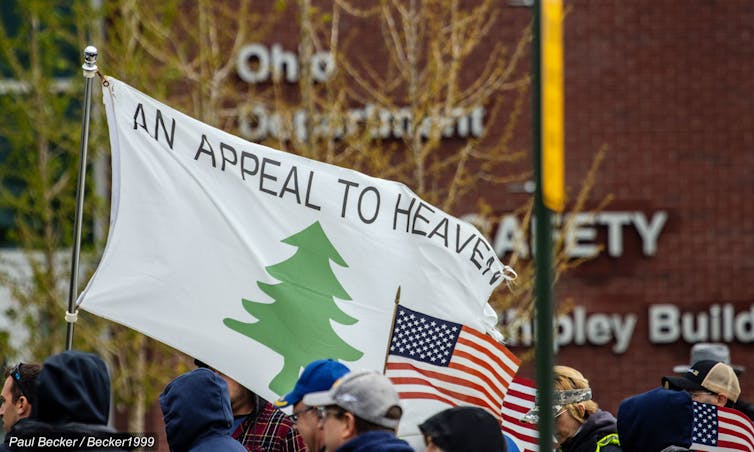
A powerful example of NAR’s political rhetoric in action is the rise and influence of flags “call to heaven”. For those who have the new apostolic reform, these flags symbolize the belief that when any earthly authority fails, people have the right to appeal directly to the authority of God to justify resistance.
This was obvious during January 6, 2021, Capitol Insurrection, when these flags were displayed in a good place.
To be clear, its leaders do not call for violence but rather to direct political commitment and protest. For some believers, however, calls for a “spiritual war” can become a slippery slope in the justification of violence, as in the case of the alleged Minnesota shooter.
Understanding the mandate of the seven mountains is essential to grasp the dynamics of contemporary efforts to align government and culture with a particular vision of Christian authority and influence.
This article is republished from the conversation under a Creative Commons license. Read the original article.


