3I/ATLAS-Like Interstellar Objects Could Kick Start Planet Formation around High-Mass Stars


The discovery of 1I/Oumuamua, 2I/Borisov and 3I/ATLAS showed that a significant number of interstellar objects populate interstellar space. Their ubiquity means that these objects also reside in protoplanetary disks, which constitute the reservoir for planet formation. There, interstellar objects could initiate the formation of giant exoplanets by overcoming the 1 m (3.3 ft) barrier present in the standard model of planet formation.
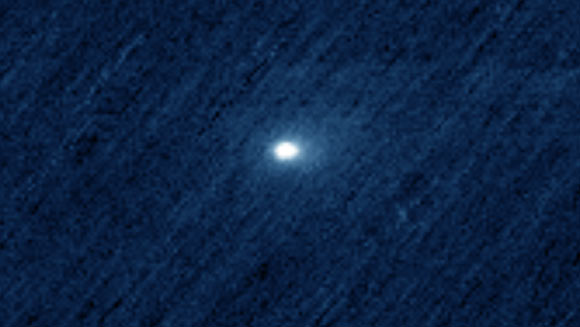
This colorized image, taken by the CaSSIS instrument aboard ESA’s Trace Gas Orbiter on October 3, 2025, shows the interstellar comet 3I/ATLAS. Image credit: ESA/TGO/CaSSIS.
Interstellar objects are bodies resembling asteroids and comets that have been ejected from their home systems and now wander interstellar space, occasionally encountering other star systems.
Since 2017, astronomers have detected three interstellar objects crossing our solar system: 1I/’Oumuamua, 2I/Borisov and more recently 3I/ATLAS.
“However, interstellar objects could have more influence than it seems at first glance,” said Professor Susanne Pfalzner, astronomer at the Forschungszentrum Jülich.
“Interstellar objects may be able to jump-start planet formation, particularly around higher-mass stars.”
Planets form as dust disks around young stars through a process of accretion that, according to theory, involves smaller particles coming together to form slightly larger objects, and so on until planet-sized bodies have assembled.
However, theorists have struggled to explain how anything larger than a meter forms by accretion in the hubbub of a planet-forming disk around a young star: In computer simulations, the rocks bounce off each other or break apart when they collide rather than sticking together.
Interstellar objects can potentially circumvent this problem. The team’s models show how the dusty planet-forming disk around each young star could gravitationally capture millions of interstellar objects the size of 1I/’Oumuamua, whose length has been estimated at about 100 m (328 feet).
“Interstellar space would provide ready-made seeds for the formation of the next generation of planets,” said Professor Pfalzner.
If interstellar objects can act as planet seeds, that also solves another mystery.
Gas giant planets like Jupiter are rare around the smallest, coolest stars, which astronomers call M dwarfs. They are more often found around more massive stars similar to the Sun.
The problem, however, is that planet-forming disks around Sun-like stars have a lifespan of about two million years before dissipating and are very difficult to form into gas giant planets on such a short time scale.
However, if the captured interstellar objects are present as seeds on which more material can accumulate, this speeds up the planet formation process and giant planets can form over the lifetime of the disk.
“Higher mass stars are more effective at capturing interstellar objects in their disks,” Professor Pfalzner said.
“Therefore, the formation of planets seeded by interstellar objects should be more efficient around these stars, providing a rapid means of forming giant planets.”
“And their rapid formation is exactly what we observed.”
Professor Pfalzner presented his results in September 2025 at the Joint EPSC-DPS2025 meeting in Helsinki, Finland.
_____
S. Pfalzner. 2025. Interstellar objects function as seeds for planet formation, mainly around high-mass stars. EPSC Summaries 18: EPSC-DPS2025-1927; doi: 10.5194/epsc-dps2025-1927


