“Take the Oil” | The Nation


January 7, 2026
Trump’s Venezuelan oil fantasies.
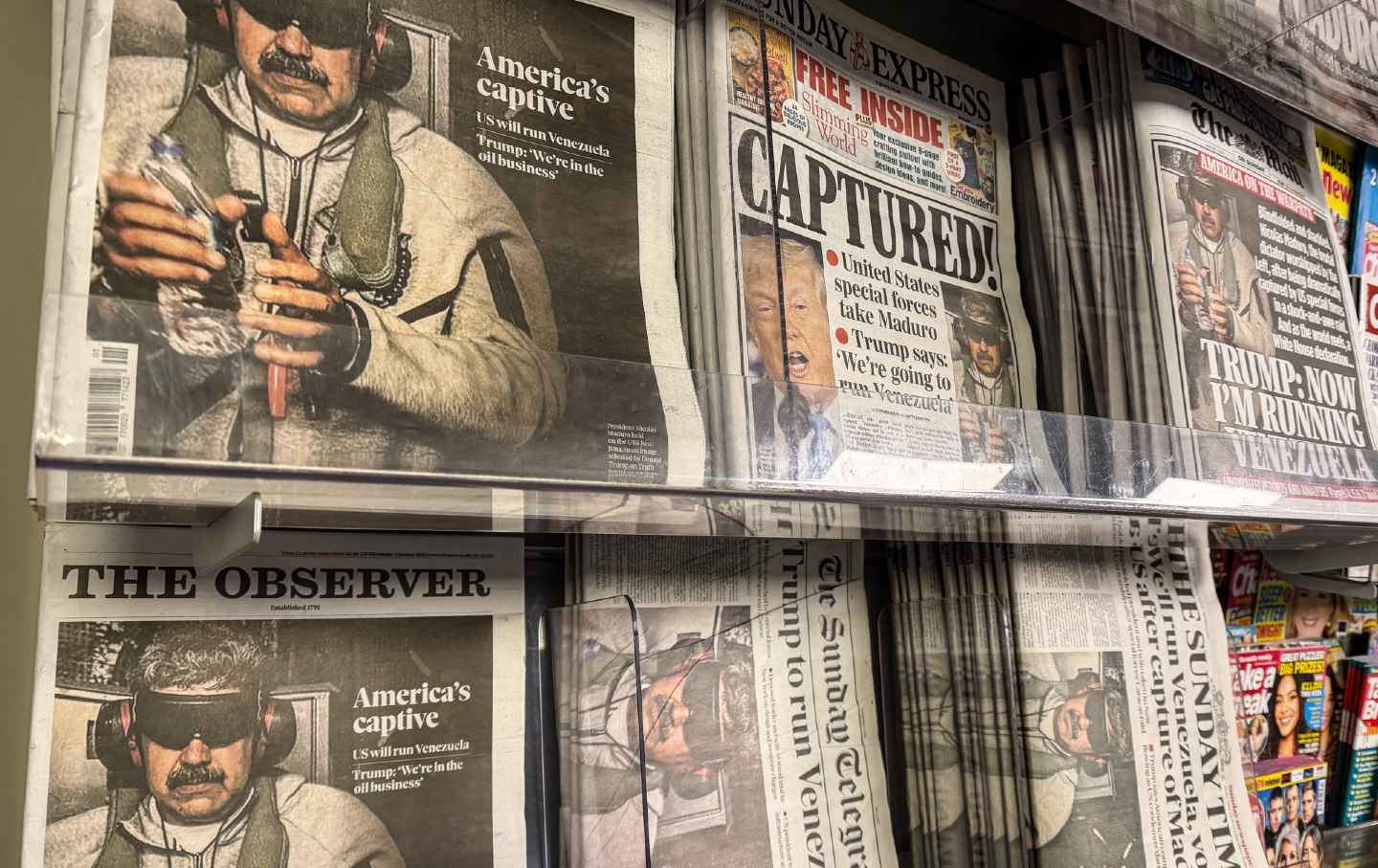
“Take the oil.”
No, that was not Donald Trump’s stated goal for Operation Absolute Resolve, the capture of Venezuelan President Nicolás Maduro on January 3, but rather his September 2016 reference to the U.S. military presence in Iraq. “You know, it used to be that the spoils belonged to the winner,” he told the NBC show’s Matt Lauer. Today to show. “Now there was no winner, believe me… But I always said: take the oil. »
And this wasn’t the first time Trump talked about seizing foreign oil fields. In a 2011 interview with George Stephanopolous, he said the United States should “accept it,” referring to Iraqi oil. A few days later, in the midst of the anti-Gaddafi uprising in Libya, Trump said, “I’ll just go take the oil.”
Indeed, seizing foreign oil for America’s supposed benefit has been a Trump obsession for some time. Growing up in the 1950s and 1960s, when American automobiles dominated world markets and American oil companies controlled most of the world’s most prolific oil fields, he has long expressed nostalgia for that era of big cars and oil prosperity — a nostalgia that instills the pipe dream of America made “great again.”
It now appears that Trump plans to apply his “take the oil” mentality to Venezuela, a country with vast oil reserves — 303 billion barrels, the largest in the world — but whose oil industry is devastated by sanctions.
“We’re going to ask our very large American oil companies, the largest in the world, to come in, spend billions of dollars, repair the badly damaged infrastructure, the oil infrastructure, and start making money for the country,” he said in a public speech shortly after the Jan. 3 raid.
Current number
Under the initiative, Trump said, Venezuela’s state-owned oil company, Petróleos de Venezuela, SA (PdVSA), will be forced to return control of oil fields it nationalized in the 1970s to U.S. companies that once exploited those fields. In Trump’s mind, these are “our fields,” not Venezuela’s, even though the oil is extracted from Venezuela’s sovereign territory.
“We built Venezuela’s oil industry with American talent, drive and skills, and the socialist regime stole them from us,” Trump said on January 3. “This constituted one of the largest thefts of American property in our nation’s history. »
As with everything Trump says, these statements are riddled with errors and lies. American oil companies are not “the largest in the world,” but they are dwarfed by Saudi Arabia’s state-owned company Saudi Aramco. Venezuela’s oil fields have never been “US property” but have been operated by US companies under concession agreements with the Venezuelan government. And they were not “stolen” by a “socialist regime,” but rather nationalized under laws passed under the center-left administration of Carlos Andrés Pérez – in a way far more democratic than the Saudi royal family’s takeover of Aramco, a joint venture of Texaco, Chevron and ExxonMobil.
However, much more than lies, Trump’s comments on Venezuelan oil are full of nostalgia and fantasy.
As he puts it, Venezuela’s oil production – now at historic lows – can be rapidly increased by US companies, generating huge profits for US companies and Trump’s chosen beneficiaries (presumably including various allies and apparatchiks of the Trump family’s business empire). But all this flies in the face of economic and geological reality, which stands in the way of any rapid increase in Venezuelan oil production and profits.
For starters, you can’t just “take the oil” from Venezuela’s fields. Most of Venezuela’s untapped oil is extra-heavy crude, a substance that more closely resembles Canadian tar sands than the liquid materials seeping from the ground in countries like Saudi Arabia and Iran. Extracting and processing Venezuelan heavy crude requires specialized skills and equipment that only a few large international companies possess. Much of the existing infrastructure needed for this has deteriorated in recent years – a consequence of US sanctions, poor management of PdVSA and the departure of qualified technicians. It is therefore not surprising that Venezuela’s oil production has declined sharply in recent years, from 2.7 million barrels per day in 2011 to around 800,000 barrels per day in 2023.
Popular
“Swipe left below to see more authors”Swipe →
Simply restoring previous yields to fields already in production will require years of effort and immense expense. Analysts at Energy Aspects, a London-based consultancy, said The New York Times that adding half a million barrels per day to Venezuela’s oil production would cost about $10 billion and take about two years. To restore production levels reached before 2011, the company noted, it could require “tens of billions of dollars over several years.”
If this were the “golden age” that Trump often refers to, when global demand for oil was growing and major U.S. oil companies were eagerly seeking new deposits to exploit, we might expect a rush by U.S. companies to access Venezuela’s newly reopened reserves. But global demand is not expected to increase significantly in the coming years as electric vehicles (EVs) gain popularity, so large companies are not rushing to increase capacity. Predicting future oil prices is always risky, but there is no reason to assume that oil prices will rise from their current rate of $60 per barrel to $90 per barrel or more, thus justifying the multibillion-dollar investments that will be needed to restore Venezuela’s oil fields to their former glory.
What is more likely is a random sale of PdVSA’s assets to various oil wealth aspirants – some with the expertise to prosper and others not. It will certainly generate lots of money for well-connected lawyers, bankers, fixers and scammers in the United States and Venezuela, but not the immense wealth envisioned by Trump – and certainly not the benefits he promised ordinary Venezuelans.
Furthermore, to the extent that they compete for access to prime assets, some of these interests could resort to violence. This should not be entirely unexpected, given that some senior Venezuelan military and political officials have obtained important positions within PdVSA and other state-owned companies – valuable interests for which they may be willing to fight. Popular resistance to a takeover of Venezuelan oil fields by American companies, possibly in the form of infrastructure sabotage, is also conceivable. Under these circumstances, Trump may feel compelled to put “boots on the ground” in Venezuela, as he has threatened to do. Instead of generating new wealth for the United States and Venezuela, Trump’s desire to seize their oil could therefore lead to endless conflict, at high cost for both countries.
More than The Nation
How Trump’s unlawful assassination of Qassem Soleimani in 2020 – and the West’s indifferent response – laid the groundwork for the brazen kidnapping of Nicolas Maduro.
Séamus Malekafzali
Behind today’s headlines lies a story of imperial outrage, including that of a Philadelphia indentured man who wreaked havoc in Venezuela in the early 20th century and helped overthrow a president.
Greg Grandin
Where is the international outrage over the US attack on Venezuela and the kidnapping of Maduro?
Elie Mystal
Senators and House members accuse Trump and his aides of disregarding the Constitution and lying to Congress.
John Nichols
Don’t be fooled by the anti-interventionist language. The Trump administration is all too eager to use military force.
William D. Hartung


