Infrasound Can Subtly Raise Stress and Discomfort, New Study Finds


New research suggests that infrasound (very low frequency sound below 20 Hz) can increase cortisol levels and irritability, offering a scientific explanation for why some “haunted” places seem unsettling.
Dispersion and others. used a combination of self-reports and biological measurements to demonstrate that infrasound can have irritant and aversive properties on humans. Likewise, infrasound appears to influence the increase in negative affective evaluations.
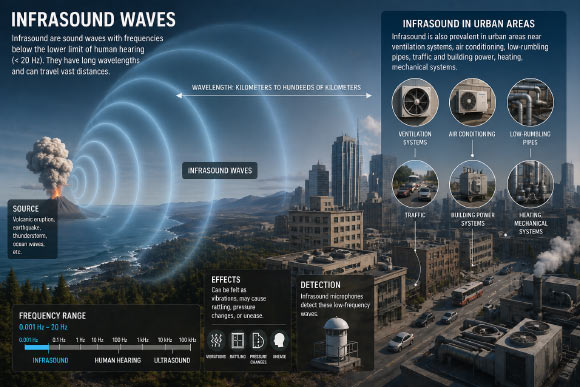
Infrasound can be defined acoustically as sound waves with an upper frequency limit below 20 Hz.
This can occur naturally, generated, for example, by tectonic or volcanic activity, convective storms, and air-water interactions, such as during upstream water releases.
However, infrasound is also prevalent in urban areas, near ventilation systems, air conditioning, low-noise pipelines, building traffic and energy, heating and mechanical systems.
Exploratory field recordings also detected low-frequency acoustic energy in the infrasound range from similar urban sources as well as during musical performances.
“Infrasound is ubiquitous in everyday environments and appears near ventilation systems, traffic and industrial machinery,” said Professor Rodney Schmaltz of MacEwan University.
“Many people are exposed to it without knowing it. Our results suggest that even brief exposure can alter mood and increase cortisol levels, highlighting the importance of understanding how infrasound affects people in real-world settings.”
For their study, the authors recruited 36 participants and invited them to sit alone in a room while calming or unsettling music played.
For half of the participants, hidden subwoofers played infrasound at 18 Hz. After listening, they were asked to report their feelings, their emotional evaluation of the music and whether they thought infrasound was present. They also gave saliva samples before and after listening.
The researchers found that participants’ salivary cortisol levels were higher if they had listened to infrasound.
These participants also reported feeling more irritable and less interested, and thinking the music was sadder. But they couldn’t say they were listening to infrasound.
“This study suggests that the body can respond to infrasound even when we cannot consciously hear it,” Professor Schmaltz.
“Participants could not reliably identify whether infrasound was present, and their beliefs about its activation had no detectable effect on their cortisol or mood.”
“Increased irritability and higher cortisol levels are naturally linked, because when people feel more irritated or stressed, cortisol tends to increase as part of the body’s normal response to stress,” said Kale Scatterty, a Ph.D. student at the University of Alberta.
“But infrasound exposure had effects on both outcomes that went beyond this natural relationship.”
These results indicate that humans can detect but not identify infrasound, although the mechanism remains unclear.
They also suggest that we may need to study whether prolonged exposure to infrasound could impact health due to persistently elevated cortisol levels and well-being issues linked to lowered mood and increased irritability.
“Increased cortisol levels help the body respond to immediate stressors by inducing a state of alertness,” said Professor Trevor Hamilton of MacEwan University.
“This is an evolutionarily adapted response that helps us in many situations. However, prolonged release of cortisol is not a good thing. It can lead to various physiological conditions and impair mental health.”
The results appear in the journal Frontiers of behavioral neuroscience.
_____
Kale R. Scatterty and others. 2026. Exposure to infrasound is linked to aversive responding, negative appraisal, and elevated salivary cortisol in humans. In front. Behavior. Neuroscience 20; doi: 10.3389/fnbeh.2026.1729876


