
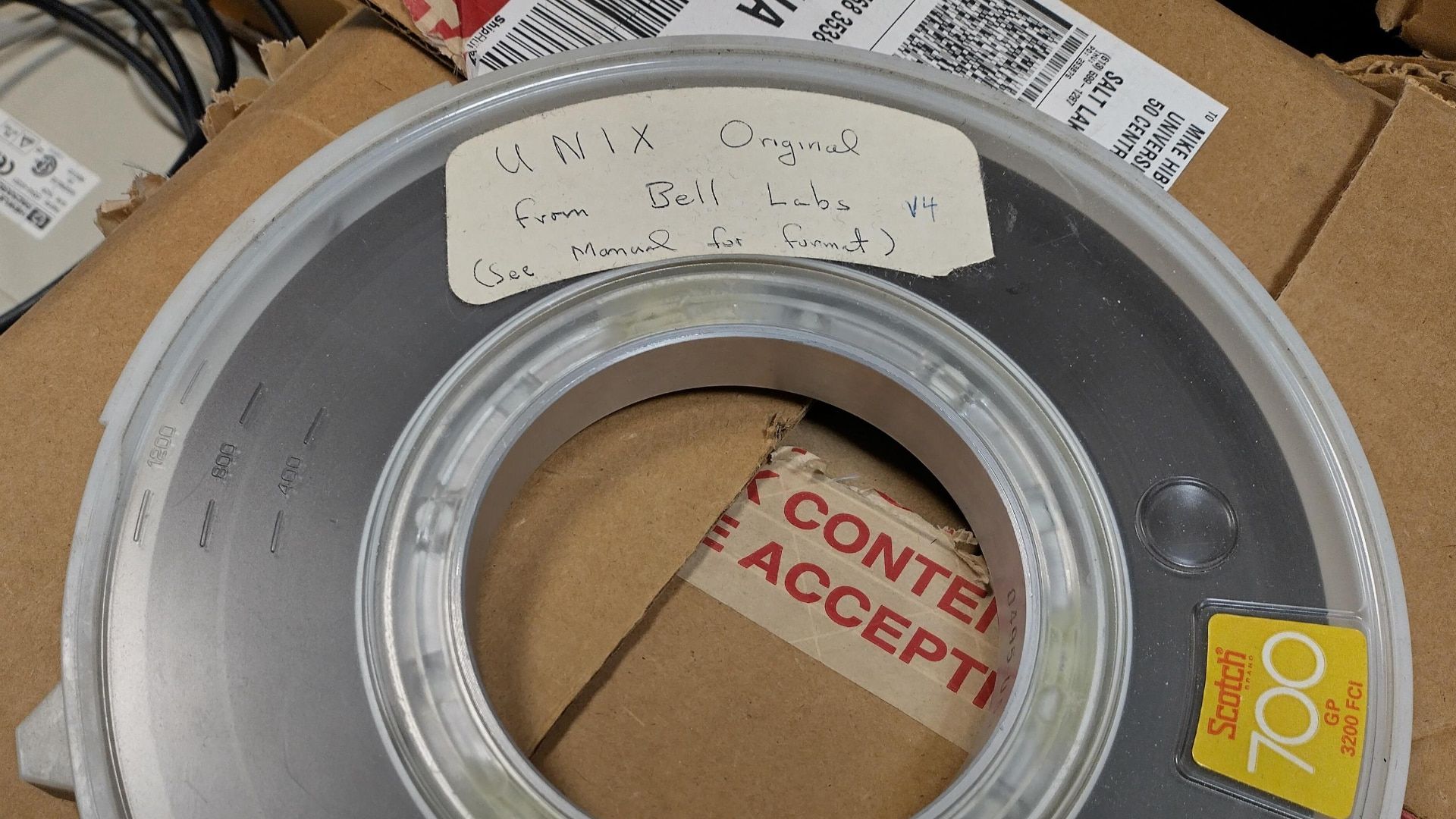
Linux, macOS, FreeBSD, Android, and other operating systems can trace their lineage back to the early commercial versions of Unix. One of the missing links in that chain, UNIX Fourth Edition, is now publicly available after being lost for decades.
UNIX Fourth Edition, also known as UNIX V4, was first released in November 1973. It was developed by AT&T and Western Electric, and it marked the first time that C code was used in the kernel instead of primarily assembly language. Early versions of Unix were built for mainframes and ‘minicomputers’—the microcomputer revolution that powered the Apple II, Commodore 64, BBC Micro, and other 8-bit personal desktops was still years away. The Linux kernel, FreeBSD project, and other Unix-like clones didn’t show up until the 1990s.
For decades, there were no known copies of UNIX Fourth Edition, with only some source code and manuals surviving to the present day. That changed when a nine-track tape reel containing UNIX V4 was discovered in a storage room at the University of Utah’s Kahlert School of Computing. The tape was delivered to the Computer History Museum, which has now been digitized and uploaded to the Internet Archive.
The now-archived tape also had some interesting history of its own. It was delivered to Martin Newell, a computer scientist who is best known for creating the Utah teapot, a common reference test model for 3D modeling. Newell worked at the University of Utah from 1977 to 1979, before moving onto Xerox PARC, but the UNIX V4 tape apparently stayed behind for all these years.
There’s already documentation for installing and using UNIX V4 from the digitized tapes in a PDP-11 emulator, though it’s not useful for much else than historical research. Still, it’s great to see another piece of computing history safely preserved. There are still no known copies of UNIX V2 and UNIX V3, so hopefully, those will also turn up eventually.
The archive page explains, “This is the raw analog waveform and the reconstructed digital tape image (analog.tap), read at the Computer History Museum’s Shustek Research Archives on 19 December 2025 by Al Kossow using a modified tape reader and analyzed with Len Shustek’s readtape tool. The tape was found in July 2025 by Aleks Maricq in the storage closet of the Flux Research Group in the Merrill Engineering Building, among the documents of Jay Lepreau. It was brought to the Computer History Museum by Jon Duerig and Thalia Archibald.”
Let this be an important lesson: you should clean out your storage closets, because there could be long-lost computer history in there somewhere.
Source: Internet Archive via OSNews


