55-Million-Year-Old Crocodilian Eggshells Reveal They May Have Pounced on Prey From Trees


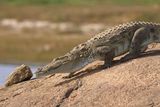
Scientists have discovered the oldest known crocodilian eggshells in a breeder’s garden. The fossils are around 55 million years old and belong to a group of ancient crocodiles called mekosuchines – some of which are thought to have fallen from trees and hunted prey like modern-day leopards.
“These eggshells gave us insight into the intimate history of mekosuchines,” Xavier Panadès i Blas, lead author of the paper, said in a statement.
“We can now study not only the strange anatomy of these crocodiles, but also how they reproduce and adapt to changing environments,” Panadès i Blas continued.
The eggshells, first described in the Journal of Vertebrate Paleontology, were found in Murgon, Queensland, about 270 kilometers northwest of Brisbane, Australia.
Learn more: 70 million-year-old dinosaur egg reveals ancient nesting clues
Who was Wakkaoolithus godthelpi?
Today, Murgon is a small rural town, nestled between farmland and bush. Fifty-five million years ago, the area would have been covered in swamps surrounded by lush forests, according to the researchers.
The modest clay pit where the eggshells were found was once a shallow swamp or lake and is now one of the oldest fossil sites in the country.
Paleontologists have been digging the pit for more than four decades. The excavations led to the discovery of what may be the world’s oldest known songbird and the southern hemisphere’s oldest bat, not to mention a plethora of other animal species, including salamanders, ancient marsupials and turtles.
For this study, the researchers examined the microstructure of 12 eggshells originally collected in the 1990s. Their analysis reveals that the elements in the eggshells show greater similarity to those of alligators and caimans than to those of modern crocodiles, but contain notable differences from all three.
The type of eggshell has since been named Wakkaoolithus godthelpi — in recognition of the members of the Wakka Wakka First Nation on whose lands the eggshells were found, and Henk Godthelpin tribute to his involvement on the Murgon site. The name is also inspired by Latin, more specifically “oolithus”, which combines the Latin words for egg (“ovum”) and stone (“lithus”).
Mekosuchines: ancient relatives of modern-day crocodiles
Mekosuchines thrived in what is now Australia, dominating the landscape long before modern crocodiles appeared. Australia, then still attached to Antarctica and South America, was home to several species, ranging from Mekosuchus inexpectatus to species that might have been semi-arboreal (i.e. they spent part of their lives on trees), such as Trilophosuchus rackhami.
“Some were also apparently ‘fangs’ at least partly semi-arboreal,” UNSW palaeontologist Professor Michael Archer said in a statement.
“They may have hunted like leopards, dropping from the trees onto whatever they unsuspectingly caught for dinner.”
The eggshells are thought to belong to a genus called Kambara, which are among the earliest mekosuchine species and the only ones known to have existed in and around the fossil site.
According to the Australian Museum, members of the Kambara genus were broad-snouted, generalist feeders who feasted on small vertebrates, including mammals and turtles. Researchers describe crocodiles as “semi-aquatic ambush predators.”
Eggshells may also offer clues about the local environment, wrote research associate Michael David Stein, involved in the project, in a paper for The conversation. Specifically, there is relatively little evidence of bacterial decay, suggesting that the nest may have experienced dry periods. Researchers say this could mean that the Kambara living at the site would have hatchings timed with the start of the rainy season.
Don’t put your eggs (shells) in one basket
Although eggshells don’t get the airtime that skeletal remains do, the researchers say this study highlights their value as a paleontological resource that can offer insight into the nesting and breeding behavior of the species that laid them.
“Our study shows how powerful these fragments can be. Eggshells should be a routine and standard part of paleontological research – collected, preserved and analyzed alongside bones and teeth,” said Panadès i Blas.
Learn more: A stash of tough dinosaur eggs tells us the origins of giant reptiles
Article sources
Our Discovermagazine.com editors use peer-reviewed research and high-quality sources for our articles, and our editors review the articles for scientific accuracy and editorial standards. See the sources used below for this article:


