61 Years After Bloody Sunday, We Are Entering a New Era of Voter Suppression


Two ongoing efforts threaten to erode the promise won by Selma’s 1965 infantrymen.
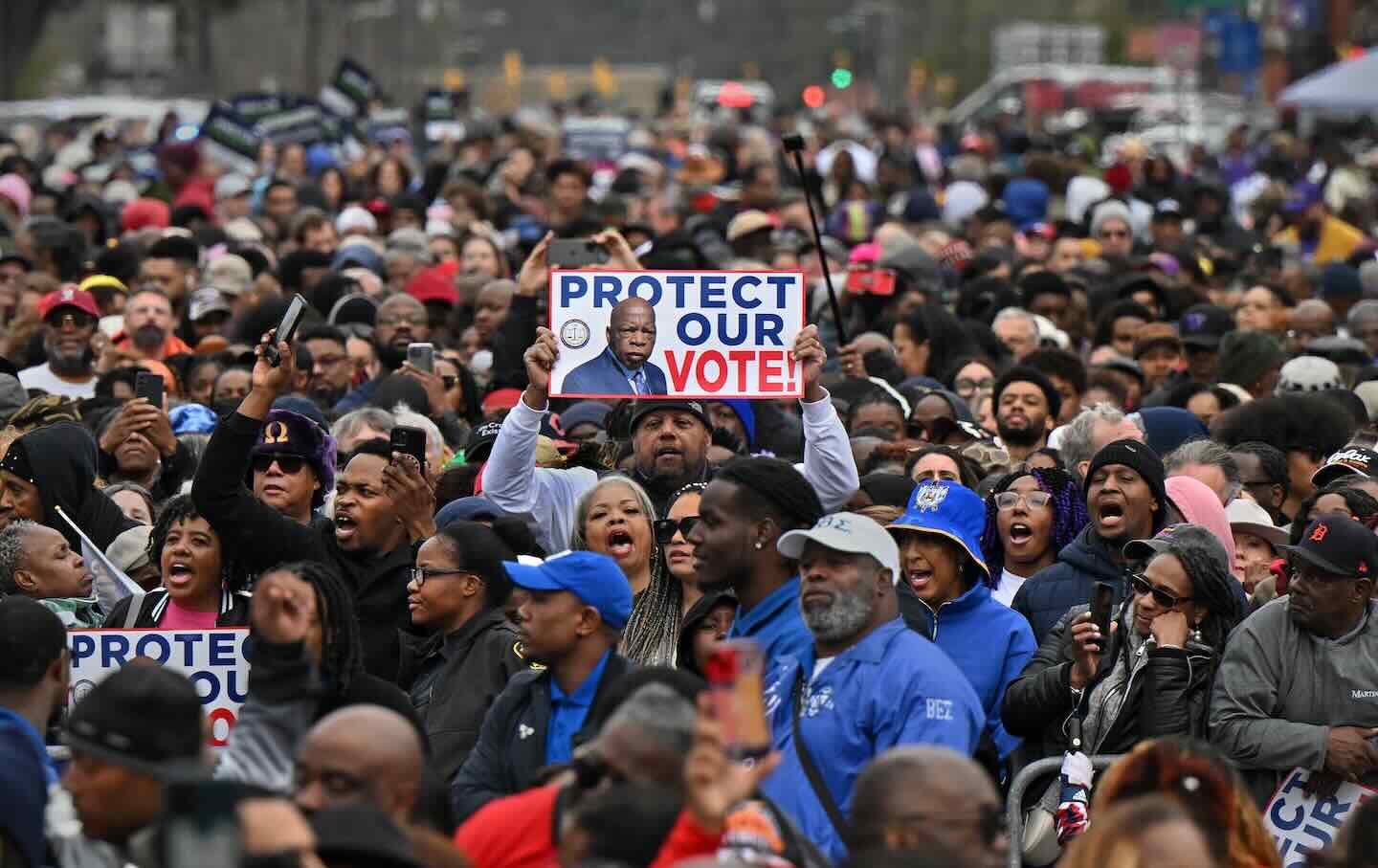
Thousands of people are gathered and waiting to cross the Edmund Pettus Bridge to commemorate the 60th anniversary of the bridge’s jubilee and “Bloody Sunday” in Selma, Alabama, in 1965.
(Michael S. Williamson/The Washington Post via Getty Images)
As writer Zora Neale Hurston eloquently observed: “There are years that ask questions, and there are years that answer.” »
1965 was one of those years that answered. And 2026 promises to be its heir.
In 1965, a group of ordinary citizens found themselves on the brink of history. On one side was the brutal reality they had experienced since the final days of Reconstruction, that of white hoods and open coffins, strange fruits and sunset towns. On the other, the promise of true equality, which had eluded them for so long.
They didn’t know it then, but their courageous actions on a bridge in Selma would set in motion a series of events that would radically alter the course of history, dividing the civil rights struggle into two eras: before and after Selma. The Voting Rights Act, signed into law five months later, codified what the Constitution had promised black Americans for nearly a century.
As we mark 61 years of that fateful march, we find ourselves at another inflection point: at another door. But behind this door there is no progress; it’s a regression.
Two consequential voting rights developments greet us this year: a seemingly innocuous change in Postal Service procedure that actually has massive ramifications for mail-in voting, and a looming congressional vote on the so-called “SAVE America Act,” which passed the House last month and now heads to the Senate. Together, they threaten to erode the promise won by Selma’s foot soldiers.
Despite its misleading name, the SAVE America Act is not intended to save our elections. It’s about sabotaging them. The measure would require U.S. citizens to present documents like a passport or birth certificate to register to vote. The problem: Nearly half of Americans don’t have a passport, and 69 million women can’t use their birth certificate to prove their citizenship because it doesn’t match their current legal name.
What the SAVE America Act conveniently overlooks is that we Already have a robust voter verification system. Every state in this country verifies voter ID. Each. When you register to vote, your information is checked against state databases: your driver’s license number, the last four digits of your Social Security number, your address.
And this system works. Because when states go looking for the voter fraud that the SAVE America Act claims to solve, they find virtually nothing. The Bipartisan Policy Center tracked non-citizen voting for 24 years and found 77 confirmed cases.
Seventy-seven. Over a quarter of a century.
The SAVE America Act replaces this system, which works, with one that creates a barrier that tens of millions of American citizens cannot clear.
We know what happens when governments do this, because Kansas tried it as early as 2013. Its legislature passed a law almost identical to the one currently proposed. The result: approximately 31,000 eligible citizens, or 12% of all candidates, were unfairly prevented from registering to vote. The law was ultimately ruled unconstitutional.
And then there’s what’s happening to the U.S. Postal Service. This change is so technical that you’d be forgiven for missing it, but it has far-reaching implications for voting.
On Christmas Eve, the USPS quietly updated its rules to clarify something it says has always been true: A postmark is not, and never has been, a record of when a piece of mail was dropped off. It is a record of the date the mail was processed.
For decades, this distinction didn’t matter much, because the old postal network was structured to almost automatically align the two dates; Mail dropped off at a post office was generally processed and postmarked the same evening at a nearby establishment. The postmark became, in practice, a reliable timestamp when a piece of mail, such as a ballot, was dropped off with the USPS.
Popular
“Swipe left below to see more authors”Swipe →
But now that is changing. As part of the massive overhaul of the Postal Service, mail processing has been consolidated from nearly 200 local facilities to just 60 regional centers. Post offices located more than 50 miles from a regional center have been reduced to a single morning pickup. Mail dropped off in the afternoon waits until the next day to even begin to be processed. The gap between the date a ballot is mailed and the date it is postmarked — a gap that has been virtually nonexistent for years — is now a day or more for millions of Americans, especially those in rural areas.
Sixteen states and the District of Columbia allow ballots to be counted after Election Day if they are postmarked on Election Day, considering that postmark legal proof that a voter acted on time. But when a ballot cast on Election Day is routinely not processed until the next day, that proof may never materialize, even for voters who did everything correctly.
Taken together, these two questions form an interlocking system. The SAVE America Act prevents millions of people from registering. Changes to the Postal Service mean that even those who register and vote can have their ballots disqualified. Tactics may be different. One speaks the language of election security, the other the language of operational efficiency. But the result is the same: a smaller electorate and results determined before a single vote is counted.
Efforts to modernize the Postal Service should not come at the expense of mail-in voters, especially those in rural communities who rely most on the mail to make their voices heard. The Senate must recognize the SAVE America Act for what it is – a modern poll tax dressed up in the language of election security – and reject it accordingly. And we should all honor Selma by actively defending the inclusive, multiracial democracy she made possible.
Make no mistake, 2026 will be a year of answer. The question is whether this response will honor the sacrifice of those who crossed the Selma Bridge or betray it.
Even before February 28, the reasons for Donald Trump’s imploding popularity couldn’t have been clearer: rampant corruption and billions of dollars’ worth of personal enrichment during an affordability crisis, a foreign policy guided solely by his own abandoned sense of morality, and the deployment of a murderous campaign of occupation, detention, and deportation on American streets.
Today, an undeclared, unauthorized, unpopular and unconstitutional war of aggression against Iran has spread like wildfire across the region and Europe. A new “forever war” – with an ever-increasing likelihood of US troops on the ground – could very well be upon us.
As we have seen time and time again, this administration uses lies, misdirection, and attempts to flood the zone to justify its abuses of power at home and abroad. Just as Trump, Marco Rubio, and Pete Hegseth offer erratic and contradictory justifications for attacks on Iran, the administration is also spreading the lie that the upcoming midterm elections are threatened by non-citizens registered to vote. When these lies go unchecked, they become the basis for further authoritarian encroachment and war.
In these dark times, independent journalism is the only one that can uncover the lies that threaten our republic – and civilians around the world – and shine a light on the truth.
The nation‘s experienced team of writers, editors and fact-checkers understand the scale of what we face and the urgency with which we must act. That’s why we publish critical reporting and analysis on the war with Iran, ICE violence at home, new forms of voter suppression emerging in the courts, and much more.
But this journalism is only possible with your support.
This month of March, The nation must raise $50,000 to ensure we have the resources to produce reports and analysis that set the record straight and empower people of conscience to organize. Will you donate today?