7-year-old Maya child had green jade ‘tooth gem,’ new study finds


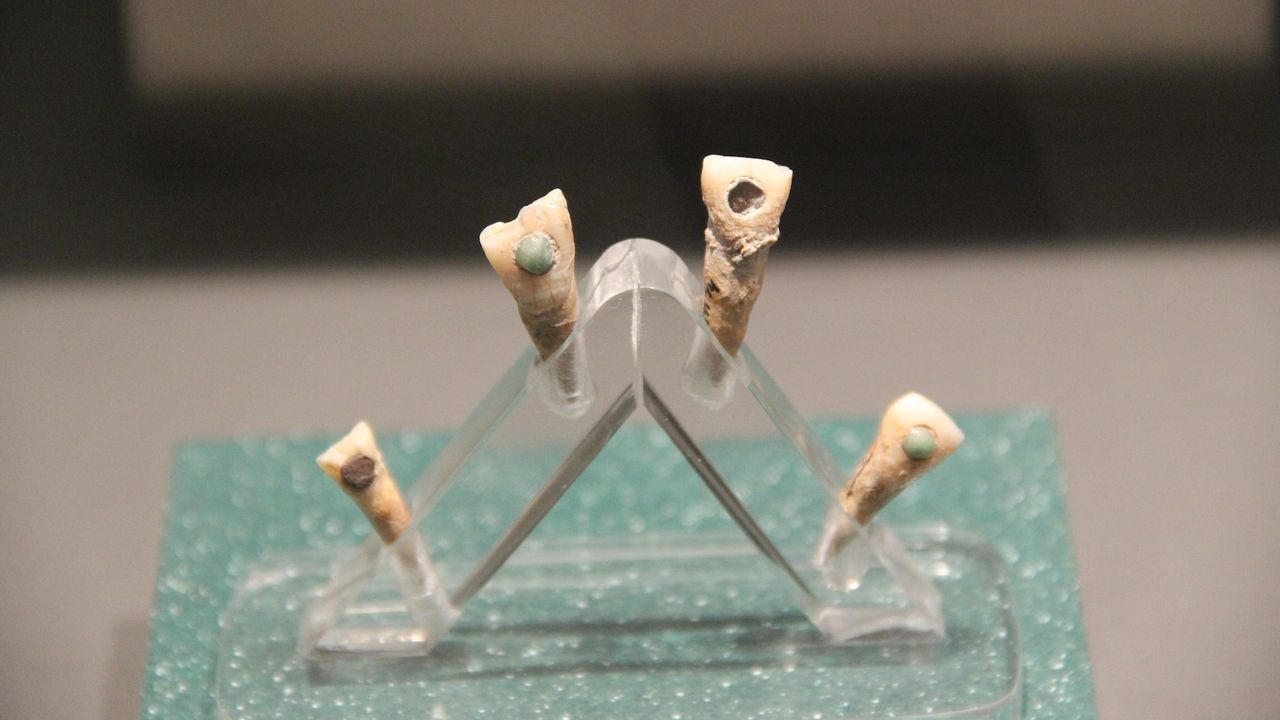
Centuries ago, Maya Children as young as 7 had “dental gems” – jade inlays in their teeth which probably symbolized social maturity or a rite of passage, according to a new study.
Archaeologists already knew that prehispanic Mayan adults often sported teeth inlays. But “what is enticing is the young age of individuals” analyzed in the new research, wrote the authors in the study.
But a new study in the November 2025 issue of the Journal of Archaeological Science: Reports Examined three isolated teeth with jade inlays housed at the Popol Vuh museum in Guatemala. Based on the degree of formation of the roots of each tooth, the researchers determined that each tooth came from a child from 7 to 10 years old.
Dental fashion
One of the decorated teeth was an upper upper left incisor – one of the upper front teeth – and another was a right upper canine. The third tooth was a lower incisor. It is not known if they all came from one child.
“Unfortunately, these teeth are not associated with bone skeletal remains,” wrote the authors in the study, “we cannot therefore affirm their origin with certainty and whether or not they belong to a single individual or up to three different.”
According to the study, the Mayans have often deliberately shaped their teeth by classifying them or engraving them. It was also common for craftsmen to use stone tools to sculpt artificial holes in the surfaces of prominent teeth and place gems there – generally jade, but also obsidian or pyrite – which were fixed in place with organic glue.
There is evidence that adolescents aged 10 to 15 had deposited or engraved teeth, but these people had no dental inclays, noted the study. There is also a “very limited number” of Mayans between 15 and 20 years old who had dental inlays in the archaeological file, they wrote.
Mayans may not have put dental inlays on younger individuals because it could have damaged growth teeth. An idea is that “inlays could have been too invasive to be carried out on such young people,” the team wrote in the study. However, the X -rays of the three teeth in the new study indicated that the most interior layer, known as dental pulp, was not damaged and that the teeth did not have natural cavities or cavities.
The mysteries remain
An analysis of the three teeth suggests that the inlays have been put in place while the children were alive, the authors wrote.
It is an important discovery because Two teeth with jade inlays found in Belize Perhaps from a child as young as 3 years old. However, this discovery is “controversial”, in part because inlays may have been created after death as part of a funeral ritual, wrote the authors of the new study.
They also warned that the new discovery could reflect a regional or local tradition which was not widespread in the Mayan world or that dental inlays were a sign that a child had started to assume responsibilities for adults, such as household work or work.
Until dental inlays are in the teeth of Mayan children, it will be difficult to determine why these young people had them.
“Unless more cases are documented, any possible interpretation of the reasons for the realization of these permanent modifications in these young individuals remains at the level of hypotheses and cannot be generalized to the entire Mayan kingdom,” wrote the authors in the study.
Ancient Maya Quiz: What do you know about civilization that has built pyramids through mesoameric?


