7,000-year-old deer antler headdress uncovered in Germany


To the untrained eye, it might look like the remains of a ferocious predator’s feast. But this particular wood is thousands of years old and could be a remnant of interactions between Europe’s last hunter-gatherers and the continent’s first farmers.
Neolithic farmers belonging to what archaeologists call the “linear pottery culture” began to expand across Europe around 5,500 BCE. During this migration, they pushed back Mesolithic hunter-gatherers, particularly from central Germany, further north.
“There is a long period during which farmers and hunter-gatherers coexist,” said Oliver Dietrich, co-author of a recent study published in Prehistoric Zeitschrift and press officer at the State Office for Heritage Management and Archeology of Saxony-Anhalt – State Museum of Prehistory, tells Popular science. “The Neolithic and the Mesolithic are therefore not mutually exclusive periods, but describe two partly contemporary lifestyles. »
Archaeologists know very little about the contacts between these two peoples. Consider the German colony of Eilsleben-Vosswelle, a prehistoric farming community that existed on the frontier, with hunter-gatherers to the north and farmers to the south. It was probably fortified and may have experienced significant interactions with proximal hunter-gatherer groups.
“The material culture discovered at Eilsleben reflects this border situation, as it displays many influences from the hunter-gatherer world,” Dietrich continues. “[Among] this is the antler industry, that is, tools and other implements made from antler in a Mesolithic/hunter-gatherer style. Deer antler is a great example,” he adds, referring to a 7,000-year-old antler discovered in Eilsleben.
Dietrich and his colleagues studied the artifact for signs of human modification. They found that the rectangle-shaped skull fragment, cut marks (suggesting skinning), and notches at the base fit the bill. The artifact was likely worn as part of a mask or headdress, and the notches would have held it in place. The headdress also dates back to 5291-5034 BCE.
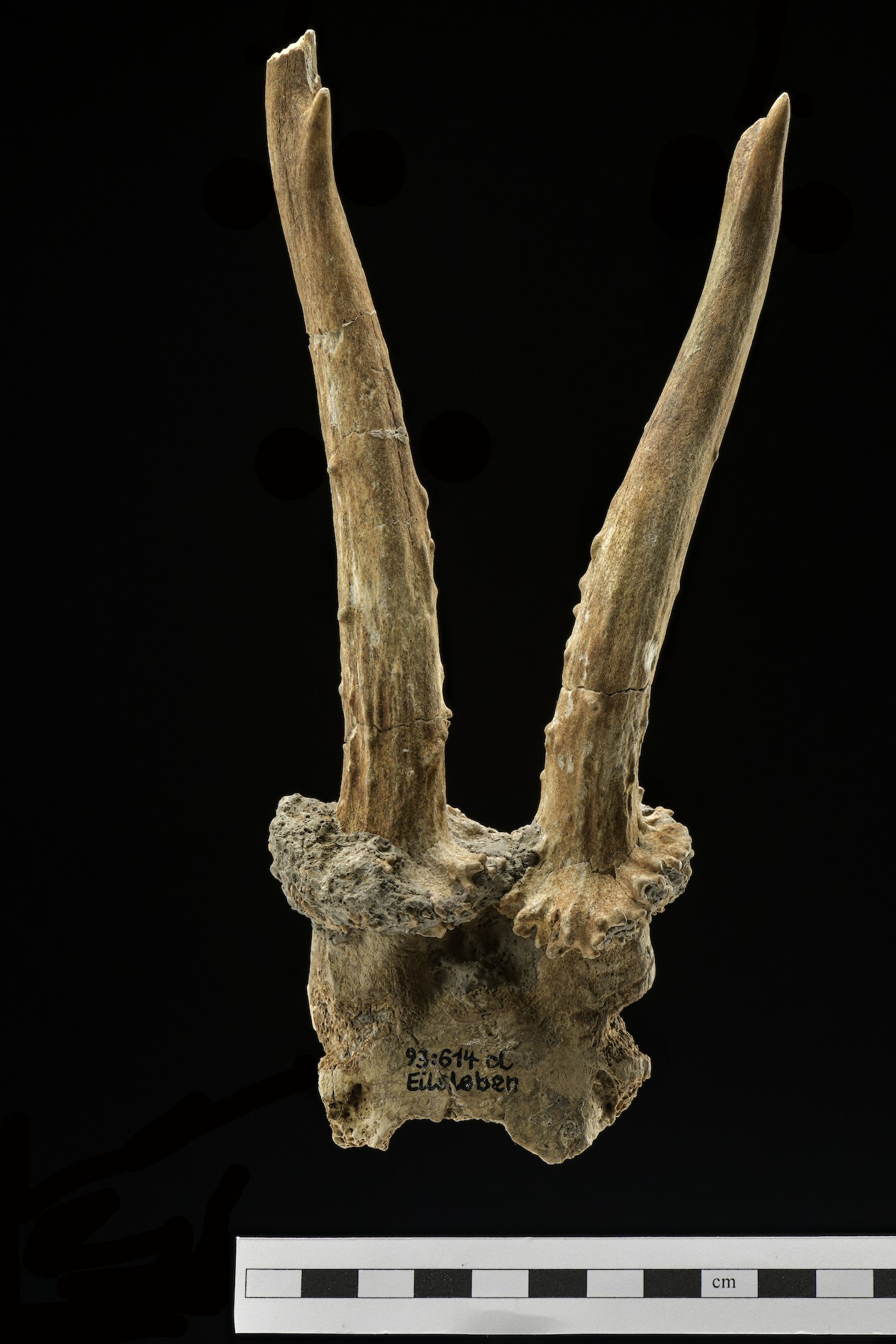
“Similar headgear is not known from early agricultural contexts, but there are good analogies with hunter-gatherer contexts. The best comparison for the Eilsleben Woods is that of the Bad Dürrenberg shaman’s grave,” says Dietrich.
The Bad Dürrenberg shaman was a woman aged 30 to 40 years, who died around 9,000 years ago. She was buried alongside a child of around 6 months in a complex grave in present-day central Germany. Researchers identified her as a shaman, or spiritual leader, thanks in part to animal tooth pendants and a deer antler that researchers believe was a headdress.
Although the Bad Dürrenberg shaman’s grave is older than the Eilsleben antler, the shaman’s antler “provides an interpretive framework for the discovery,” says Dietrich. According to the researchers, Eilsleben Wood could represent a contact between specialists in hunter-gatherer rituals and farmers.
Some transitions associated with the Neolithic lifestyle were not healthy, according to a statement from the State Office for Heritage Management and Archeology Saxony-Anhalt – State Museum of Prehistory. In this context, it is possible that early farmers sought help from a healer connected to the spirit world and who was certainly an expert in the healing properties of local flora.

The best new PopSci 2025 releases


