Supreme Court declines to revisit gay marriage decision : NPR

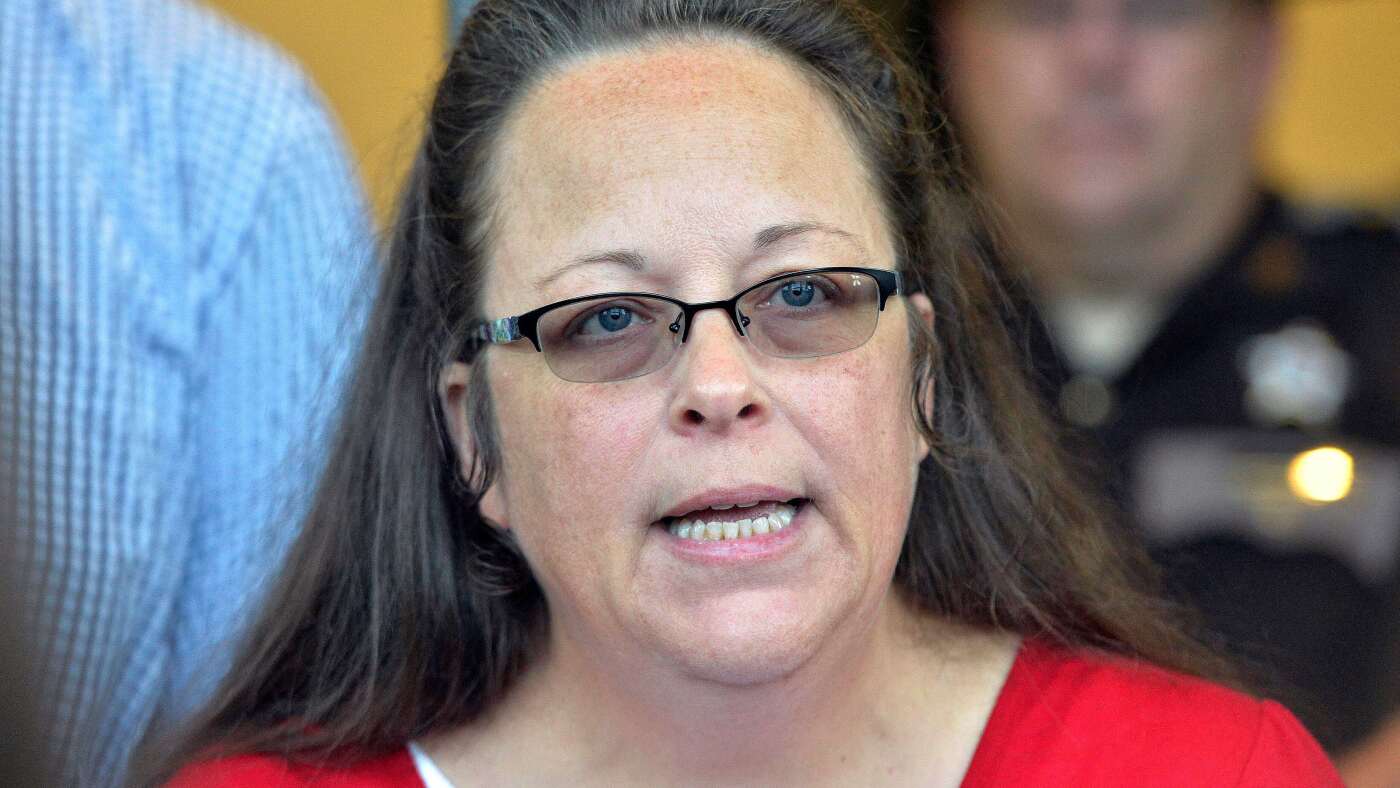

Rowan County Clerk Kim Davis gives a statement to the media outside the front door of the Rowan County Judicial Center in Morehead, Kentucky, in September 2015.
Timothy D. Easley/AP
hide caption
toggle caption
Timothy D. Easley/AP
The U.S. Supreme Court on Monday declined to take up a case challenging its landmark decision to legalize same-sex marriage nationwide.
The challenge to the court’s 2015 decision came from Kim Davis, the former Kentucky employee who refused to issue same-sex licenses after the Obergefell v. Court ruling. Hodges, who recognized a constitutional right to same-sex marriage.
As a result of her refusal, Davis was jailed for contempt of court and lost her re-election as clerk. A jury also ordered her to pay $360,000 to a couple she refused to marry. Davis attempted to evade payment of that verdict by further requesting that the court affirm that she has First Amendment religious protection from liability for her actions.
The court rejected his request without comment.
Davis has long argued that religious freedoms are in conflict with Obergefell.
“If ever there was a case of exceptional importance, that of the first person in the history of the Republic who was imprisoned for following his religious beliefs regarding the historical definition of marriage, this should be it,” she argued in her petition to the court.
She is not the only one who wants to challenge the legality of same-sex marriage. According to Lambda Legal, which advocates for gay rights, this year alone at least nine states have considered bills or resolutions criticizing Obergefell or seeking to limit marriage to heterosexual couples. On October 24, the Texas Supreme Court adopted a provision allowing judges to refuse to perform same-sex marriage ceremonies based on religious beliefs.
In his concurring opinion in the case that overturned the constitutional right to abortion, Justice Clarence Thomas expressly stated that the Supreme Court should reconsider its positions on birth control, same-sex marriage, and same-sex intimacy.
If the Supreme Court had decided to hear Davis’ case and then overturn Obergefell, same-sex marriage would still be federally protected. In 2022, former President Joe Biden signed the Respect in Marriage Act into law, which repeals the Defense of Marriage Act and recognizes the legitimacy of same-sex and interracial marriages. However, if Obergefell were overturned, states could refuse to recognize same-sex marriages.
The court’s decision not to hear Davis’ petition means the constitutionality of same-sex marriage is reaffirmed, at least for now.


