Want to hear dinosaurs ‘sing’? These instruments bring prehistory back to life


Credit: UNSPLASH / CC0 public domain
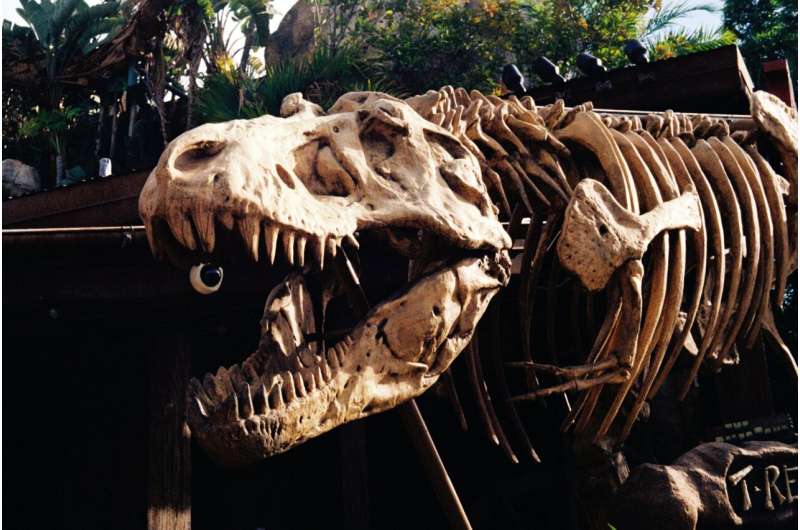
The roar of a T. Rex, made emblematic by Jurassic Park, has become the soundtrack of prehistoric times.
In reality, no one – not even paleontologists – can say with certainty what dinosaurs looked like, although there have been many assumptions. The mystery fueled from research decades and, for Courtney Brown, an associate professor at the Southern Methodist University, he inspired her to look for answers through an unexpected medium: music.
For more than a decade, Brown has been building musical instruments in mode on Hadrosaurs skulls, or duck beak dinosaurs that traveled the planet about 70 million years ago. Trained as a solid artist and computer engineer, Brown hopes that his fusion of paleontology and music will resemble an immersive act – not just an artistic experience, but a way of peer on the past and the present.
Calling fossil music
Brown calls his instruments Dinosaur Choir, a name reflecting his intention to be played together. The project seed was planted during a background road trip in 2011. During a stand at a new-mexic museum, Brown heard what was considered to be the call of a parasaurolophus, a haadrosaur of leaves with a long and distinctive head of head.
“I pressed the [exhibit’s] Button, I heard the sound and it was incredible, “said Brown.” I thought the dinosaurs were singers too, because I am a singer. I felt very connected to the dinosaurs for the first time. “”
This moment sparked a question that has since guided his work: what if you could look like a dinosaur?
After starting his doctorate in musical arts on Arizona State University, Brown decided to build his first Dinosaur choir instrument.
She turned to science to reinvent the voice of the Corythosaurus, another kind of Hadrosaurus. Using CT scans of a teenage skull from Corythosaurus, she and her collaborators printed 3D the head of the dinosaur and the airways, the integrated resonance chambers which formerly carried her calls.
Paleontologists believe that the crest of a Hadrosaurus allowed him to produce deep and booming sounds that may have warned others of the predators, kept herds together or attracted friends.
Between 2011 and 2013, Brown completed the first model of the instrument, which is played with a spokesperson, a bit like a trumpet. The air vibrates a mechanical larynx, and the sound swells through the respiratory tract of the 3D printed skull before emerging as an obsessive sound. With a breathing change, calls can go from a whisper to a full -bodied roar.
Brown then built another version of the instrument with materials that transported sound more clearly. In 2015, these first versions of Dinosaur Choir earned him a honorary mention during a solid art competition in Austria.
After a few years of calm, the project found a new momentum in 2021, when Brown received a Fulbright subsidy to do research at the University of Alberta. There, she has teamed up with Cezary Gajewski, an associate teacher of design studies who had built kiosks, furniture and sculptures, but never a musical instrument. A Brown video sent to Gajewski herself playing Dinosaur choir instruments had stuck her curiosity, and the two started to collaborate.
With other collaborators, Brown and Gajewski analyzed the latest CT scans and 3D models from Corypieosaurus to build a replica of a head of adult Corythosaurus.
The central challenge for the design of Brown and Gajewski was born from the pandemic: how to let people “play” without blowing in an instrument. Their solution was to equip the instruments with sensors that could collect the vibrations of breathing or voice and convert them into electrical signals – a bit like a guitar pick -up, Gajewski said.
The signals fuel a digital vocal box which causes a speaker to send air waves through the replicated dinosaur skull. A camera follows the shape of the mouth, which also affects sound.
The vocal box is delivered with several digital models which can be exchanged. A model is based on the Syrinx, the vocal organ that allows birds to sing. Brown added it after a 2023 study described a fossilized larynx of an armored dinosaur which showed bird-shaped features, suggesting that certain non-Avial dinosaurs may have produced sounds close to those of modern birds.
Part of the symphony
In March, Brown presented his Dinosaurs choir during a Georgia competition where inventors around the world have new instruments. Dinosaur Choir won third place. A few months later, Brown pulled one of his dinosaurs skulls at a conference of musical instruments in Australia, where it attracted curiosity, questions and a lot of attention – something that Brown says happens wherever it goes.
During the conference, the instrument “was right next to the elevator and the stairs, so it was a very beautiful acoustics,” said Brown. “I saw a few people, when they were waiting for the elevator, played the dinosaur a little before their departure. I thought it was cool.”
For those who wish to play the instruments of the Dinosaurs choral – something that Brown has learned to do for years of practice – she wants to make 3D printing plans accessible to the public at the end of spring or summer. Gajewski says that the impression of an instrument is not cheap, but for the most dedicated players (or 3D printing enthusiasts), luck can be worth it.
If you do not have access to a 3D printer, Brown has rendered the Dinosaur Choir software available online. Everything you need is a computer microphone and a camera.
As for the future of the Dinosaurs’ choir, Brown intends to spend Hadrosaurs to an armored dinosaur of plant eater called a nodosaur, which lived more than 100 million years ago. This dinosaur, she said, is completely different, with nasal passages of curlicue. A nodosaur fossil was found in the county of Tarrant in the 1990s, she said, and the CT scans are open source. “It would be a kind of local dinosaur, which I thought cool.”
In the end, Brown imagines a future where the Dinosaurs’ choir is played with other instruments – perhaps even a complete orchestra – its ancient sounds mixing with winds, brass and strings.
She has already played an earlier version of the instrument alongside a snorkel in a room entitled “How to speak dinosaur the court of dinosaur”, which she describes as a dinosaur courting a snorkel “pepe the pew – style”. With the new designs, Brown trained with a saxophonist in Dallas winds.
The objective, she said, is to bring “this experience embodied in the dinosaurs sounds. By exploding in the dinosaur, you somehow become one with it in the same way when I play the accordion, I have the impression of not being an accordion. I am interested in developing this really deep empathy with something that is extinguished.”
2025 The Dallas Morning News. Distributed by Tribune Content Agency, LLC.
Quote: Do you want to hear the “sing” dinosaurs? These instruments bring back prehistory to life (2025, September 13) recovered on September 13, 2025 from https://phys.org/News/2025-09-dinosaurs-TRUMESTORY-LIFE.HTML
This document is subject to copyright. In addition to any fair program for private or research purposes, no part can be reproduced without written authorization. The content is provided only for information purposes.


