Engineers propose massive airbags for airplanes


An India air flight from Ahmedabad to London spent only 30 seconds in the air before the disaster is hit earlier this year. Preliminary reports indicate that the airplane control switches of the aircraft were inexplicably disabled shortly after takeoff, cutting from fuel to motors and causing total loss of power. The frantic recordings of the cockpit reveal the two pilots questioning themselves in the confusion for those who made the fatal decision. In the middle of chaos, the plane fell and embarrassed, killing everyone except one on board. It was the deadliest aviation disaster in a decade.
A pair of aeronautical engineers from the Birla Institute of Technology and Science in India thinks that they have developed a design that could help prevent similar accidents – a design that involves massive external airbags and AI controlled. Called Rebirth of the project, the multilayer security system would modernize planes with a series of sensors that constantly monitor the flight conditions. If the system determines that an accident below 3,000 feet is inevitable, giant airbags would unfold, forming a protective cocoon designed to absorb impact energy and reduce damage. An infrared tag and flashing lamps would also be activated during the accident in order to facilitate the location of the padded wreckage for emergency stakeholders.
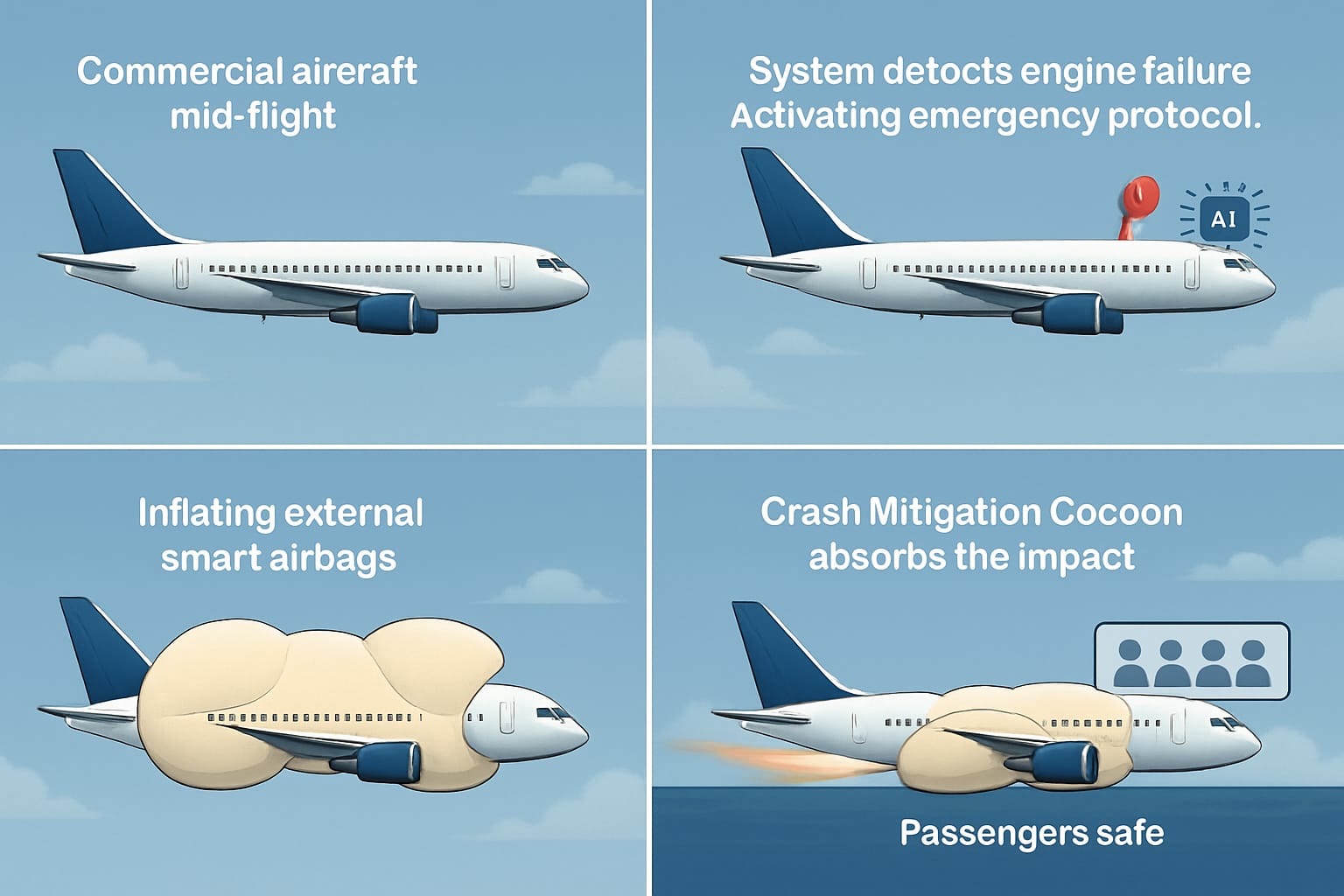
The engineers call for their conception, which is appointed for 2025 James Dyson Award, the first “crash survival system fed by AI” in the world “. Although still in its early test phases, they say that computer simulations show that the system can reduce crash forces by more than 60%. In theory, a softer landing, combined with faster emergency intervention decisions based on AI, could make the difference between surviving passengers or die in an accident. An aviation expert speaking with Popular science said the concept is promising but warned that many unanswered questions remain, in particular with regard to the additional weight of airbags.
“It looks like an interesting idea, but the air disasters that this airbag system aims to alleviate would mean that future planes would all have the additional weight and other compromises to alleviate an accident in 20 years,” said Jeff Edwards, a retired firm of the US Navy 1-6 Popular science.
The Renaissance has become a “response to sorrow”
Eshel Wasim and Dharsan Srinivasan, the brain behind the Renaissance, say that the concept was a direct response to the India air accident, which left them and family members.
“My mother couldn’t sleep,” writes Wasim. “She kept thinking about the fear that passengers and pilots had to feel, knowing that there was no way out. This helplessness haunted us. ”
The pair began to browse academic research on airline safety measures and discovered a notable gap. Most airline safety systems are designed to prevent accidents, with a relatively little focused accent on improving survival when an accident is inevitable. In this spirit, they decided to develop a method targeting three specific objectives: slow down an airplane before impact, absorb the strength of the accident and help rescuers locate and respond to the site faster.
“The Renaissance is more than engineering – it is a response to sorrow,” write engineers. “A promise that survival can be planned and that even after failure, there can be a second chance.”
Use of AI, giant airbags and reverse propellants to make accidents safer
The Renaissance, as a system, begins to work long before the deployment of popcorn-shaped airbags. Sensors distributed throughout the altitude of the plane monitor, speed, engine condition, steering and pilot response. These sensors relay the data to an on -board AI system, which analyzes the information to determine if a crash seems imminent. If the system takes this determination at 3,000 feet or below, it triggers the deployment of the airbag. The engineers note that the pilots have a brief window to replace the Deployment of the AI deployment, although it is not clear exactly how long this window lasts.
If a pilot replacement does not occur, massive airbags are deployed from the nose, belly and tail of the aircraft. All this should occur in less than two seconds. The so-called “intelligent airbags” are built from layers of Kevlar, TPU, Zylon and STF, materials specially selected for their absorbing properties. These layers of fabric are reinforced by an interior lining of various “non -Newtonian fluids” (liquids which have no constant viscosity), which help to absorb the impact more. Assuming that the engines are always functional, they will also automatically engage in the opposite push to help slow the plane. According to engineers, this reverse thrust could reduce the speed of the plane before the impact of 8 to 20%.
Once the airplane covered by the airbag will have an impact, the system automatically pulls the infrared tag, the GPS coordinates and the lights to help the first stakeholders to identify it quickly.
“He is preparing for the worst when everything else fails,” write the engineers.
Until now, Wasim and Srinivasan say they have seen promising results of computer simulations of their system. They also built a 1:12 ladder prototype and started to reach out to decision -makers, aircraft manufacturers and government agencies to initiate larger and real tests. In theory, they believe that the system could be modernized on various types of aircraft, new and old.
“Today, the Renaissance is ready for scale tests, with diagrams, simulations and data of prepared materials,” they write.

Too heavy airbags could do could do more harm than good
Edwards, Avsafe’s aviation expert, said more test data is necessary before the viability of the airbag system can be determined. The real efficiency of the system, he noted, may partly depend on its overall weight. Although airbags and propellants are intended to reduce the force of the impact, this advantage could be offset if the system is so heavy that it adds a significant weight and drag. The airbags themselves should also be enormous to significantly reduce the impact forces of a commercial aircraft weighing more than 600,000 pounds.
“The weight penalty alone would be a major concern,” said Edwards.
There is also a certain uncertainty about the overall effectiveness of the AI monitoring system as proposed. Although the AI can detect proximity to the plane with the ground and make the decision to deploy security measures, Edwards said that there were still many other variables in real time which must be taken into account when landing at altitude.
Parachutes, “magic skin” and hatch: the fiery world of aircraft safety ideas
Rebirth follows a long line of ambitious air security proposals, many of which never end up seeing daylight. Certain plans with two smaller motor engines are already capable of deploying large “whole” parachutes designed to help an airplane to descend safely in the event of an engine failure. In 2011, researchers supported by the financing of NASA explored the development of the “magic skin” of so-called self-healing for planes that could protect the outside of lightning, extreme temperatures and electromagnetic interference. The process consisted in coating the plans with a conductive film and a foam absorbing energy. They also explored means so that the coating is repaired if he was perforated or torn.
Other proposed security measures have notably been less high technology. After the terrorist attacks of September 11, Airbus filed a patent for a hatch installed at the entrance to the cockpit, apparently designed to eject a potential airplane attacker outdoors. The same patent even proposed the deployment of tranquilizing gas in the cabin as an anti -terrorist measure. As far as we can say, none of these concepts has ever made commercial aircraft.
If Rebirth eventually won the Dyson Award when he was announced on November 5, he will join a group of ready -to -use proposals. Former prize winners include a team that has created an off-road trailer used to transport wounded soldiers to Ukraine, a biomedical portable glove used to test glaucoma, and an “e-color” waste glass used to reduce the heat absorption of buildings. Prize winners receive $ 40,000 at a price.

More offers, reviews and purchasing guides


