New method for making graphene turns defects into improvements


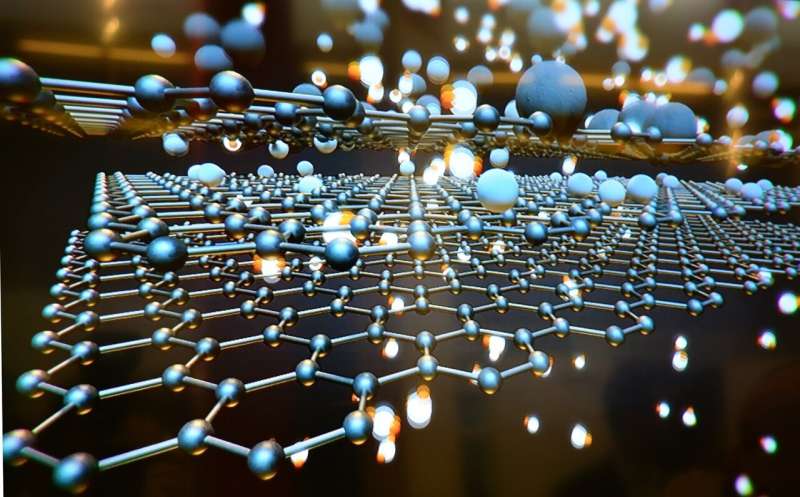
Credit: Public Pixabay / CC0 domain
Recent research has found a new way to make graphene that adds structural defects to improve the performance of the material that could have advantages on a range of applications – sensors and batteries to electronics.
Scientists at the University of Nottingham University School, the University of Warwick and Diamond Light Source have developed a single step process to develop graphene -type films using a molecule, Azupyrene, whose form imitates that of the desired defect. Research has been published today in Chemicals.
David Duncan, an associate professor at the University of Nottingham and one of the main authors of the study, explains: “Our study explores a new way of making graphene, this super thin and super strong material is made of carbon atoms, and although the perfect graphene is remarkable, it is sometimes too perfect.
“Usually, material defects are considered to be problems or errors that reduce performance, we have used them intentionally to add features. We have found that defects can make graphics more` `sticky ” to other materials, which makes them more useful as a catalyst, as well as to improve its capacity to detect different gases. Semi-marital and magnetic graphene, for potential applications in the semiconductor “.
The graphene consists of a flat tiles of six carbon atoms in a ring. The desired defect has neighboring rings made up of 5 and 7 carbon atoms. Azupyrene has a shape (or a topology) which naturally includes the same type of irregular rings to be introduced into the graphene. Azupyrene was used to develop graphene to create films with a high rate of this specific defect type and, by modifying the temperature during growth, the quantity of defects in the final material could be controlled.
The researchers at the Manchester Graphène Institute also successfully demonstrated that graphene could be transferred to different surfaces retaining defects, a key technological realization to apply these films to real devices.
This work has used a wide range of advanced tools, bringing together collaboration through the United Kingdom, Germany and Sweden using advanced microscopy and spectroscopy at the Diamond Light Source in Oxfordshire and Max IV in Sweden, as well as the British national supercomputer Arche2, allowing researchers to study the atomic structure, Defects defective graphics.
Professor Reinhard Maurer, Department of Chemistry, University of Warwick, said: “By carefully choosing the starting molecule and growth conditions, we have shown that it is possible to develop graphene in which imperfections can be more controlled. We characterize the signatures of these imperfects by bringing together atomic scale, spectroscopy and computer simulation.
“This study testifies to what can be carried out thanks to international collaboration and the integration of a diversified scientific expertise,” said Dr. Tien-Lin Lee of Diamond Light Source. “By combining microscopy, advanced spectroscopy and computer modeling through the institutions of the United Kingdom, Germany and Sweden, we were able to discover the mechanisms on a atomic scale behind the formation of defects in the graphene, something that no technique or unique team could have done alone.”
More information:
Benedikt p klein et al, synthesis in a stage of the graphene containing topological defects, Chemicals (2025). DOI: 10.1039 / D5SC03699B
Supplied by the University of Nottingham
Quote: New method for making graphics transforms defects into improvements (2025, September 20) recovered on September 20, 2025 from https://phys.org/news/2025-09-method-graphène-defects.html
This document is subject to copyright. In addition to any fair program for private or research purposes, no part can be reproduced without written authorization. The content is provided only for information purposes.


