What exactly is the UV Index? A dermatologist explains.


From 2:19 p.m. today, it is officially fall in the northern hemisphere. Pumpkin patches and apple orchards will replace beach trips, swimsuits will be hidden and the sun will start to bed earlier. But part of your summer routine should remain part of your daily life: sunscreen. Protecting your skin from ultraviolet sun (UV) light is important all year round. To monitor your risk level, you can use the UV index.
“Sometimes people think you can only have a high UV clue when it is very hot, but in fact, the index and the UV temperature are separate concepts. It is possible to have a high UV index even if the temperature is cold, “said Dr. Sameer G. Gupta, known as a dermatological surgeon at Massachusetts Eye and Ear Hospital in Boston, said to Boston, known as a dermatological surgeon at Massachusetts Eye and Ear Hospital in Boston, said in Boston, Dermatological. Popular science.
What is the UV index?
The UV index gives a daily forecast of the expected risk of overexposure to the sun’s rays. He predicts this risk on a scale of 1 to 11+. The number 1 means a minimum risk of overexposure, while 11+ indicates a very high risk.
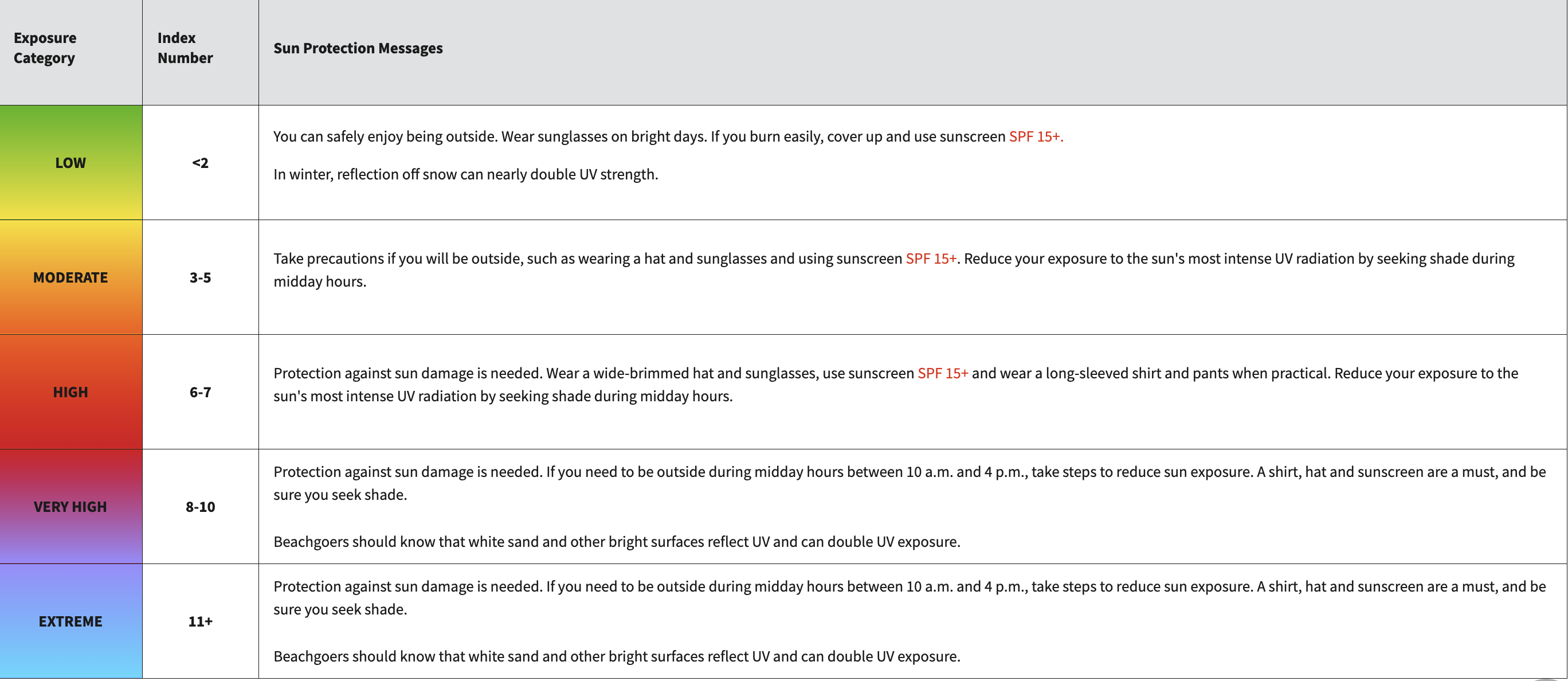
“Basically, higher values mean that it takes less time for evil [from the sun] To perform, ”explains Gupta. The higher the UV score, “the faster you can undergo damage to the sun or skin damage. »»
It is important to be particularly cautious when the UV index is considered high (6 to 7), very high (8 to 10) or extreme (11+). Sunburn can only occur in a few minutes if the skin is not protected by clothes of sunscreen, shelter or UPF at this level.
The UV index takes into account several other factors. The geographic location, the day of the day, the elevation, the cover of the clouds and more can help to estimate the level of UV radiation which is likely to reach the soil.
[ Related: Do I really need to wear sunscreen every day? We asked dermatologists. ]
What does the UV index measure?
The UV index measures ultraviolet radiation from the sun. There are three main types of UV radiation: ultraviolet A (UVA), ultraviolet B (UVB) and Ultraviolet C (UVC). The difference between these rays is based on their wavelengths.
Almost all the UV influence that reaches the earth is considered UVA, but some UVBs reach us. UVA and UVB rays can affect our health in different ways, which is why wearing a wide spectrum sunscreen that protects against both is crucial.
According to the CDC, the UVA penetrates more deep into the skin and is more constant throughout the year.
“Ultraviolet B is the wavelength that causes sunburn,” explains Gupta. “There are other wavelengths that can damage the skin, but it is the one that causes sunburns most frequently.”
UVC radiation is in fact the highest energy part of the UV radiation spectrum, but it does not reach the surface of the earth. The ozone layer of the atmosphere blocks UVC, so that the only way we can be exposed to it is a false source like a laser or a lamp. However, if exposed, UVC can cause burns and eyes wounds.
You can monitor the UV index where you use the Environmental Protection Agency (EPA) website or their application. Many weather applications also include the UV index in their report.
Another easy way to say the amount of exposure to UVs you get is to follow the shadow rule. If your shadow is larger than you, your UV exposure is probably weaker. This usually occurs early in the morning or later in the afternoon. A shorter shadow indicates that you are exposed to higher levels of UV radiation. This usually occurs around noon.
[ Related: Mineral vs. chemical sunscreen: What’s best for protecting your skin? ]
How will UV light fluctuate throughout the year?
During the summer, the sun is at its highest point in the sky during noon. This is why wearing clothes of sunscreen and UPF and / or avoid being in the sun from 10 a.m. to 2 p.m. is recommended.
During the summer, “UV rays somehow have this short path to travel through the atmosphere to arrive,” explains Gupta.
In the fall, the sun will sit below the sky. Its influence must travel further through the atmosphere to reach us, so there is more chance of dispersing. Although UV exposure tends to drop, the same factors that help calculate the amount of sun risk are at stake.
“It all depends on where you are and the rise in your location, the thickness of the ozone layer in this specific area, the cloud cover,” explains Gupta. “These are some of the modification features that may have an impact on UVs regardless of the season.”
For example, during skiing, the combination of elevation and rays reflecting on white snow and your face can cause sunburn on exposed skin. Fresh snow can reflect almost all the radiation of the sun, making it dangerous if the skin is not protected.
[ Related: Sunscreen may have kept ancient humans alive during a polar reversal. ]
How to be in sun safety all year round
According to GUPTA, trying to limit sun exposure between 10 a.m. and 4 p.m. can help prevent serious skin damage. Wearing large hats on board, sunglasses and sunscreen that you will apply again will also help reduce the sun damage during this foliage hike.
“Use a SPF 30 -spectrum sunscreen or more every day of the year,” said Gupta.
Whatever the season, it is also useful to use the UV index as expected, to help you plan your day around the worst of the sun’s rays
“We are all used to watching the weather and planning our days around temperature and things as if it will rain. The UV index is another tool to help us plan the UV exhibitions of the day, ”explains GUPTA. “So, if the UV index will be high a given day, try to make a concerted effort to postpone activities to the sun, whatever the temperature, especially during these peak hours.”
This story is the third in a series of stories on sunscreen and part of the popular sciences Ask us anything series,, Where we answer your most bizarre and burning questions, from the ordinary to the wall. Do you have something you always wanted to know? Ask.

More offers, reviews and purchasing guides


