Why the US government might shut down and what to know


Anthony ZurcherCorresponding to North America And
James Fitzgerald

 Anadolu via Getty Images
Funding from the United States government will be cut at the end of Tuesday, unless the Republican Party of President Donald Trump can agree with the opposition democrats on a path to follow for a bill of expenditure.
This could lead to government services – but not all – in the United States.
Although budgetary confrontations are common in American policy, this particular expenditure struggle is particularly tense, since Trump has spent the last nine months considerably reducing the size of the federal government.
Why could the US government close?
In simple terms: any closure will be the result of an inability of both parties to meet and adopt a bill funding government services in October and beyond.
The Republicans control the two chambers of the Congress, but in the Senate – or the upper House – they are short of the 60 votes they need to adopt a spending bill.
Democrats therefore have a lever effect in this case. They refuse to support a bill presented by the Republicans who, according to them, will make more difficult for Americans to offer themselves health care and have mainly done this on the progression of their health policy objectives.
They call for an extension of tax credits that make health insurance cheaper for millions of Americans – which should expire – and a reversal of Medicaid cuts that have been made by Trump. They are also opposed to proposing expense discounts to centers for Disease Control and National Institutes of Health.
A stopping bill was previously adopted in the House, or in the lower chamber, but has not yet erased the Senate.
When would the closure occur?
If no agreement is concluded at 00:01 HA on Wednesday (05:01 BST), the United States will have its first closure in almost seven years.
The last time the government closed was at the end of 2018, during Trump’s first term. The two parties make the last trigger efforts while trying to avoid a rehearsal.
For the first time since his return to the White House, Trump will meet the four leaders of the Congress on Monday – which means the best democrats in the Chamber and the Senate as well as their republican counterparts.
But Trump attenuated the expectations of an agreement, telling the American partner of the BBC CBS News: “I don’t know how we are going to solve this problem.”
What is the probability of a closure?
At this stage, the prospects for a kind of government closure seem high.
On the republican side, officials of the Trump administration have not wanted, so far, to offer substantive concessions.
They seem to believe that the Democrats, because the requests aside in exchange for the maintenance of the open government, will bring the weight of the public blame – as they have done in certain past closures.
Democrats, on the other hand, believe that their pressure to preserve subsidies to health insurance is popular.
In addition, their leaders in the congress caused the left -wing activists for saving during the last budget fight in March. Many Democrats who are crumbling for a larger struggle this time – and finance the government is one of the only places where their party has a lever effect.
What is different in the threat this time?
What stands out from this current impasse is the position of the White House.
In the past, long closures were generally considered politically dangerous, hindering the daily life of voters and the images of the legislators and the president.
But this time, the Trump administration seems more than happy to close large parts of the United States government for an extended period. In fact, officials threatened to use a closure to identify “non -essential” workers who could then be permanently released.
In addition, after previous closures, government operations mainly returned to normal, with staff and expenditure levels widely dated to the previous levels once the dead end is resolved.
In the past nine months, however, the Trump administration has reduced spending and pushed workers out of their work, testing the limits of presidential power. A closure could allow the administration to accelerate its massive discounts.
What impacts would have a closure?
The whole government will not close if the congress does not adopt a spending bill.
Border protection, medical care in hospital, police and air traffic control should continue to operate during the stop.
Although social security and health insurance checks are always sent, checking services and card issuance could stop.
Generally, in a closure, essential workers continue as normal – some of them without paying for the moment – but government employees deemed not essential are temporarily placed on unpaid leave. In the past, these workers were then paid retrospectively.
This means that services such as the food assistance program, the preschool funded by the federal government, the issuance of student loans, food inspections and operations in national parks should be reduced or closed.
There could also be a travel delays if the establishment is getting longer and unpaid workers stop running, and prolonged closure could also have secondary impacts on the American economy.
To what extent are the closures common in the United States?
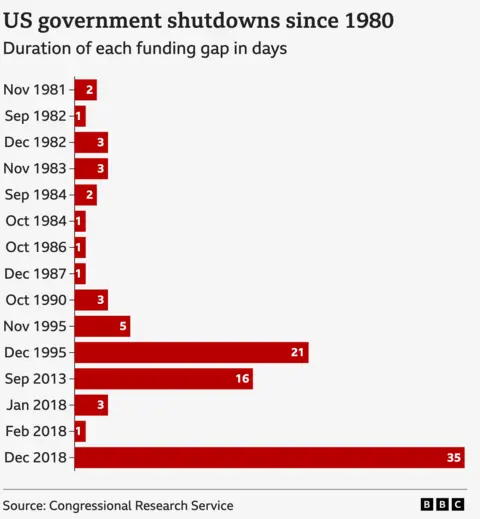
Quite common in the past 50 years.
There were three during Trump’s first term, the longest in history of 36 days, which ended in January 2019. This was caused by disagreements on the financing of a wall on the border of Mexico.
The Congressional Budget Office (CBO) estimated that it reduced economic production of around $ 11 billion, including 3 billion dollars which it has never found.
Republican colleague Ronald Reagan supervised eight closures during his presidency in the 1980s – although all were relatively brief.
The closings on budgets are almost unique to American politics.
Under the American system, the various branches of the government must achieve an agreement on spending plans before they can become law.
In most countries, budgetary votes become confidence in the government itself. But because the United States has equal and often divided government branches, this is not the case.


