Natural antimicrobial drugs found in pollen could help protect bee colonies from infection


Credit: Public Pixabay / CC0 domain
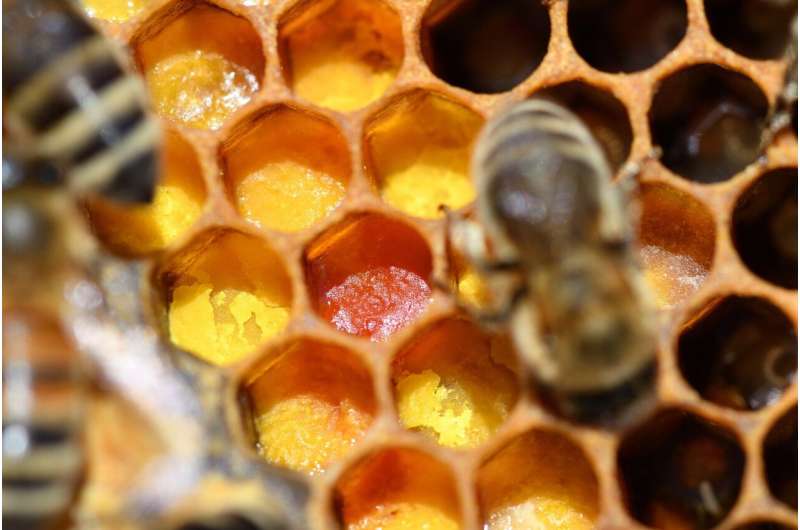
A hive of bee, with its large reserves of pollen, wax and honey, is like a treasure of the fortress: with strong defenses, but a boon for enemies that can overcome them. More than 30 bee parasites are known, covering provists, viruses, bacteria, fungi and arthropods – and this continuous number of growing. As a result, beekeepers are always looking for new ways to protect their precious hives.
A team of researchers from the United States suspected that a new new source of ecological treatments for bee diseases could hide at sight: in the pollen gathered by bees. They estimated that so-called endophytes, symbiotic bacteria and fungi living in most plant tissues should benefit when their hosts are pollinated. This could be an incentive for these microbes to develop compounds that keep the pollinators of their healthy host.
And now they have shown that their intuition was correct.
“We have found that the same beneficial bacteria occur in the stores of bee colonies and on the pollen of neighboring plants,” said Dr. Daniel May, member of the faculty of the Washington College of Maryland, American, and the corresponding author of a study in Borders in microbiology.
“We also show that these bacteria produce similar antimicrobial compounds which kill pathogens of bees and plants, making it an excellent starting point for new cultivation and emergency treatments.”
Precious pollen
May and his colleagues went to bacteria of the Actinobacteria Phylum, the source of two thirds of antibiotics currently in clinical use. Between April and June 2021, they collected pollen of 10 native plant species in the lake nature reserve at the University of Wisconsin – Madison. They also collected pollen in the stores of a nearby hive.
The authors have isolated 16 strains of plant actinobacteria and 18 stumps of pollen inside the hive. DNA bars coding and genome sequencing revealed that identical or closely linked species have occurred in the two types of samples.
The majority (72%) belonged to the genus Streptomyces, the source of many compounds used in medicine and agriculture, for example as antibiotics or as anticancer and antiparasite drugs. Some of the closest relatives of streptomyce species found here are currently being studied elsewhere as potential sources of compounds against cultivated plant disease.
The authors then led “competition tests”, where known pathogens were cultivated with isolated streptomyces here. Almost all of these elements have proven to be effective inhibitors of aspergillus niger mold, which can cause a bee disease called Stonebrood.
Individual strains have also proven to be moderately active against two bacterial pathogens of bees, larvae from Paenibacillus and Serratia Marcescens, and against three pathogens of crops, amylave, pseudomonas syringae and ralstonia solanaceum.
‘Ris back to the hive’
“We have isolated the same streptomyce bacteria of flowers, bees covered with pollen leaving flowers and hives. We conclude from our results that endophytes actinobacteria on pollen grains are picked up by pollinating bees and pushing the pollen stalls of hive, where they help defend the colony against the disease,” said May.
The authors found clear evidence in the genome of sequenced species that they were indeed endophytes, rather than living in a loose and random association with plants. They had genes coding for enzymes that allow streptomyces to colonize plant tissues, produce hormones to stimulate the growth of their host or recover metals around the roots.
The results have confirmed that a wide variety of interesting bioactive compounds remain to be discovered in endophytes, many of which could help us keep bees healthy. They also suggest that a landscape rich in plant species is beneficial for bees, because it ensures greater diversity of actinobacterial endophytes at their disposal.
“In the future, the treatment of bee diseases could be a question of simply introducing good beneficial bacteria into hives to help control specific pathogens,” concluded May.
More information:
Endophytes Streptomytes of bee beehives inhibit pathogens of plants and bees, Borders in microbiology (2025). DOI: 10.3389 / FMICB.2025.1644842
Quote: Natural antimicrobial drugs found in pollen could help protect bee colonies from infection (2025, September 30) recovered on September 30, 2025 from https://phys.org/News/2025-09-natural-astimicrobial-drugs-pollen-bee.html
This document is subject to copyright. In addition to any fair program for private or research purposes, no part can be reproduced without written authorization. The content is provided only for information purposes.