Bering Land Bridge emerged much later than we thought it did, new study finds


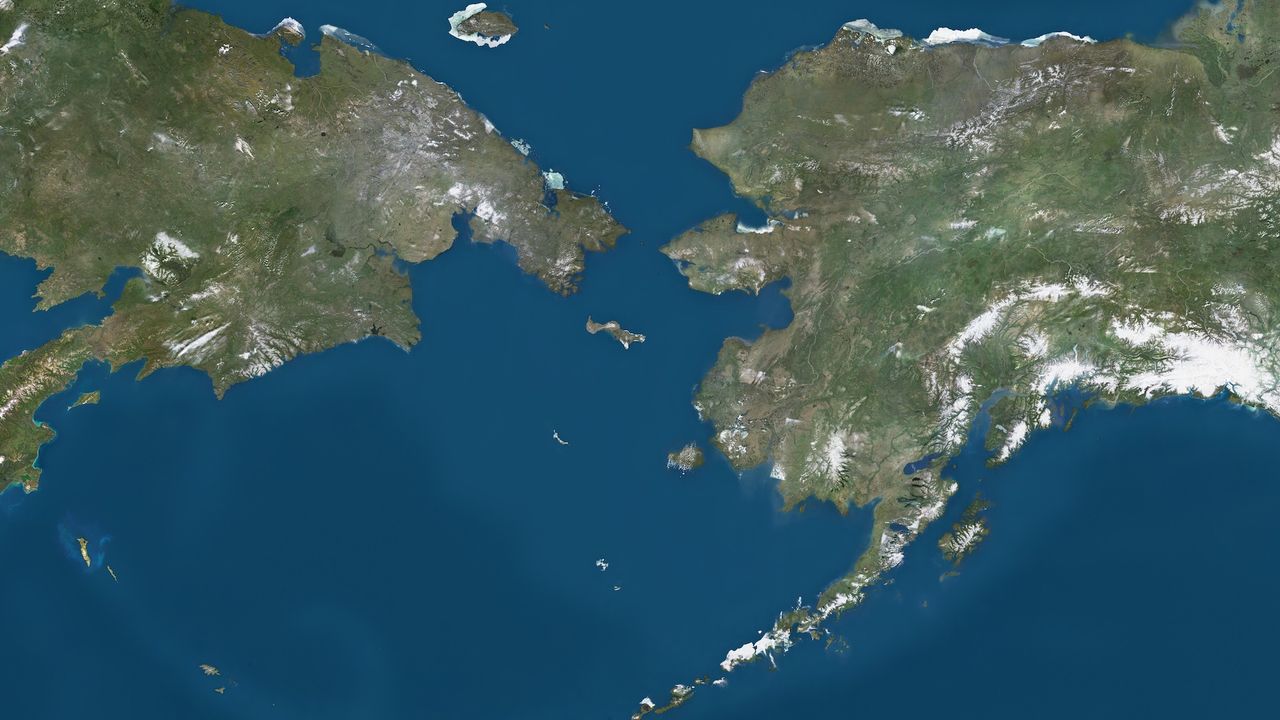
The Bering terrestrial bridge which once connected Asia and Alaska may have emerged much later during the last glacial period that was previously thought, narrowing the time window during which humans could have migrated to the Americas, suggests growing evidence.
The terrestrial bridge probably existed around 35,000 years ago, before the coldest part of the last glacial period, known as the last glacial maximum (LGM), according to a new study. This does not care with one of the oldest human activity sites dated to the Americas – the 23,000 -year -old footprints Found in White Sands National Park in New Mexico.
Ice era cycles
The earth regularly undergoes cycles in which More or less ice covers the surface of the world. At the height of each glacial period, the world level of the sea falls as the water on the planet becomes frozen in massive glacial caps. At the end of these frozen moments, as temperatures increase, the ice caps melt and sea level increases.
Previous research has revealed that the Bring Land Bridge has left animals such as mammoths And horses Activate Asia and the Americas. A better understanding of the moment when this terrestrial bridge was recently above sea level could help shed light at the time and the way humans have migrated for the first time to the new world.
Previous work suggested that the world level of the sea was around 425 feet (130 meters) lower at LGM between 26,500 and 19,000 years old, Jesse FarmerAn assistant professor at the Environment School for the University of Massachusetts Boston and co-author of a new study on the terrestrial deck, told Live Science. This had led scientists to estimate that the Bering terrestrial bridge was above sea level from 70,000, he noted.
However, there were two indications that there may be even more in the complete image of the Bring Land Bridge. First, “it is not possible to know very precisely the sea level from that time,” said Farmer. “With our existing tools, an uncertainty of around 10 to 20 meters (33 to 66 feet) would be very good.”
Second, “in this case, we are not concerned about the global average, but in particular the Bering Strait,” said Farmer. The high latitudes, like the place where the Bering Strait is located, were relatively close to the place where the glacial caps would have grown. The weight of the ice would have pressed the land, increasing the local sea level.
Indeed, in A PNAS paper 2023Farmer and his colleagues revealed that the Bering terrestrial bridge could have been flooded between 46,000 years ago and 35,700 years agoThis means that it was only exposed to level passages after after that. The data on ocean sediments suggest that the typical nutrients of the peaceful ocean began to break into the Arctic Ocean during this period, with the most likely explanation that the Bering Strait was then opened.
These results suggested that the Bering terrestrial bridge may only have reopened about 10,000 years before the height of the last glacial period, significantly later than before. A question that this helps to answer is to know which human lines – ours or our extinct parents – could have made the trip to the new world.
“The late emergence would support the idea that fully modern humans first made the trip to the North American continent”. Ian BuvitAn independent archaeologist who did not participate in this research, told Live Science. “”Neanderthal And DenisovansThe other two hominids known for having occupied parts of Siberia, were already extinguished, or on the verge of extinction, throughout Northeast Asia at that time. “”
In addition, analyzes of fossil of old animals up to around 46,000 years in Eurasia and the Americas, such as mammoths, bison, lions and bears, argued that the Bering terrestrial bridge was later opened than before – much closer to LGM. The computer models of migration of these creatures on the basis of fossil deposits suggested that the terrestrial bridge was closed during the period, the 2023 document suggested that it was.
“You have two completely different data sets telling the same story,” said Farmer.
Although the Bring Land Bridge may not have opened until later, Farmer noted that the knowledge of the sea displayed by the Ancestors of Modern Inuit suggested that it was still possible of ancient humans could have headed for boat Americas, just as ancient humans migrated through the sea towards Australia and New Guinea.
“Any human migration in the Americas before 40,000 to 35,000 years would have required a motorcycle and the possibility of navigating outdoors,” said Buvit. “As far as we know, it was only achieved by anatomically modern humans.”


