Is Life inside Enceladus? Cassini Uncovers Complex Organic Chemistry in Saturn’s Ocean Moon


For almost two decades, Enladus, a 500 -kilometer moon of Saturn, was a target greater than the extraterrestrial life hunt. In 2005, shortly after its arrival in orbit around the anchored planet, the joint mission of NASA-European Space Agency (ESA) found proof of dropping that Enladus hosted a liquid-water-water ocean under its bright white ice crust-pulverizing seawater bodies from the South Pole of the Moon. Since then, astrobiologists have been increasingly fascinated by Enlade, because other studies on ice grains in plumes have revealed multiple molecular building blocks of life which escaped from the hidden ocean.
From now on, scientists revisit Cassini data – which ended its mission in 2017 – spied on even more attractive ingredients in plumes: consequences of complex organic molecules which, on earth, are involved in chemistry associated with even greater molecules considered essential to biology. Posted Wednesday in Natural astronomyThe discovery strengthens the case of monitoring missions to seek signs of life in the enigmatic moon of Saturn and Oceanic.
The results show “there is a chemical complexity in the underground ocean of Enladus”, explains Nozair Khawaja, a planetary scientist from the Free University of Berlin in Germany, who directed the Natural astronomy study.
On the support of scientific journalism
If you appreciate this article, plan to support our award -winning journalism by subscription. By buying a subscription, you help to ensure the future of striking stories about discoveries and ideas that shape our world today.
“These new results are very intriguing and raise the question of what, exactly, is the true nature and the origin of organic matters in the ocean of Enladus,” explains Kevin Hand, planetary scientist and director of the Ocean worlds laboratory at the NASA Laboratory propulsion jet, which was not involved in the study.
In addition to his distance from the earth, Enladus has kept so much of his secrets for so long because the Orbiter Cassini was not really designed for such a deep examination of a single specific object. “The goal of the mission was to understand Saturn, its rings and moon systems,” said Khawaja. Cassini launched almost 30 years ago, transporting instruments built in the 1980s or 1990s, when the polar plumes in the ocean and southern moon subsoil were unknown. The reorientation of this vintage kit for in -depth astrobiology was difficult – not at least because of the difficulty of the resulting data.
“Cassini’s instruments were made to analyze the chemical composition of dust and ice particles, but they were not supposed to explore the underground material from Enlade,” said Khawaja. A particular problem was the relatively low resolution available from a mass spectrometer on Cassini called Cosmic Dust Analyzer (CDA), which analyzed the chemical composition of puffs of ice grain stretching its detectors each time the spaceship has crossed a plume. The plumes have proven to be so thick of material, explains Khawaja that the ADC would be overwhelmed during the Cassini Enladus flies.
The result was that countless types of particles with similar masses have blurred in ADC detections, which makes it almost impossible for scientists on Earth to discern them. They could clearly see that ordinary water molecules included the vast majority of the materials collected – 98%, says Khawaja. Assembling the nature of the remaining 2%, however, required many carefully choreographed Malenchons and adjust the operations of the ADC over several years. The Flyby who finally struck a bull eye was a maneuver on October 9, 2008, named E5. It was not the first and it was not the closest, but E5 was special because of its higher speed to the average and a fortuitous chronometry eruption of Enlade.
Cassini’s speed during E5 was almost 18 kilometers per second (km / s) – about 6 km / s faster than most other flies, which resulted in massive ADC data improvements. “The impact speed was higher, and at such high speeds, the water molecules break. They don’t survive. But other species such as organic materials remain, ”explains Khawaja. E5 was also lucky because he sent Cassini plowing a plume which had been ejected for a few minutes in advance. This assured that the material was fresh from the basement of Enlade and had not been modified or degraded by the cosmic radiation. “The curtain is mounted,” says Khawaja. But years of meticulous data analysis were still to come.
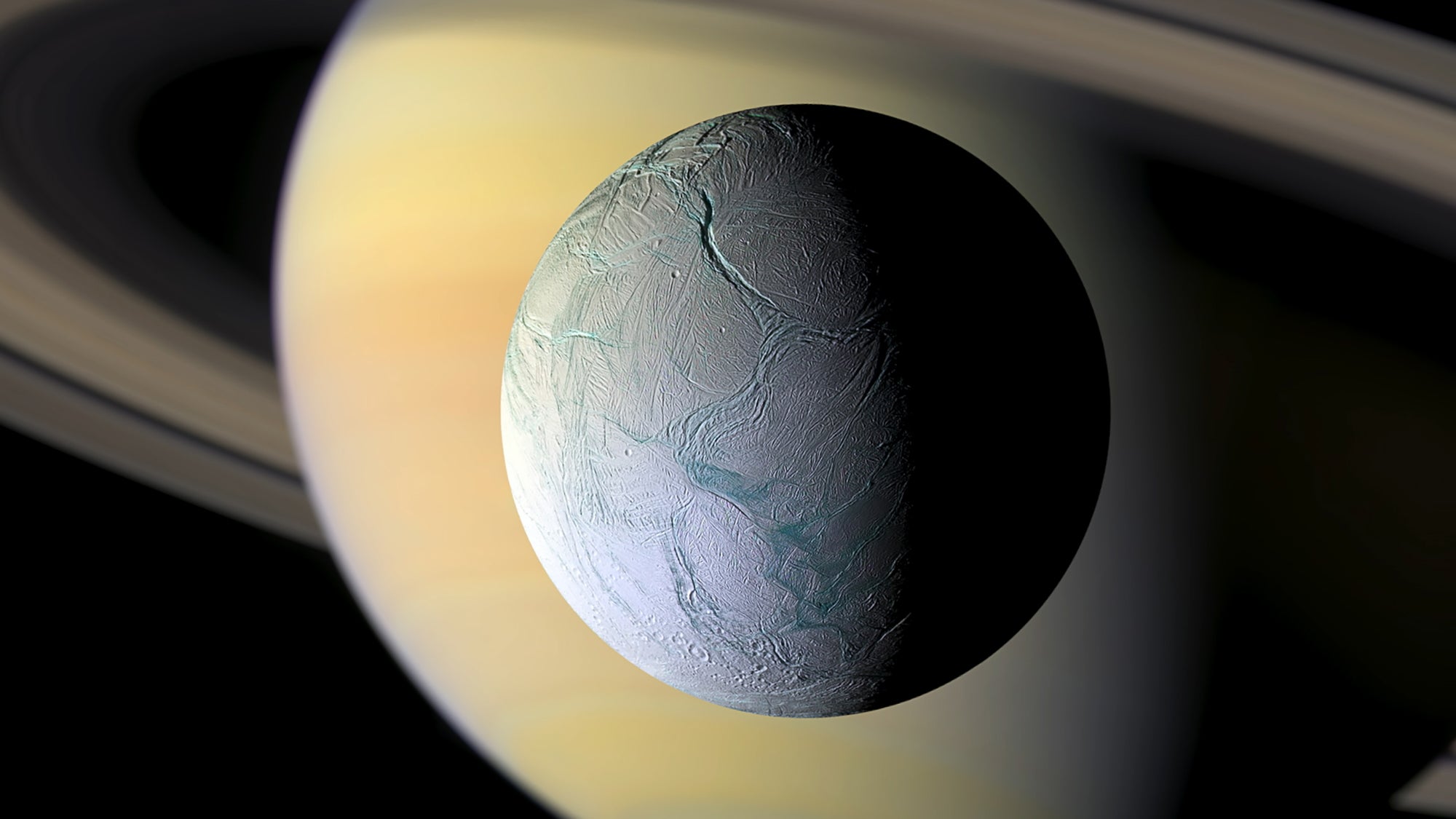
A view of Enladus in the context of Saturn.
Goddard Space Flight Center of NASA
Some of the new study co-authors published an article in 2011 analyzing the results of the E5 Flyby. “At the time, we clearly saw the characteristics of organic molecules in mass spectra produced by the ADC, but we could not nail the type of these organics. We just knew they were there,” explains Khawaja. On the basis of exhaustive experiences examining how the differences in impact speeds on the ice grain affect the data of the ADC, he and his colleagues think that they have now found most of what is in plumes, with major implications for the possibility of the moon to host life.
“I think it makes sense that it would take diligence and patience to fully understand the data of the ADC. I applaud them for taking care of their analyzes, ”explains Shannon Mackenzie, a planetary scientist at the physics laboratory applied to Johns Hopkins University, who was not involved in the study.
The work of the team revealed that the plumes contain several chemical compounds that Cassini previously detected in the ring E, an ice and dust of Enladus makes because it spits material in its orbit around Saturn. “There were complex organs in the signal which had a benzenike structure, with many compartments linked to side chains with trendy oxygen and nitrogen. They were like hydrocarbons – massive and complex, ”explains Khawaja. The analysis also found other materials which had been observed in the ring e: amines, aromatic and molecules bearing oxygen. Their presence in freshly ejected plumes, maintains Khawaja, confirms that they are all from the underground ocean of Enladus. More exciting, the study also revealed new unpublished compounds that are not seen in the plume, coming from somewhere in the Moon.
“In these fresh grains, we have molecules like esters and ethers, which transported oxygen to themselves and had double bonds,” explains Khawaja. Another new discovery was the presence of compounds where oxygen and nitrogen were probably combined. “We suspect that these are some sort of intermediaries to make further and complex, perhaps potentially biological that are biologically relevant,” he adds. The certainty is elusive because the biological products collected by the ADC have been broken into several tiny fragments; Researchers always find how to reconstruct these fragments.
“This work shows that some of the fragments are indeed derived from fairly large and complex organic compounds,” explains Hand. “But perhaps these compounds came from even larger compounds. What would we find exactly if we were plunging into the ocean below-are the compounds reported here just the tip of the astrobiological iceberg?”
Khawaja already has ideas about what monitoring missions could find by deepening with better advanced instruments. The cocktail of newly revealed compounds, he says, could feed a “network of reactions” to create pyrimidines – a class of molecules necessary for DNA formation. (And, here on earth, DNA is what leads to fish, lions, humans and life as we know it.) This network of reactions could also produce lipids – molecules that can arrange in cell membranes. Even thus, Khawaja notes: “We have no less idea about real biological relevance.”
For the moment, in the absence of a monitoring mission at or on the way to Enceladus, the team develops an advanced computer model from the entire underground system of Enladus in the hope of pinching the sources and probable interactions of the rich assortment of chemical compounds from the Moon. There is also room for discovery in Cassini’s data. “There are still certain spectral types that I see and that I do not understand,” explains Khawaja.
In the end, the majority of the hope of definitive responses on life on short -term Enlaze lies in a mission always on the ESA drawing board. Such a mission would most likely include an orbiter, although much more advanced than Cassini, with a Lander as a possible addition. “In a mission like this, a Lander and an orbiter should complement each other,” says Khawaja.
But not all of them are sold on the idea of Lander. “The results of this study corroborate the mission concepts which do not even need to land – we could simply fly continuously through the plumes and collect fresh materials,” explains Hand. “Why risk landing when Enladus distributes free samples?”
Regardless of these logistical debates, what is clear is that Enceladus remains one of the most attractive destinations to look for extraterrestrial life.
“Water, energy and good chemicals – all three keys to habitability are there,” explains Khawaja. Even if future studies fail to find life, he maintains, the implications would be enormous. “If it is not There, despite these three keys, it would mean that life needs something more. »»


