An absurdist play prepares New Yorkers for climate disasters


Edgemere Farm was born from a climate disaster and community resilience. In the wake of Hurricane Sandy, volunteers have transformed an abandoned plot, damaged by floods into a lush organic garden.
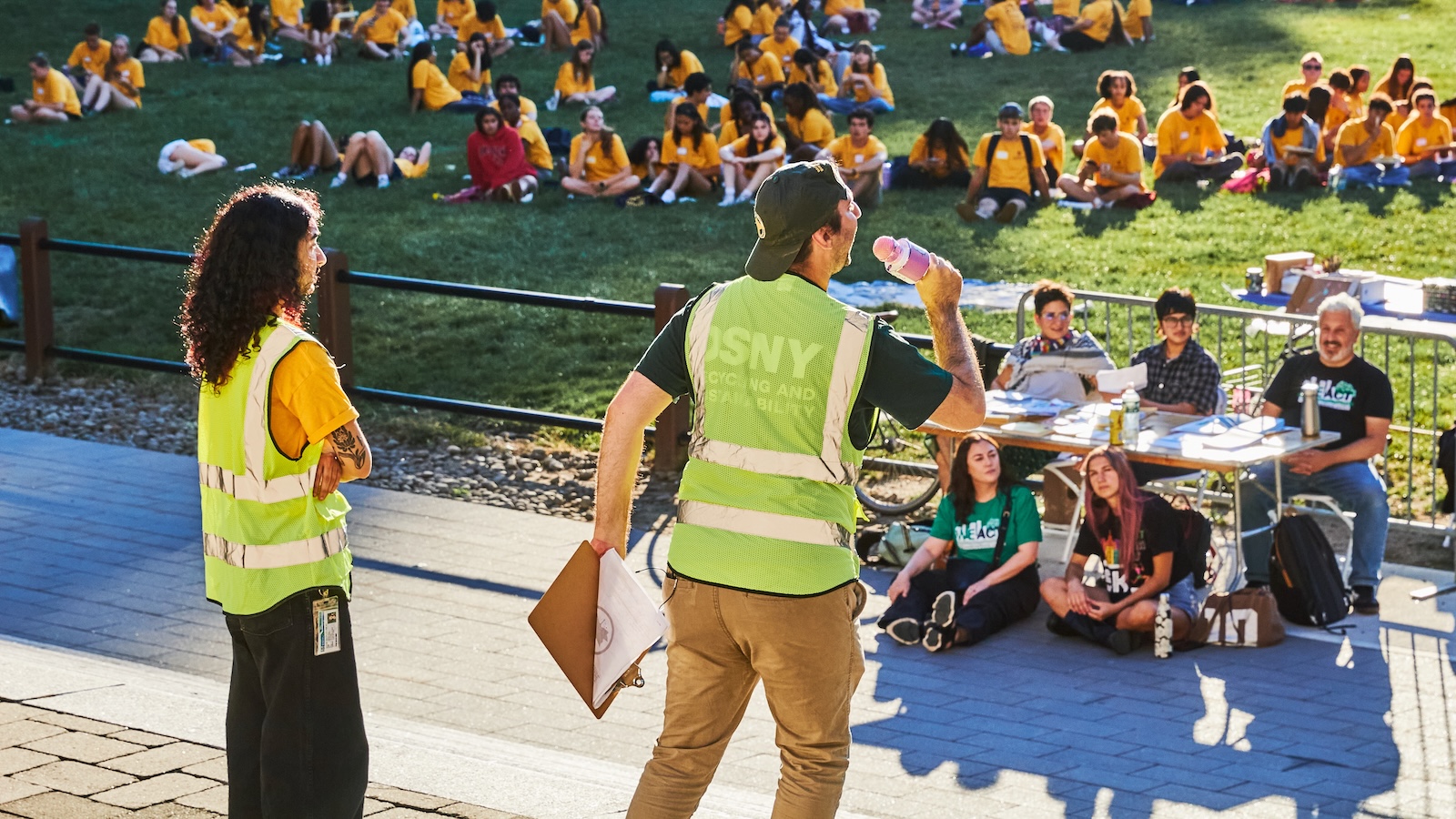
One day in mid-September, the half-acting site in Far Rockaway, New York, suffered another youthful cure: for an hour, it became a cellar store. Two hundred people gathered to look at a performance of Flood sensor auntAn hour -long play written by a local urban planner and Sabina Sethi Unni theater artist. It plays as a humanized flood sensor – a tool that detects high water levels and provides this data to a publicly accessible card.
Sethi Unni’s anthropomorphized device comes up against his chai-shop colleagues and dreams of becoming a movie star. A pair of health inspectors in the city of Lovelorn, a member of the City Council for the Research of Attention and a Rain God who directs a cult of an apartment in a cramped room, completes the cast.
Many people associate the urban floods of cities like New Orleans and Miami. But it also becomes more frequent in the north too. Thirty-four of the 43 people killed when Hurricane Sandy struck in New York in 2012 in 2012 drowned in floods on storm lands, many of which in low neighborhoods. The rain that followed the walking of the Hurricane Ida on the coast in 2021 killed 13 people, including 11 in apartments in the basement. Even a strong downpour like the one that New York experienced in July can flood houses and threaten lives.
Flood sensor aunt strives to educate people on the threat by combining absurd comedy with practical advice to survive to come to come. It celebrates the power of the community to overcome crises, while offering public tangible tools such as free flooding alarms and headlights provided in collaboration with the city’s emergency management office and local non -profit organizations. The room explains how to access 311 and make a disaster plan – through an extravagance of SEO of synths, brilliantly, carried out in parks, warehouses and, at least one occasion, a boat.
Sethi Unni talked about his work at Climate Week in September and recently played his play in Boston. She hopes to approach other dramatic subjects, such as community council meetings – and wants to see more artists approach the climate crisis with humor and hope.
Grist has caught up with Sethi Unni to discuss public art as an infrastructure for preparation for disasters, Facebook pages and talkative families as artistic inspiration, and exactly what a flood sensor is.
This conversation has been modified for duration and clarity.
Q: How did you start doing climate change theater?
A: Hurricane Ida has been a real revelation in terms of shortcomings that we have to reach the South Asian and Indo-Caribarous communities. People live in apartments in the basement, which are largely illegal, so people are afraid of reaching out to the city. They cannot access tenants’ protections. They are just trapped in this net.
People talk about floods as something that happens when you are on the coast. But a large part of the districts most affected by the IDA were the interior districts of the Queens with high underground water tables. In the communities in which we play, like the Queens of the South, the floods are so real and the deaths of the basement are real. And the city historically, even if they really try to adopt all these creative approaches, has not done an excellent job to achieve communities that do not speak English, communities of color, communities that do not place faith and confidence in government.
I was in school planning during Hurricane Ida. Many of my lessons were entirely on how we can impose the city. The answers were very top to bottom – like: “We have to build a maritime wall.” Sometimes it’s the right call, but sometimes more mild care infrastructure is what we need. What if more people knew what floods are? What if we change our policy around apartments in the basement? I considered it a way to reach the communities where they are, with messengers of trust [and] cultural references.
In American conscience, disasters, in particular floods and hurricanes, are considered apolitical. But obviously, where people live in cities are caused by red and segregation. In New York, social housing is often found in low areas. And many American and island Immigrants from the Pacific live in these apartments in the subsoil.
Q: What inspired this part – and what is exactly a flood sensor?
A: I am one of this Facebook page called Community Flood Watch. He is especially a guy from Howard Beach publishing reports from Noaa on floods at Howard Beach. I am obsessed with floods. Normally people report floods thanks to 311 calls. But you should know what 311 is, you must more or less speak English and you must have time to call. SO [flood sensors] are a good alternative. They produce another form of data that can, hopefully, be used to advocate it.
A flood sensor is super cute. It is a device that is put on high surfaces which calculates the distance between the height where it is placed and the ground. When it rains, the distance between it and the ground changes due to the water level. But flood sensors also look like surveillance cameras. We are therefore trying to publicize this type of Lidar Bancal technology.
I also think that it is a very good physical way to talk about floods, because the floods are very ephemeral, and a flood sensor is something that exists here and now.
Q: He is still there between the floods.
A: Exactly. It exists when it rains, it exists when the weather is nice. Interior floods are not something that you talk about a lot unless you are used to your block floods. But this is a very serious problem.
Q: So what role can art play in people’s education on these ephemeral but also dangerous things?
A: I think it’s a healthy part of the ecosystem. I think people react to art – people react to humor and entertainment and freshness and joy in their neighborhoods. It’s a way to captivate people. People need repeated information in different ways, whether through songs and dances or puppets of hands and jazz socks. Sometimes a brochure of a page translated into two languages is not the best way for people to receive information, but a song on the Go-Sacs played on the Synth East.
Gracieuse of the City of New York emergency management department
Q: I was struck by the quantity of play regarding hyperlocal policy. We see people negotiating the bureaucracy in order to make a life, to build a community, to survive – the owners of Chai Shop fight a bureaucrate of intermediate level which wants to close. So, I ask now: when we sail in the climate crisis, should we have sympathy for bureaucrats?
A: We should and should not. The show is partly a suggestion to bureaucrats that we can use creative strategies to inform communities of their risk. It should not only be a thing from top to bottom or a boring community visit. [Flood Sensor Aunty] is a little fun of bureaucrats who are permit sticks, and can cause a lot of trouble by acting as urban planning cops.
But it is also a love letter to our bureaucrats who are trying to make changes and repel this great carefree system. We actually have a bureaucrat, Jill Cornell, to whom I contacted for technical assistance. Jill makes community engagement with the city’s emergency management office. And now she has a monologue in the show, and she sings and dances, and she may be a better dancer than all of us.
Q: At one point, your character Flood sensor aunt Said “Gossip saves lives”. Is it true?
A: Ragots totally save lives. Aunt gossip saves lives. In a real sense, people who do domestic work in households do a lot of work in the event of a disaster. This brilliant civil engineer named Sangamithra Iyer, who gave a talkback during one of our performances last spring, explained how care is infrastructure, and women’s work in households is climate infrastructure. The gossip can mean knowing which neighbors I am supposed to check – this neighbor always takes a walk at this hour of the day, and I have not seen them; These neighbors are old, I should probably call them. This kind of work of bodies and bodies occupied is the way we save lives.
I’m talking about my real neighbors in the show. We share the mint of our gardens, feed the same stray cats, we registered after the storms.
Q: It is difficult to try to draw attention to a busy public park. How to get your message across despite all the noise and distraction that being in public in a big city implies?
A: It is usually just the most daring and most brilliant thing. When we created our whole, we said to ourselves: “What color contrasts best against green and blue?” But we want to let the place shine – as, if we are in Edgemere, we are in Edgemere. The beautiful tomato stems are also part of the whole.
There is this genre within public art called “useful art”. Even if you don’t really listen to what we say, we give you a Go-Sac, we give you an alarm of the floods, we give you a front lamp, we give you all these resources to protect you. Many people think that the pieces are very good opportunities to change hearts and minds, but sometimes people just need to know what’s going on. Perhaps they should think of racial social risk policy, but maybe they also need an alarm of floods for their basement.
There is a general conviction of the climate policy that we protect ourselves against floods by the projects of the body of army engineers, as a maritime wall. But what is happening if, too, the things that ensure securely are to know our neighbors, to love our aunts, to verify the elderly in our communities? These soft forms of infrastructure also deserve funding and attention, and must also be considered as real forms of infrastructure.


