U.S. consumers’ faith in government’s ability to keep food safe hits new low


Consumer confidence in food security in the United States is at a record level, according to a Gallup survey.
The survey revealed that only 12% of American adults say they have a “big” faith while 41% say that they have a “good amount of confidence in the federal government to ensure the security of food supply. This figure has dropped sharply since 2019, when 68% were in these two combined categories.
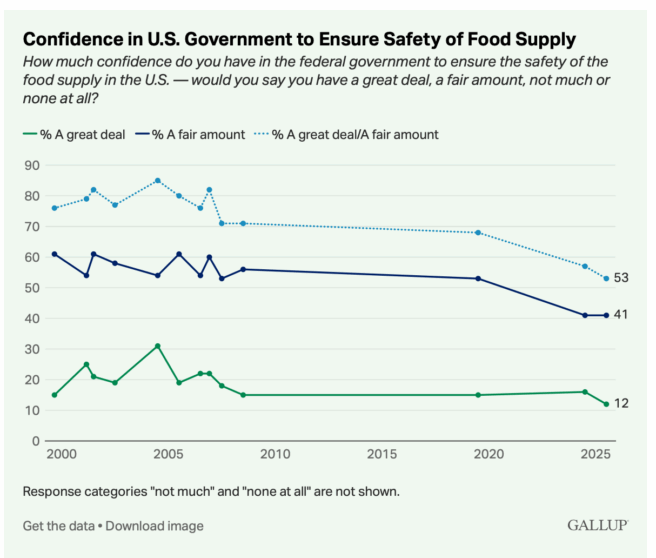
About eight out of 10 Americans expressed at least a “fair” quantity of confidence in the government to ensure food security in measures from 1999 to 2006. Confidence fell in the middle of a huge Salmonella epidemic in 2007, about seven out of 10 American adults, and remained at this level until 2019, after which he fell further in 2024.
Fewer democrats are now confident in the federal government to ensure food security, compared to 74% in 2024 to 48% now. Meanwhile, the confidence of the Republicans in the government to ensure that food supply security has increased by 12 points to 62%.
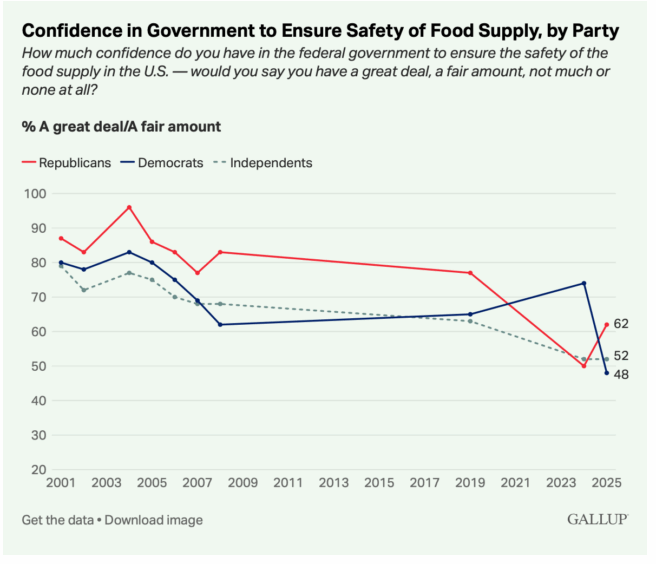
According to Gallup, these changes are probably in response to changes in the party of the President in office, of the Democrat Joe Biden to the Republican Donald Trump. Democratic confidence can also be lower due to the Trump administration’s proposals to considerably reduce federal spending on domestic programs, including Food and Drug Administration. Confidence remains unchanged from 52%political self -employed.
“In particular, the model is reversed with regard to the perceptions of the food security of the grocery store. While 67% of Republicans say that they are at least somewhat confident in the safety of food sold in grocery stores, this figure reaches 70% among the independents and 80% among the Democrats”, according to the analysis of the surveys.
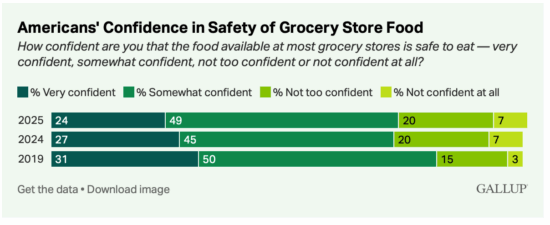
A distinct survey question has asked consumers about food safety in grocery stores.
The 73% of American adults who are “very” (24%) or “somewhat” confident (49%) that the food sold in grocery stores are sure to eat with the 72% found in 2024, but down nine percentage points, compared to 81% in 2019.
Most changes since 2019 are seen among those who are very confident, which has slipped seven points to 24%.
According to the survey, around six in 10 consumers pay attention to food warnings. About a quarter allows “a lot” attention to warnings and 35% of “good amount” of attention. Less than a quarter said they pay “a little” attention and that 18% pay “not too much” or “none at all”.
At 68%, women are much more likely than men, 51%, who say they pay a “good amount” of attention to food warnings. The attention also varies according to education, with 68% of the third cycle, 63% of university graduates and 64% of those who paid particular attention, against only 50% of adults without college studies paying attention to warnings.
Consumers with an annual household income of $ 50,000 to $ 100,000, 65% pay attention to food warnings, compared to those which earn $ 100,000 or 61%. Those who earn less than $ 50,000 pay the least attention to warnings with only 52% saying that the warnings are important.
(To register for a free subscription to Food Safety News, click here)


