Polling provides clues for why neither side is budging in the shutdown standoff: From the Politics Desk


Welcome to the online version of From the Politics Desk, a newsletter that brings you the NBC News Politics team’s latest reporting and analysis from the White House, Capitol Hill and the campaign trail.
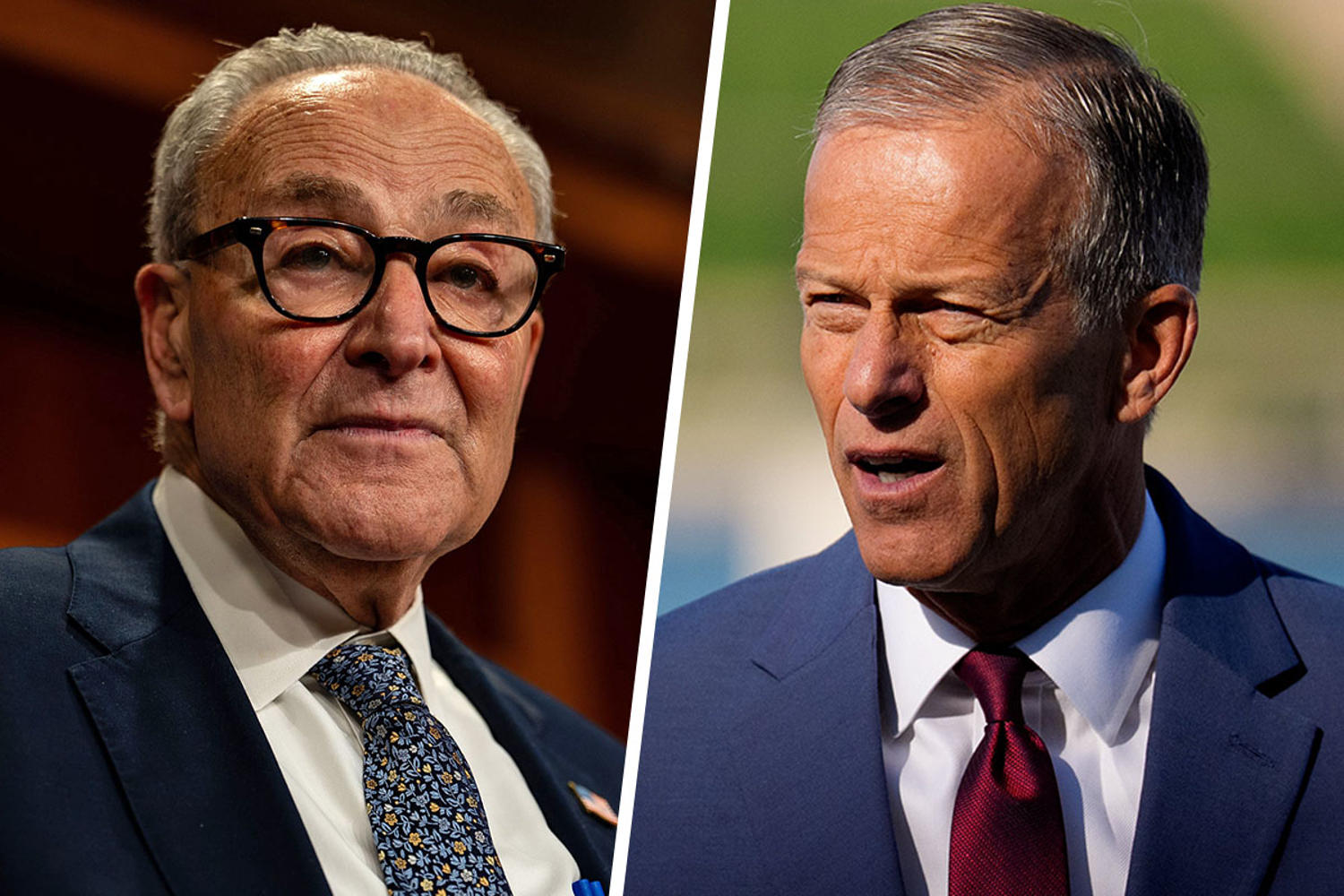
In today’s edition, Bridget Bowman zeroes in on an key dynamic in government shutdown polling that helps explain why both sides remain at an impasse. Plus, Andrea Mitchell examines why there’s finally a glimmer of hope for the Gaza peace talks.
Sign up to receive this newsletter in your inbox every weekday here.
— Adam Wollner
Polling provides clues for why neither side is budging in the shutdown standoff
By Bridget Bowman
It’s Day 8 of the government shutdown, and there’s still no end in sight. The Senate voted today for the sixth time on a House-passed stopgap funding measure and a Democratic counterproposal, both of which failed — again. No senator has budged and the House is not in session.
Recent polling helps explain why neither side is willing to back down at this point.
Some surveys have shown President Donald Trump and Republicans shouldering more of the blame for the shutdown, which Democrats have been quick to highlight as they remain steadfast in their demands to extend Obamacare tax credits as part of any negotiations to reopen the government.
But those polls also show that a sizable chunk of Americans say both parties are equally to blame for the impasse.
When the shares of those who blame Democrats and those who blame both parties are combined, that amounts to a majority of Americans placing some blame on Democrats. Using that same metric, an even larger majority says Republicans are responsible for the shutdown.
Take the three most recent polls that asked which party is most responsible for the shutdown:
- An Economist/YouGov poll, conducted on Oct. 4-6, found that 64% of Americans say that Republicans in Congress or both parties are equally to blame, and a combined 53% say Democrats and both parties are to blame.
- A CBS News/YouGov poll, conducted on Oct. 1-3, found that 70% of Americans say Republicans or both parties are responsible, while 61% say Democrats or both parties are to blame.
- An NPR/PBS NewsHour/Marist poll, conducted on Sept. 22-26, before the shutdown began, found that 69% say Republicans or both parties are to blame, while 58% say the same of Democrats or both parties.
- So, even though the GOP is getting more of the blame for the shutdown, they may be taking some solace in data that shows majorities of Americans are also placing at least some blame on Democrats, too. And that could help explain why Republicans aren’t necessarily feeling the pressure to cave to Democratic demands — at least not yet.
Vibe check: Democratic Sens. Ruben Gallego and Mark Kelly of Arizona publicly sparred with House Speaker Mike Johnson, R-La., and Rep. Mike Lawler, R-N.Y., over the delay in swearing in a Democrat who won a special election in Arizona last month. Read more →
Gaza, two years later
Analysis by Andrea Mitchell
Two years after the massacre that seared the heart and soul of Israel’s people, the surviving hostages may finally be on the verge of coming home, along with the remains of those who did not survive.
Sixty-five thousand Gazans have been killed by the war that followed, including thousands of children, according to the Hamas-run health ministry, which does not distinguish between civilian and military deaths. Thousands more are injured; their homes, schools and hospitals reduced to rubble.
After repeated diplomatic failures, there is finally a glimmer of hope for a solution. Secretary of State Marco Rubio said that “good progress” has been made with the peace talks. And President Donald Trump said he may go to the Middle East in the coming days if a deal comes together.
Both sides are exhausted, with the Hamas leadership assassinated and Israel’s generals pleading with the politicians to declare victory and bring the soldiers home. For the first time, Trump is pressuring Israel’s Prime Minister Benjamin Netanyahu to do exactly that. But the political hatred and security concerns embedded in 80 years of bloodshed cannot be resolved overnight.
The immediate challenge is setting the terms for Hamas to release the hostages, and Israel to agree on which Palestinian prisoners will be freed in return. In the past, Hamas has demanded the freedom of high-value prisoners like jailed Palestinian leader Marwan Barghouti, whose release has always been an Israeli red line. Trump’s team is smartly focusing on freeing all the hostages first, alive and dead, denying Hamas leverage for the knottier bargaining to come: deciding how much territory Israel will retain as a buffer, when will Hamas disarm, and who will secure and govern Gaza in the future.
What has changed now is Trump’s level of frustration with Israeli Prime Minister Benjamin Netanyahu, fueled in large part by the country’s unilateral attack on Qatar, the key intermediary in ceasefire negotiations with Hamas. Netanyahu’s own spy chief, Mossad leader David Barnea, strongly opposed the targeted assassination, according to multiple reports confirmed by NBC News. And the strike missed its intended target, only wounding Hamas negotiator Khalil al-Hayya, but killing his son.
It left al-Hayya defiant, potentially complicating the talks now underway. And it infuriated the other Arab leaders whose support for the Trump peace plan is critical to its success. As a result, Trump insisted that Netanyahu publicly apologize to Qatar before the negotiations could even proceed. For the first time, he also pressured the Israeli leader to halt his bombing to create a window for diplomacy.
After all the pain and suffering on both sides during the last two years — and the decades of misery that preceded Oct. 7 — is it even possible to build a foundation for a new, peaceful Gaza? Trump’s grand vision goes even further, imagining an entire region transformed by Israeli’s superior intelligence operations against Hamas, Hezbollah and their patrons in Iran, and the lure of an Israeli alliance with the economic powerhouses of the Arab Persian Gulf states.
The hope is that a region exhausted by war can finally experience the benefits of peace and economic security for Israelis and Palestinians alike.
🗞️ Today’s other top stories
- 🚨 Exclusive: White House officials have held increasingly serious discussions in recent days about Trump invoking the Insurrection Act, a rarely used 19th-century law that gives the president the power to deploy active-duty troops inside the U.S. for law enforcement purposes, five people with knowledge of the talks told NBC News. Read more →
- 🗣️ Ramped-up rhetoric: Trump said in a Truth Social post that Chicago Mayor Brandon Johnson and Illinois Gov. JB Pritzker “should be in jail” as 500 National Guard members arrived in the Chicago area.
- ⚖️ Comey update: Former FBI Director James Comey entered a not guilty plea during an appearance in a federal court in Virginia for his arraignment on charges brought after a public campaign by Trump to prosecute him. Read more →
- ➡️ The purge: The FBI has fired at least three special agents who worked in connection with former special counsel Jack Smith’s probe of Trump. Read more →
- 📈 Market watch: Despite a government shutdown, weakening labor market and stubborn inflation, the stock market has thrived this year. Read more →
- 🔴 GOP split: Rep. Marjorie Taylor Greene, R-Ga., once a loyal foot soldier for Trump, has been increasingly bucking him and the party on issues ranging from Obamacare subsidies to the Jeffrey Epstein files. Read more →
- 🔵 Democratic divide: State Rep. Justin Pearson, one of the “Tennessee Three” who drew national attention in 2023 for protesting gun violence on the state House floor, launched a Democratic primary challenge against longtime Rep. Steve Cohen. Read more →
- 🗳️ About last night: Trump-backed Matt Van Epps won the special GOP primary in Tennessee’s 7th District and will face off against Democratic state Rep. Aftyn Behn in the Dec. 2 general election. Read more →
- 🌴 Trading peaches for palm trees: The Senate confirmed Herschel Walker as U.S. ambassador to the Bahamas, making the former Georgia Senate candidate the first person to hold the post in nearly 15 years. Read more →
- Follow live politics updates →
That’s all From the Politics Desk for now. Today’s newsletter was compiled by Adam Wollner.
If you have feedback — likes or dislikes — email us at politicsnewsletter@nbcuni.com
And if you’re a fan, please share with everyone and anyone. They can sign up here.