Rainbow-on-a-chip’ could help keep AI energy demands in check — and it was created by accident


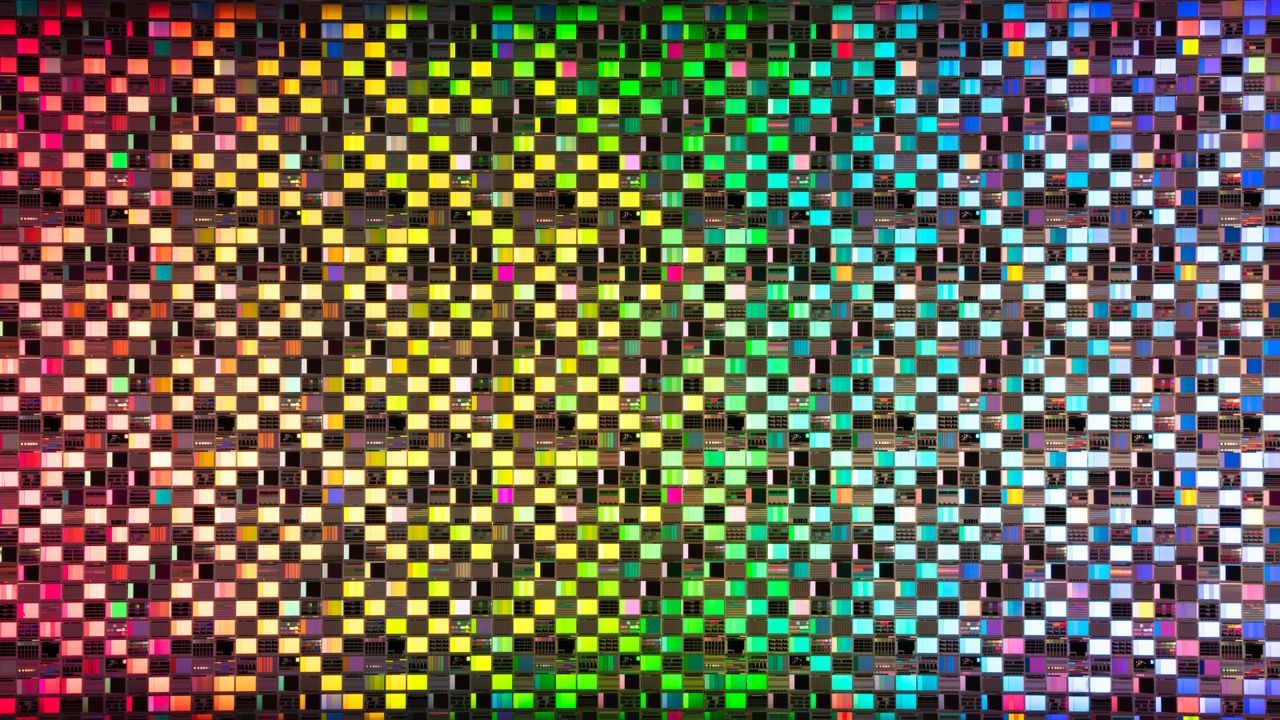
A laboratory accident led engineers to build a chip that emits a rainbow of powerful laser beams. It could help data centers better manage growing volumes of data. artificial intelligence (AI).
The new photonics chip contains an industrial-grade laser source combined with a precisely designed optical circuit that shapes and stabilizes light before splitting it into multiple evenly spaced colors.
Create this rainbow This effect – called frequency combing – typically requires large, expensive lasers and amplifiers. However, researchers stumbled upon a way to pack this powerful photonics technology into a single, small chip as they sought to improve lidar (light detection and ranging) technology.
Uses of lidar laser pulses to measure distance based on the time it takes them to travel to an object and bounce back. In trying to produce more powerful lasers that could capture detailed data from greater distances, the team noticed that the chip split light into multiple colors.
What is a frequency comb?
A frequency comb is a type of laser light consisting of multiple colors or frequencies evenly spaced across the entire surface. optical spectrum. When plotted on a spectrogram, these frequencies appear as spikes resembling the teeth of a comb.
The top of each “tooth” represents a stable, precisely defined wavelength that can carry information independently of the others. Because the wavelengths are both frequency and phase locked, meaning their peaks remain perfectly aligned, they do not interfere with each other. This allows multiple data streams to flow in parallel through a single optical channel, such as fiber optic cable.
After stumbling upon this effect, scientists then developed a way to reproduce it intentionally and in a controllable way. They also integrated the technology into a silicon chip where light travels through waveguides a few micrometers wide; one micrometer (1 µm) is equivalent to one thousandth of a millimeter (0.0001 cm), or about one hundredth the width of a human hair.
The team published their results on October 7 in the journal Natural photonics. This advancement is particularly important now that AI is increasingly placing strain on data center infrastructure resourcesthe researchers said.
“Data centers have created a huge demand for powerful and efficient light sources containing many wavelengths,” study co-author Andrés Gil-Molinaprincipal engineer at Xscape Photonics and former researcher at Columbia Engineering, said in a statement statement.
“The technology we developed takes a very powerful laser and turns it into dozens of clean, high-power channels on a chip. This means you can replace racks of individual lasers with a single compact device, reducing costs, saving space and opening the door to much faster, more energy-efficient systems.
Rainbow on chip
To create a frequency comb on a chip, researchers needed to find a high-power laser that could be integrated into a compact photonic circuit. They ultimately settled on a multi-mode laser diode, which is widely used in medical devices and laser cutting tools.
Multi-mode laser diodes can produce powerful beams of laser light, but the beam is “disordered,” meaning researchers had to figure out how to fine-tune and stabilize the light to make it usable, the researchers said in the study.
They achieved this by using a technique called self-injection locking, which involves integrating resonators into the chip that reflect a small portion of the light back into the laser. This filters and stabilizes the light, which gives a beam that is both powerful and very stable.
Once stabilized, the chip divides the laser beam into a multi-colored frequency comb. The result is a small but efficient photonic device that combines the power of an industrial laser with the precision needed for data transmission and sensing applications, the scientists added.
Beyond data centers, the new chip could enable the creation of portable spectrometers, ultra-precise optical clocks, compact quantum devices and even advanced lidar systems.
“It’s about integrating laboratory-grade light sources into real-world devices,” Gil-Molina said. “If you can make them powerful, efficient and small enough, you can install them almost anywhere.”


