Earth’s Falling Reflectivity Means the Planet Is Getting Darker—And Hotter


October 22, 2025
3 min reading
Earth is getting darker, which could accelerate global warming
The planet’s brightness is decreasing – precipitation, circulation and temperature are changing
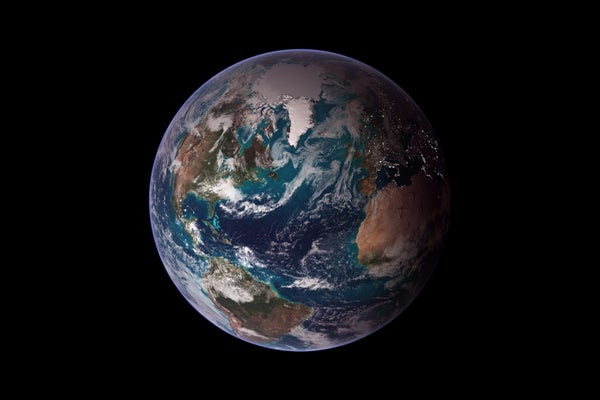
NASA/Goddard Space Flight Center/Reto Stöckli
The view of Earth from space is famous: bright blue ocean, swirls of white clouds, touches of terrestrial green. The brightness in this image results from the sun’s rays shining on the planet, where they are either reflected or absorbed by materials on Earth’s surface and in our atmosphere. But a new study looking at Earth’s overall brightness reveals that something strange is happening in this familiar image.
Scientists measure the planet’s brightness by taking into account how much light reaches Earth and how much is reflected back to space (as measured by orbiting satellites). This reflectivity is known as albedo, and Earth’s overall albedo has been declining for decades. But according to a new study recently published in Proceedings of the National Academy of Sciences USAthis change is not uniform: the northern hemisphere becomes even darker than its southern counterpart. This loss of brightness could lead to increased warming in the Northern Hemisphere, throwing Earth’s weather systems out of balance.
Norman Loeb, a senior radiation science technologist at NASA and lead author of the study, and colleagues studied changes in Earth’s brightness using data from three different satellites measuring incoming sunlight versus what’s called outgoing longwave radiation, or the amount of radiation reflected back to space, over a 24-year period. They combined this data with data from high-resolution spectral imagers, snow and cloud maps, and computer climate models. What they discovered was surprising.
On supporting science journalism
If you enjoy this article, please consider supporting our award-winning journalism by subscription. By purchasing a subscription, you are helping to ensure the future of impactful stories about the discoveries and ideas shaping our world today.
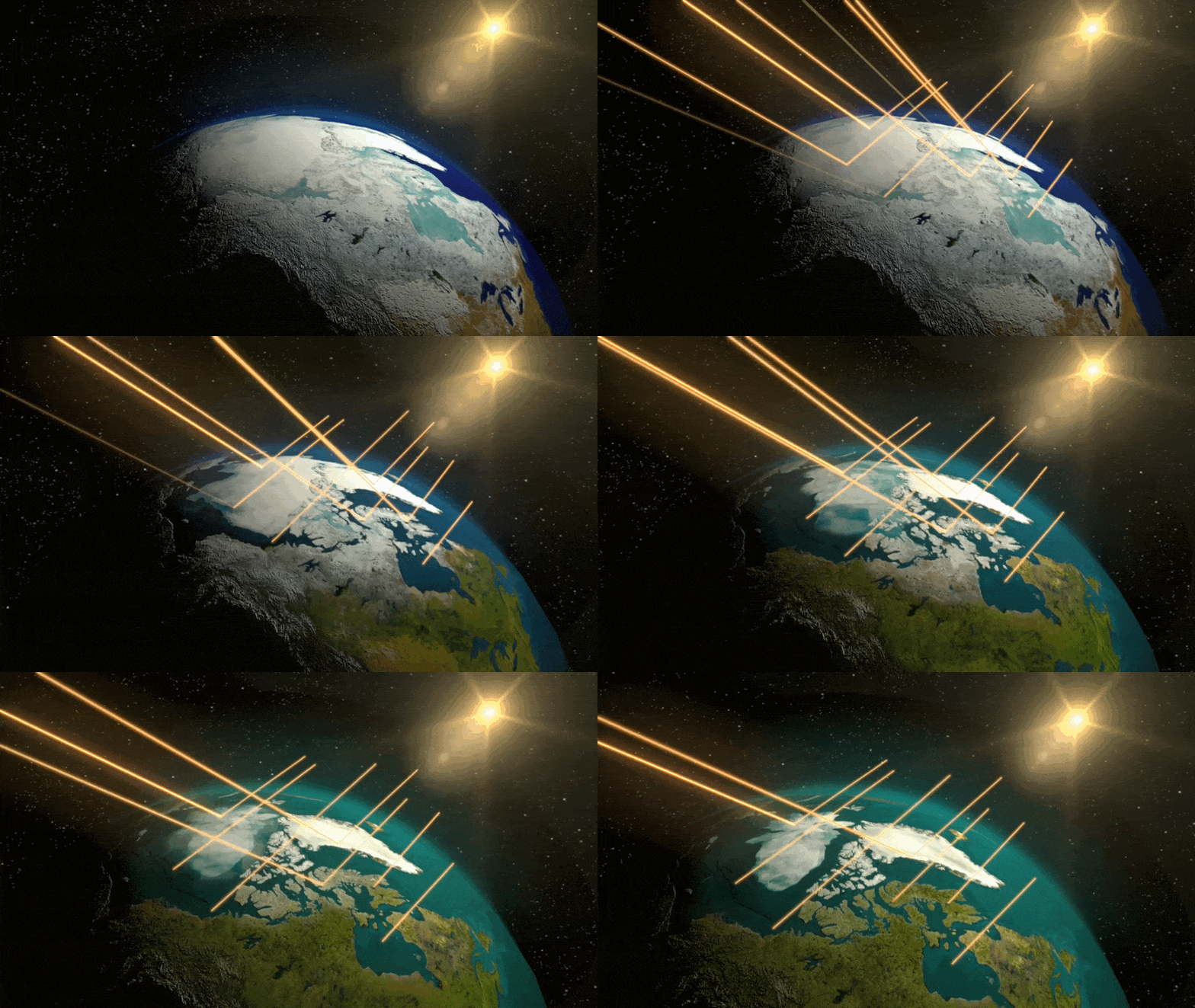
This is a conceptual animation showing how polar ice reflects sunlight. As this ice begins to melt, less sunlight is reflected back into space. Instead, it is absorbed by oceans and land, increasing global temperatures and fueling even greater melting.
NASA/Goddard Space Flight Center Concept Image Lab
Historically, scientists believed that a fundamental property of Earth was that the brightness of the northern and southern hemispheres was symmetrical. The two hemispheres have different albedos: the Northern Hemisphere has more land, snow and ice, and is therefore more reflective. “One has a lot of continents; one has more oceans. One has Antarctica; one has the Arctic Ocean,” says Brian Soden, a professor of atmospheric sciences at the University of Miami. But despite these differences, they appear to reflect the same amount of sunlight from space.
This balance was thought to be due to cloud cover. Formed by both water vapor and aerosols, clouds can, at different altitudes, reflect or absorb solar rays. But Loeb’s team discovered a break in hemispherical symmetry, which suggests there is a limit to the role clouds play in maintaining it. Researchers have hypotheses about why they observed differences between the hemispheres: As the Earth warms, the air retains more water vapor, which absorbs solar radiation. The Northern Hemisphere is experiencing increased warming, which could explain some degree of darkening.
Part of the difference could also come from changes in aerosols, small particles in the atmosphere ranging from pollutants to dust or sea salt, which reflect solar radiation. Due to tighter controls on aerosols in the Northern Hemisphere since the early 2000s in countries like the United States and China, coupled with melting ice and snow, this part of the globe reflects less sunlight. In the Southern Hemisphere, on the other hand, a major volcanic eruption and the Australian bushfires have both contributed to the formation of aerosols in the atmosphere in recent years, increasing reflectivity.
When the balance of reflectivity changes, “the entire climate circulation will shift to transport energy from the hemisphere that has a surplus to the one that has a deficit,” Soden says. This could influence ocean currents and the location of precipitation bands, which could impact water availability.
And of course, if solar radiation increases, the Northern Hemisphere will continue to warm. This could mean more ice and snow will melt, further fueling the warming and darkening of the planet. Although he can’t confirm the correlation, Loeb says tropical precipitation in the Northern Hemisphere has increased compared to the South. “It’s still early,” he said, “I’ll be very interested to see what other implications might come from this.”
It’s time to defend science
If you enjoyed this article, I would like to ask for your support. Scientific American has been defending science and industry for 180 years, and we are currently experiencing perhaps the most critical moment in these two centuries of history.
I was a Scientific American subscriber since the age of 12, and it helped shape the way I see the world. SciAm always educates and delights me, and inspires a sense of respect for our vast and magnificent universe. I hope this is the case for you too.
If you subscribe to Scientific Americanyou help ensure our coverage centers on meaningful research and discoveries; that we have the resources to account for decisions that threaten laboratories across the United States; and that we support budding and working scientists at a time when the value of science itself too often goes unrecognized.
In exchange, you receive essential information, captivating podcasts, brilliant infographics, newsletters not to be missed, unmissable videos, stimulating games and the best writings and reports from the scientific world. You can even offer a subscription to someone.
There has never been a more important time for us to stand up and show why science matters. I hope you will support us in this mission.


