Cosmic ‘Knots’ May Have Briefly Dominated Newborn Universe, Physicists Say


Knots appear today in various areas of mathematics and physics. A team of physicists from Japan and Germany suggests that in the early Universe, a “knot-dominated era” might have existed, where knots were a dominant component of the Universe, and this scenario can be tested by observations of gravitational waves; Furthermore, they propose that the end of this era involves the collapse of nodes via quantum tunneling, leading to the generation of matter-antimatter asymmetry in the Universe.
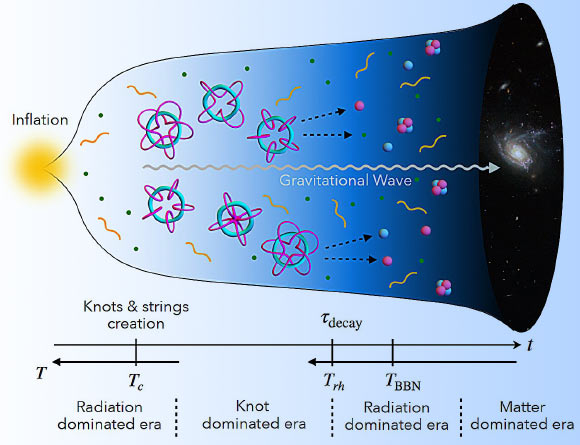
The model proposed by Eto and others. suggests a brief epoch dominated by nodes, where these tangled energy fields trumped everything else, a scenario that could be probed by gravitational wave signals. Image credit: Muneto Nitta / Hiroshima University.
Knots, defined mathematically as closed curves embedded in three-dimensional space, appear not only when tying a tie, but also in various fields of science today, as pioneered by Lord Kelvin.
Although his hypothesis that atoms are aether vortex nodes was ultimately refuted, it stimulated the development of knot theory and its applications in multiple areas of physics.
“Our study addresses one of the most fundamental mysteries of physics: why our Universe is made of matter and not antimatter,” said Professor Muneto Nitta, a physicist at Hiroshima University and Keio University.
“This question is important because it speaks directly to why stars, galaxies and ourselves exist.”
“The Big Bang should have produced equal amounts of matter and antimatter, with each particle destroying its twin until all that was left was radiation.”
“Yet the Universe is mostly made up of matter, with almost no antimatter in sight. »
“Calculations show that everything we see today, from atoms to galaxies, exists because only one extra particle of matter survived for every billion matter-antimatter pairs.”
“The standard model of particle physics, despite its extraordinary success, cannot explain this discrepancy. »
“His forecasts are several orders of magnitude lower. »
“Explaining the origin of this small excess of matter, known as baryogenesis, is one of the greatest unsolved puzzles in physics.”
By combining a symmetry of the number of baryons minus the number of leptons (BL) with Peccei-Quinn (PQ) symmetry, Professor Nitta and his colleagues showed that knots could form naturally in the early Universe and generate the observed surplus.
These two long-studied extensions of the standard model fill some of its most puzzling gaps.
PQ symmetry solves the strong CP problem, the conundrum of why experiments fail to detect the tiny electric dipole moment that theory predicts for the neutron, and in doing so introduces the axion, one of the leading candidates for dark matter.
Meanwhile, BL symmetry explains why neutrinos, ghostly particles that can pass through entire planets unnoticed, have mass.
Keeping global PQ symmetry, rather than gauging it, preserves the delicate axion physics that solves the strong CP problem.
In physics, “gauging” a symmetry means letting it act freely at any point in space-time.
But this local freedom comes at a price. To preserve consistency, Nature must introduce a new force carrier to smooth the equations.
By assessing BL symmetry, the researchers not only ensured the presence of right-handed heavy neutrinos – necessary to keep the theory anomaly-free and central to major models of baryogenesis – but also introduced superconducting behavior that provided the magnetic backbone for perhaps some of the earliest nodes in the Universe.
As the Universe cooled after the Big Bang, its symmetries fractured through a series of phase transitions and, like ice freezing unevenly, they may have left behind threadlike defects called cosmic strings, hypothetical cracks in space-time that many cosmologists believe may still exist.
Although thinner than a proton, an inch of rope could stretch beyond mountains.
As the cosmos expanded, a twisted web of these filaments would have stretched and tangled, bearing the imprints of the primordial conditions that once prevailed.
Breaking of BL symmetry produced strings of magnetic flux tubes, while PQ symmetry gave rise to fluxless superfluid vortices.
It is their very contrast that makes them compatible.
The BL flux tube gives the Chern-Simons coupling of the superfluid PQ vortex something to latch onto.
And in turn, the coupling allows the superfluid vortex pump PQ to charge into the flow tube BL, countering the tension that would normally cause the loop to break.
The result was a metastable, topologically locked configuration called a knotted soliton.
“No one had studied these two symmetries at the same time,” Professor Nitta said.
“This was fortunate for us. Putting them together revealed a stable knot.”
While the radiation lost energy as its waves stretched through space-time, the nodes behaved like matter, fading away much more slowly.
They quickly overtook everything else, ushering in an era dominated by Nodes, where their energy density, not that of their radiation, ruled the cosmos.
But this reign did not last. The knots were finally untied through quantum tunneling, a ghostly process in which particles slip through energy barriers as if they didn’t exist at all.
Their collapse generated heavy right-handed neutrinos, an inherent consequence of the BL symmetry woven into their structure.
These massive ghostly particles then decayed into lighter, more stable forms with a slight bias toward matter rather than antimatter, giving us the Universe we know today.
“Basically, this collapse produces a lot of particles, including right-handed neutrinos, scalar bosons and the gauge boson, like a shower,” said Dr. Yu Hamada, a physicist at Deutsches Elektronen-Synchrotron and Keio University.
“Among them, right-handed neutrinos are special because their decay can naturally generate an imbalance between matter and antimatter.”
“These heavy neutrinos decay into lighter particles, such as electrons and photons, creating a secondary cascade that heats the Universe.”
“In this sense, they are the parents of all matter in the Universe today, including our own bodies, while the nodes can be considered our grandparents.”
When the researchers followed the calculations coded into their model – how efficiently the nodes produced right-handed neutrinos, the mass of those neutrinos, and the temperature to which the cosmos warmed after their decay – the matter-antimatter imbalance we observe today appeared naturally from the equation.
By rearranging the formula and incorporating a realistic mass of 1,012 gigaelectronvolts (GeV) for right-handed heavy neutrinos, and assuming that the nodes channeled most of their stored energy into creating these particles, the model naturally landed at a reheat temperature of 100 GeV.
This temperature coincidentally marks the Universe’s last window for the creation of matter.
If it were colder, the electroweak reactions that convert an imbalance of neutrinos into matter would stop permanently.
Warming to 100 GeV would also have reshaped the Universe’s gravitational wave chorus, tilting it toward higher frequencies.
Future observatories such as the Laser Interferometer Space Antenna (LISA) in Europe, Cosmic Explorer in the United States, and the Deci-Hertz Interferometer Gravitational-Wave Observatory (DECIGO) in Japan may one day listen for this subtle tuning change.
“Cosmic strings are a kind of topological soliton, objects defined by quantities that stay the same no matter how you twist or stretch them,” said Dr. Minoru Eto, a physicist at Yamagata University, Keio University and Hiroshima University.
“This property not only guarantees their stability, but also means that our result is not tied to the specifics of the model.”
“Even though the work is still theoretical, the underlying topology does not change, so we see this as an important step towards future developments.”
While Lord Kelvin had initially assumed that knots were the fundamental building blocks of matter, the researchers argued that their results provided, for the first time, a realistic model of particle physics in which knots could play a crucial role in the origin of matter.
“The next step is to refine theoretical models and simulations to better predict the formation and decay of these nodes, and relate their signatures to observational signals,” said Professor Nitta.
“In particular, upcoming gravitational wave experiments such as LISA, Cosmic Explorer and DECIGO will be able to test whether the Universe has truly passed through an era dominated by nodes.”
The team’s work appears in the journal Physical Examination Letters.
_____
Minoru Eto and others. 2025. Tying knots in particle physics. Phys. Reverend Lett 135, 091603; doi: 10.1103/s3vd-brsn


