Splatatouille No More — Chicago Rat Hole Was Instead Squished by a Squirrel


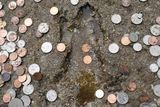
The Chicago Rat Hole is many things: a place of pilgrimage, a city landmark, and perhaps even a work of art that shows how we coexist with nature. But above all it is a rat-shaped indentation printed on a concrete slab in the Roscoe Village neighborhood, north of Chicago.
Now, a new scientific analysis led by likely longtime ecologist Michael C. Granatosky of the University of Tennessee at Knoxville has shown that the Rat Hole is actually a squirrel footprint. Having been nicknamed “Splatatouille” in homage to the 2007 Pixar rat animation, the Rat Hole may need a new name. “Splat by Scrat,” perhaps.
The true story of the rat hole
The Rat Hole had been, according to local residents, marked on the sidewalk for several decades, but after it was shared online in early 2024, fervor related to the hole reached a fever pitch.
Passersby dropped coins, figurines and, for some reason, estrogen pills into a makeshift shrine constructed from the hole. Unfortunately, for pilgrims and pedestrians alike, the slab containing the hole was removed by city authorities later that year, although council officials suggested it be exposed elsewhere.
Interest and passion for the Rat Hole had never extended to sober academic analysis. But the authors of the new study, published in Biology lettersfortunately saw it as “a rare neo-ichnological analogue for interpreting trace-producing behaviors” (which roughly translates to “a good opportunity to study how animals crash into concrete”). This analysis revealed the real culprit behind the Rat Hole.
Learn more: Medieval squirrels were the first hosts of leprosy
Who made the rat hole?
The team used images of local Chicago wildlife recorded using the iNaturalist app in their analysis. They narrowed the list of potential street performers to 37 species, after excluding candidates lacking the four limbs and tail clearly visible in the rat hole. The team further eliminated feral pigs (too rare), bats (too many wings) and beavers (too big).
Once the obvious fake tracers were removed, the team turned to careful anatomical measurements to further refine their list. Using the analysis tool ImageJ, they processed Internet images of the Rat Hole to extract measurements of the culprit’s snout-to-tail base length, forelimb length, third digit length, hind leg length, head width, tail base width, and 1 inch of tail base width.
Then, they derived these measurements from potential animal skins prepared by museums, making sure to include specimens of different ages and of both sexes.
The team then fired a salvo of statistical firepower at their paving slab problem. These tests showed that the only three species whose body plans matched the Rat Hole were the eastern gray squirrel, fox squirrel, and muskrat. A closer look at the model used to analyze the shape of the hole showed that the probability that the rat hole was left by an eastern gray squirrel was 50.67 percent, the probability that it was left by a fox squirrel was 48.00 percent, and the remainder (1.33 percent) suggested a muskrat marker.
Not a rat but a squirrel
The team noted that, although it did not incorporate density modeling into its analysis (the relevant university budget authorities likely intervened), eastern gray squirrels are much more common than muskrats or fox squirrels in Chicago. This factor makes the ancient species the most likely creator of the Rat Hole. They added that the squirrel’s bushy tail would likely not have been imprinted in the concrete, explaining why the author of the hole remained misidentified for so long.
Ultimately, the team hopes their analysis will have an impact beyond the neo-ichnological community.
“We hope that this work – despite (or perhaps more accurately, because of) its inherent frivolity – will resonate with the public and the scientific community,” they wrote.
Learn more: City squirrels might be getting bolder – or maybe you’re the one who’s changed
Article Sources
Our Discovermagazine.com editors use peer-reviewed research and high-quality sources for our articles, and our editors review the articles for scientific accuracy and editorial standards. See the sources used below for this article:


