Karoline Leavitt Says Trump Can Destroy Entire White House if He Wants


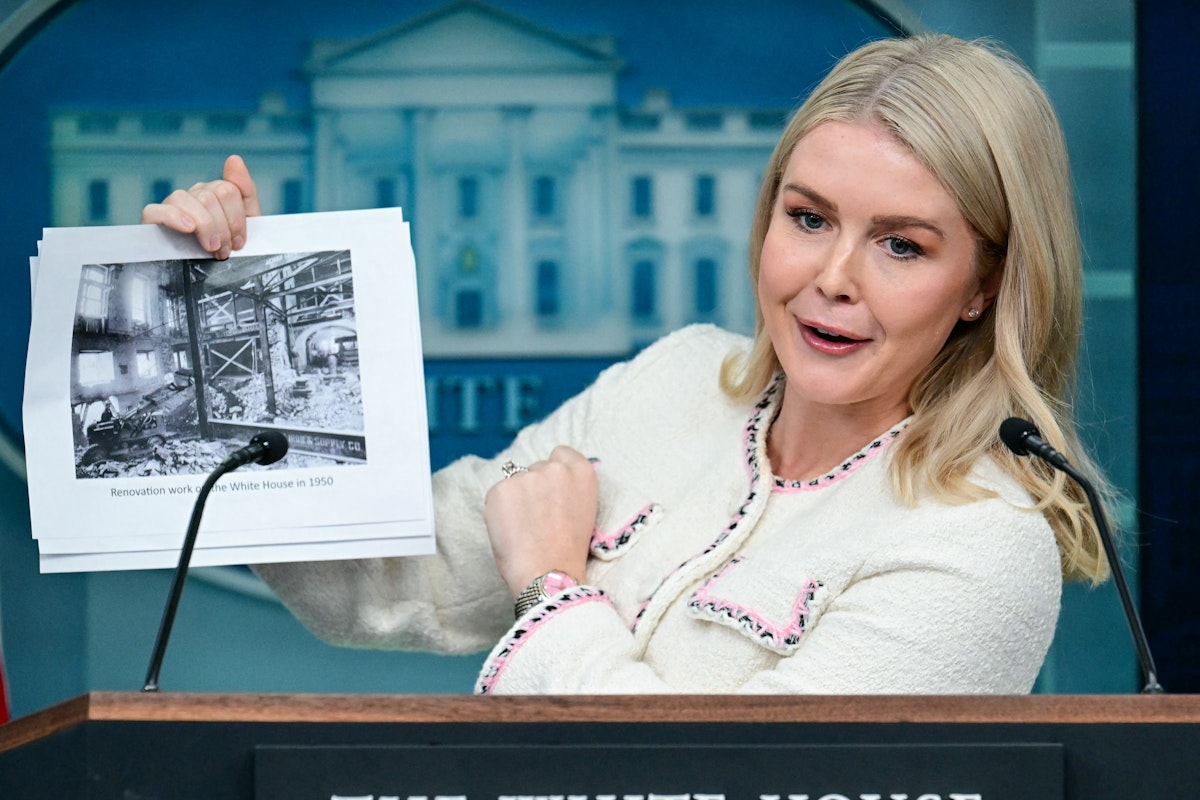
Donald Trump has complete freedom to remodel the White House as he sees fit, according to his team.
Without warning, the president razed the East Wing of the White House this week to make way for a $300 million ballroom that he said would be “100 percent” funded by himself and his “friends.”
As the demonstration progressed, it became clear that what had initially been presented as a minor expansion of one of the most important symbols of American democracy would not only destroy the historic two-story addition, built during the presidency of Franklin D. Roosevelt. It would also dwarf the White House entirely, with almost twice the size of the rest of the building.
Despite public backlash, White House Press Secretary Karoline Leavitt reaffirmed Thursday that the president has the full and unquestionable authority to change the premises as he wishes, repeatedly relying on purported concessions from legal precedent that she failed to cite.
“The White House has explained that the reason you did not submit the construction plans to the [National Capital Planning Commission] This is because this commission, as well as others, does not have control over demolitions, only over construction,” said CBS reporter Weijia Jiang. said. “So can you help us understand: Can the president demolish anything he wants without oversight? Could he demolish this building or, say, the Jefferson Memorial?”
“So it’s not the president himself who made this legal opinion. It’s a legal opinion that the NCPC has held for many years,” Leavitt said, suggesting that only vertical construction requires express approval from the federal planning agency. “Many presidents in the past have left their mark on this magnificent White House complex. »
“Looks like the answer is yes, he can tear down anything he wants?” Jiang insisted.
“That’s not what we’re saying. It’s a legal opinion that has existed for many years,” the 27-year-old press secretary reiterated.
“That’s how you interpret it,” Jiang said.
“No, this is something that presidents have been doing for years and years,” Leavitt continued, holding up photos of the West Wing’s construction in 1902 while condescendingly prompting Jiang to explain where the “rubble” in the photo came from.
The White House (along with the U.S. Capitol and Supreme Court) is technically exempt from the National Historic Preservation Act, which requires agencies to undergo scrutiny. review process and monitor public opinion before altering historic monuments. Traditionally, presidents voluntarily submit construction proposals to the NCPC anyway, in the interest of transparency.
But the Trump administration’s justification for destroying past presidential precedent and public expectations also blatantly ignores the fact that any major projects on White House grounds, such as tearing down walls or new construction, requires congressional approval and a lengthy approval process to proceed.
The destruction is a far cry from what Trump proposed when he first floated the idea of building a ballroom on the White House grounds. During the initial announcement in July, Trump claimed his project “will not interfere with the current building. It won’t. It will be near but not touching it.”
Beyond the gargantuan redesign, the sitting president doesn’t appear to be a big fan of the national symbol. During his first term, Trump reportedly called the White House “a discharge» (allegation which he publicly refuted), and he spent no small part of his second term, living and dining in his own properties rather than the executive mansion.
It is unclear whether the National Capital Planning Commission was consulted or received any meaningful information prior to the demolition of the White House, especially since it was farm since the government shut down 23 days ago.
“The decisions were made in complete secrecy and without public disclosure or appropriate consultation,” Trump wrote in a statement. letter THURSDAY. “The American people deserve full transparency regarding the extensive demolition, preparation and construction of the White House during a government shutdown, especially when it comes to changes to one of our nation’s most historically significant buildings.”


