Why do animals have spots and stripes?


The fur and scales of the animal kingdom are far from boring and are full of wild colors and patterns. These mathematically inspired patterns like leopard spots and tiger stripes are as interesting as they are complex. But how did animals get their spots, stripes and everything else? It’s a question that has intrigued scientists and mathematicians for decades, but one group might be closer to an answer.
A puzzle that even a famous code breaker couldn’t solve
In 1952, British mathematician Alan Turing hypothesized that as tissues grow, they generate chemicals that move around, in the same way that white milk spreads when poured into black coffee. According to Turing’s theory, some of these chemicals then activate pigment-producing cells, which creates spots. Other chemicals will shut down these cells, creating empty spaces between them. However, computer simulations based on Turing’s idea created spots that were fuzzier than those found in nature.
In 2023, chemical engineer Ankur Gupta of the University of Colorado at Boulder and his collaborators improved on Turing’s theory by adding another mechanism called diffusiopherosis. This is a process in which scattering particles drag other particles with them. It’s a bit like how dirty clothes are cleaned in laundry. As the soap escapes from the clothes and enters the water, it removes dirt and grime from the fabric.
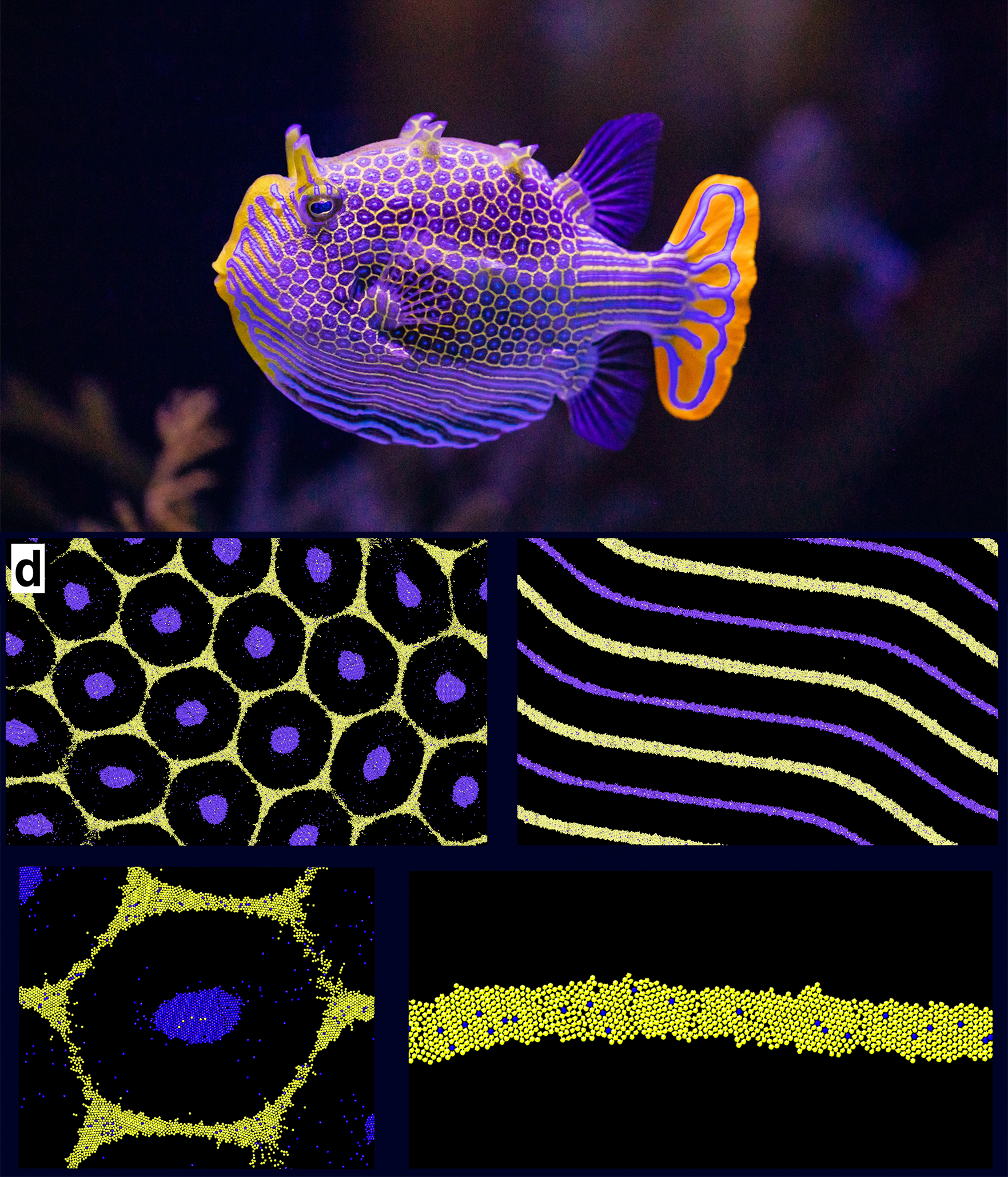
Gupta turned to the purple and black hexagonal pattern seen on the ornate boxfish, a luminous species found off the coast of Australia, as a test. He found that diffusiopherosis could generate patterns with sharper edges than Turing’s original model, but these results were just a little too perfect. All hexagons were always the same size and shape and had identical spaces between them. In nature, no model is perfect. For example, a zebra’s black stripes vary in thickness, while a boxfish’s hexagons are never perfectly uniform. Gupta and his team therefore sought to refine their theory of diffusiopherosis.
“Imperfections are everywhere in nature,” Gupta said in a statement. “We came up with a simple idea that can explain how cells assemble to create these variations.”
Like balls in a tube
In a study published today in the journal MatterGupta and the team detail how they were able to imitate the imperfect patterns and texture. After giving each cell defined sizes and then modeling how each of them moved through tissue, the simulations began to create less uniform patterns.
It’s similar to how balls of different sizes would move through a tube. Larger ones, like a basketball or bowling ball, would create thicker edges than golf balls or ping pong balls. It’s the same with cells: when larger cells group together, they create larger patterns. If the same balls traveling in a tube collide and block it, it will break a solid line. When cells experience the same traffic jam, the result is band rupture.

A mixture of two types of pigment-producing cells undergoes diffusiophoretic transport to self-assemble into a hexagonal pattern. CREDIT: Siamak Mirfendereski and Ankur Gupta/CU Boulder
“We’re able to capture these imperfections and textures just by giving these cells a size,” Gupta said.
Their new simulations showed breaks and grainy textures closer to those found in nature.
Why it matters
In the future, the team plans to use more complex interactions between cells and background chemicals to improve the accuracy of their simulations.
Understanding how pattern-making cells assemble could help engineers develop materials that can change color depending on their environment, like a chameleon’s skin does. It can also help create more effective approaches to delivering medications to a specific part of the body.
“We are inspired by the imperfect beauty of [a] natural system and I hope to exploit these imperfections for new types of functionality in the future,” Gupta said.

House of the Future Prize 2025


