6-Million-Year-Old Ice Found in Antarctica


Researchers have discovered 6 million-year-old ice and air in shallow ice cores drilled in the Allan Hills region of East Antarctica. They speculate that this ancient ice reflects the surface snowpack or permafrost that was preserved by the growth of the East Antarctic ice sheet between the middle and late Miocene.
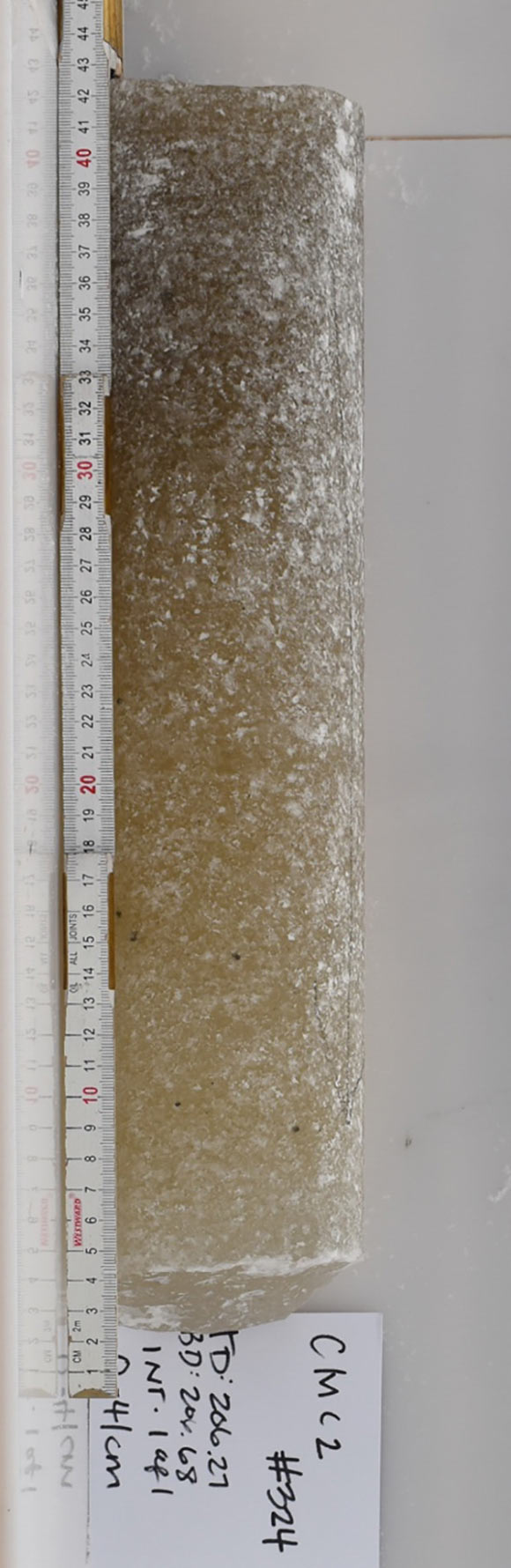
Ancient ice from the ALHIC1902 ice core. Image credit: Shackleton and others., doi: 10.1073/pnas.2502681122.
“Ice cores are like time machines that allow scientists to take a look at what our planet was like in the past,” said Dr. Sarah Shackleton, a researcher at Woods Hole Oceanographic Institution.
“The Allan Hills cores help us travel much further than we imagined possible.”
“This is the most important discovery to date for the NSF-funded Center for the Exploration of Oldest Ice (COLDEX),” said Dr. Ed Brook, director of COLDEX and a paleoclimatologist at Oregon State University.
“We knew the ice was old in this area. Initially, we hoped to find ice 3 million years old or a little older, but this discovery far exceeded our expectations.”
COLDEX is one of several teams around the world currently participating in a friendly competition aimed at extending the ice core record beyond its previous limit of 800,000 years.
Recently, a European team announced that they had discovered a deep, continuous ice core dating back 1.2 million years in the interior of East Antarctica.
Working for months at a remote camp in East Antarctica’s Allan Hills, the team drilled to depths of 100 to 200 m at the edges of the ice sheet in several locations where ice flow and rugged mountain topography combine to preserve old ice and bring it closer to the ice surface and make it easier to reach.
In contrast, recovery of the oldest continuous ice cores from sites in eastern Antarctica requires drilling to depths of more than 2,000 m.
“We are still working on the exact conditions that allow these ancient ices to survive so close to the surface,” Dr Shackleton said.
“Along with the topography, it’s probably a mix of strong winds and freezing cold.”
“The wind blows away the fresh snow and the cold slows the ice to a near stop.”
“This makes Allan Hills one of the best places in the world to find old, shallow ice, and one of the most difficult places to spend a season in the field.”
The air trapped in these new cores allows scientists to directly date the ice through careful measurements of an isotope of the rare gas, argon.
Direct dating means that scientists have measured features in the ice itself that indicate age rather than drawing a conclusion based on an associated feature or deposit.
Although the records of this old ice are not continuous, their age is unprecedented, the researchers said.
“By dating numerous samples, our team built a library of what we call ‘climate snapshots’ approximately six times older than any previously reported ice core data, complementing more recent more detailed data from cores from the Antarctic interior,” Dr Higgins said.
Temperature records from measurements of oxygen isotopes in the ice reveal that this area has experienced a gradual, long-term cooling of about 12 degrees Celsius (22 degrees Fahrenheit).
This is the first direct measurement of the extent of cooling in Antarctica over the past 6 million years.
Ongoing research on these ice cores aims to reconstruct atmospheric greenhouse gas levels and ocean heat content, which have important implications for understanding the causes of natural climate change.
“The COLDEX team will be heading to the Allan Hills in the coming months to carry out more drilling, with the potential for more detailed snapshots and even older ice,” Dr Brook said.
“Given the spectacular old ice we discovered at Allan Hills, we have also designed a new, comprehensive, longer-term study of this region to attempt to extend the record even further in time, which we hope to conduct between 2026 and 2031.”
The team’s paper was published today in the Proceedings of the National Academy of Sciences.
_____
S. Shackleton and others. 2025. Miocene and Pliocene ice and air of the Allan Hills Blue Ice Zone, East Antarctica. PNAS 122 (44): e2502681122; doi: 10.1073/pnas.2502681122


