New study settles 40-year debate: Nanotyrannus is a new species


For four decades, an often acrimonious debate has raged in paleontological circles over the correct taxonomy of a handful of rare fossil specimens. One faction insisted the fossils were juvenile Tyrannosaurus rex; the other claimed that they represented a new species nicknamed Nanotyrannus lancensis. Now paleontologists believe they have settled the debate once and for all thanks to a new analysis of a well-preserved fossil.
The verdict: it is indeed a new species, according to a new article published in the journal Nature. The authors also reclassified another specimen as a second new species, distinct from N. lancensis. In short, Nanotyrannus is a valid taxon and contains two species.
“This fossil doesn’t just settle the debate,” said Lindsay Zanno, a paleontologist at North Carolina State University and chief of paleontology at the North Carolina Museum of Natural Sciences. “This reverses decades of T. rex reverse search. This is because paleontologists have relied on these fossils to model the growth and behavior of T. rex. The new findings suggest that there may have been multiple species of tyrannosaurs and that paleontologists underestimated the diversity of dinosaurs from this period.
Our story begins in 1942, when the fossilized skull of a Nanotyrannus, nicknamed Chomper, was excavated in Montana by an expedition from the Cleveland Museum of Natural History. Originally, paleontologists thought it belonged to a Gorgosaurusbut a 1965 article disputed this identification and argued that the skull belonged to a miner. T. rex. It was not until 1988 that scientists proposed that the skull was actually that of a new species, Nanotyrannus. Since then, it has been a constant back and forth.
As recently as 2020, a highly influential article claimed that Nanotyrannus was definitely a minor T. Rex. However, a significant number of paleontologists still believed that it should be classified as a separate species. A January 2024 article, for example, came out strongly on the Nanotyrannus side of the debate. Co-authors Nicholas Longrich of the University of Bath and Evan Saitta of the University of Chicago measured growth rings in Nanotyrannus bones and concluded that the animals had almost reached adult size.
Duel of dinosaurs
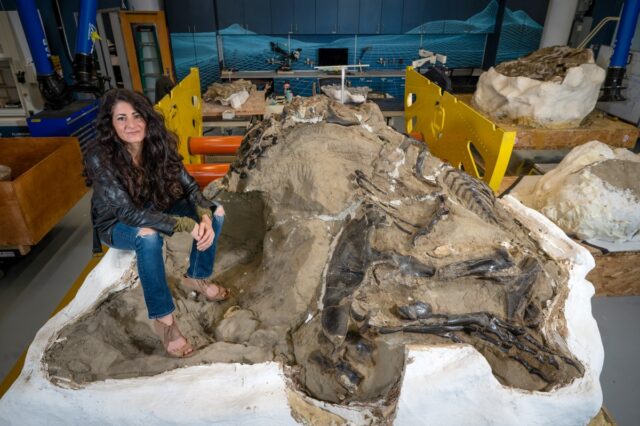
Lindsay Zanno of North Carolina State University, who also directs paleontology at the North Carolina Museum of Natural Sciences, with the “dueling dinosaurs” fossil.
Credit: NC State University/CC BY-NC-ND
Additionally, there was no evidence of hybrid fossils combining features of both Nanotyrannus And T. rexwhich is what you would expect if the first was a juvenile version of the second. Longrich and Saitta also discovered a skull bone, archived in a San Francisco museum, that belonged to a miner. T. rexand they were able to make an anatomical comparison. They argued that Nanotyrannus had a lighter build, longer limbs and larger arms than a T. rex and was probably smaller, faster and more agile.


