FDA Is Investigating the Abortion Pill Mifepristone despite Decades of Studies Showing It’s Safe


Health and Human Services Secretary Robert F. Kennedy, Jr. recently announced that the U.S. Food and Drug Administration will launch a review of the safety of the abortion pill, mifepristone. Health researchers say they are concerned that the review is politicized and based on flawed reporting. More than 100 studies published over the past several decades have shown that the drug, approved by the FDA in 2000, is safe and effective in ending a pregnancy.
Given Kennedy’s history of making scientific misrepresentations on vaccines, autism and Tylenol, some scientists fear the health secretary is basing the FDA report on unreliable sources.
“Based on what we’ve seen from this administration so far,” says Peter Lurie, former FDA associate commissioner for public health strategy and analysis, “there is every reason to fear that this study is nothing more than a data cherry-picking and distortion exercise designed to support a predetermined conclusion of lack of safety.”
On supporting science journalism
If you enjoy this article, please consider supporting our award-winning journalism by subscription. By purchasing a subscription, you are helping to ensure the future of impactful stories about the discoveries and ideas shaping our world today.
In a statement to Scientific AmericanDepartment of Health and Human Services spokeswoman Emily Hilliard said the agency is “conducting a study of reported adverse reactions to mifepristone to ensure that the FDA’s risk mitigation program for the drug is sufficient to protect women from unreported risks,” echoing an earlier statement from HHS spokesperson Andrew Nixon.
Kennedy has frequently promoted the FDA review when speaking to conservative critics who are eager for the Trump administration to ban or significantly limit abortion. Anti-abortion groups have been angered by the FDA’s recent approval of a second generic version of mifepristone.
In a post on the social network
Kennedy provided no timetable for the journal’s publication and few details about what it will encompass. But in a Sept. 19 letter to state attorneys general, Kennedy cited a report from the Ethics and Public Policy Center, a conservative think tank, that says mifepristone is more dangerous than FDA analyzes suggest and calls for an end to telehealth prescribing of the drug. The availability of mifepristone via telehealth has contributed to a nationwide increase in abortions despite total abortion bans in 12 states.
The report has serious methodological flaws, says Ushma Upadhyay, professor of reproductive sciences at the University of California, San Francisco, who calls it “junk science.” She notes that the think tank’s report has neither been peer-reviewed nor published in an established medical journal. The report also does not disclose the specific source of its data, making it impossible for other scientists to verify or try to replicate its findings, she adds. Additionally, it misrepresents the safety of mifepristone by misclassifying routine follow-up procedures as “serious adverse events,” says Upadhyay.
Kennedy signaled that the president would make final regulatory decisions regarding mifepristone. At a Senate budget hearing in May, Kennedy told lawmakers that “policy changes will ultimately come through the White House, through the President.” [Donald] Trump.” He said the think tank report “indicates that at least the [drug] the label should be changed.
“Cherry-picked” evidence
Some scientists are concerned about Kennedy’s role in this study. When talking about autism and vaccines, Kennedy has often buttressed his arguments with “questionable sources that just seem real,” says Timothy Caulfield, research director at the Health Law Institute at the University of Alberta, who studies health misinformation. “He seems to do this mainly on controversial issues – vaccines, abortion, etc. – which respond to a political agenda. »
Kennedy succeeded in removing doubts about the safety of proven interventions, including Tylenol, Caulfield says. “The doubt campaign is a very effective strategy, especially in health care,” he says. “Once this doubt is present, it can have a significant impact on the public’s health beliefs and behaviors. »
Kristan Hawkins, president of Students for Life of America, a leading anti-abortion group, said in a statement on the group’s website that the FDA review “represents a historic opportunity” to reduce use of the abortion pill “if addressed comprehensively.” The group wants the FDA to conduct an “original investigation” rather than review published studies. He says there isn’t enough evidence to show that making mifepristone available through the mail is safe and that previous studies on the drug were written by people who favored wide distribution of the pill.
The Center for Reproductive Rights, a global human rights nonprofit that advocates for abortion access, filed a lawsuit in September against HHS and the FDA in an effort to force the Trump administration to reveal the process and sources it will use to review the safety of mifepristone. “The public deserves to know what’s behind the decisions made about their health and access to life-saving medications,” says Liz Wagner, the organization’s senior federal policy advisor.
Misleading statistics
Basing the FDA review on the conservative think tank’s report on mifepristone would produce misleading results, Upadhyay says. Extensive research has shown that mifepristone is safe — so safe that the FDA, under the Biden administration, began allowing its distribution via telehealth instead of requiring pregnant women to see a doctor in person. Prescribers and pharmacies must meet specific certification requirements to be able to dispense the drug, and pregnant people must sign an agreement with the patient, Upadhyay says.
“If the FDA were to do a real review based on gold standard science, I think they would eventually remove the barriers that remain on mifepristone,” she says.
The think tank’s report found that 4.7 percent of women who use mifepristone go to the emergency room for an abortion. But Upadhyay says this is misleading: Many pregnant women who take mifepristone at home go to the emergency room simply to ask if the amount of bleeding they are having is normal. Others go to the emergency room to confirm that the abortion was successful, since over-the-counter pregnancy tests aren’t reliable until four to five weeks after the abortion, she says. Research shows that only about half of emergency room visits after an abortion result in medical treatment, Upadhyay says.
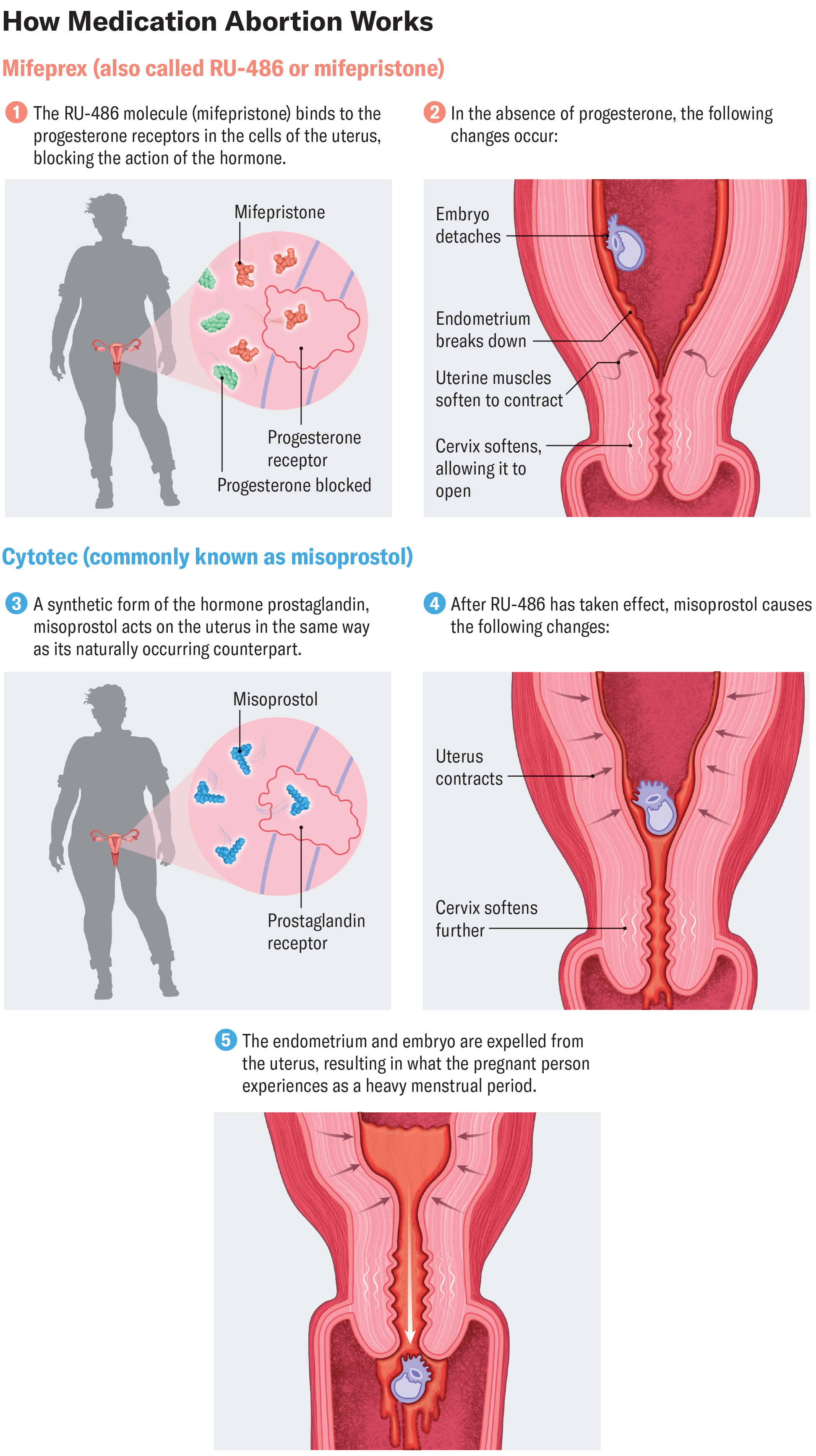
One risk of mifepristone is sepsis, a life-threatening condition in which the body’s immune system overreacts to an infection, according to the report from the Center for Ethics and Public Policy. Yet the report found that the risk of sepsis is only 0.1 percent, even lower than that stated on mifepristone’s label. The report uses this and other statistics to argue that the FDA should require that people prescribed mifepristone make “at least three in-person office visits,” including an initial visit to receive mifepristone, a second visit two days later for a dose of misoprostol (a drug used to complete abortion), and a third visit two weeks later for follow-up. These visits were mandatory when the pill was initially approved in 2000.
The think tank’s report “would not fit in any medical or public health journal,” says Jessica Mitter Pardo, a family physician and abortion care provider in New York and a member of Physicians for Reproductive Health, an advocacy group. Yet it could be “used to influence public health policy and medicine in this country,” she warns.
A delaying tactic?
Trump’s record on abortion is mixed, leaving some wondering how his administration will handle the review of mifepristone.
The president takes credit for appointing the Supreme Court justices who overturned Roe v. Wade, the historic decision that protected the right to abortion. Trump received praise from conservatives in January when he pardoned anti-abortion activists arrested for blocking entrances to reproductive health clinics. And in August, the Trump administration proposed banning Department of Veterans Affairs doctors from performing abortions, even in cases of rape and incest, with only one exception for saving the life of a pregnant person.
By tasking the FDA with reviewing the safety of mifepristone, “it’s possible that the Trump administration is setting the stage for changes to the mifepristone rules, particularly because all but two Republican senators have signed a letter asking the FDA to remove mifepristone from the market,” says Mary Ziegler, a professor at the University of California, Davis, law school who studies the history of abortion.
The Trump administration has not publicly committed to changing the use of mifepristone and has taken several steps that have irked anti-abortion groups.
In May, the Justice Department asked a judge to dismiss a lawsuit filed by Idaho, Kansas and Missouri seeking to restrict the use of mifepristone, arguing that the states lacked standing to bring suit in a Texas court.
And during his presidential campaign, Trump said he did not support a federal ban on abortion. Nearly two-thirds of adults believe abortion should be legal in most cases. Voters in 13 states have supported initiatives to keep abortion legal, sometimes by writing abortion rights into their state constitutions and other times by rejecting proposals to restrict abortion.
Ordering an FDA review of mifepristone could be a delaying tactic intended to deflect criticism from anti-abortion groups without triggering a backlash from voters who support reproductive rights, says David S. Cohen, a professor at Drexel University’s Thomas R. Kline School of Law.
Trump might be particularly wary of antagonizing voters who care about abortion — on both the right and the left — ahead of next year’s midterm elections, Ziegler says.
“It’s possible that this is just the Trump administration trying to get anti-abortionists to leave them alone,” Ziegler says of the mifepristone study. The study could simply be a delaying tactic to buy more time, she suggests. “There is no reason not to think that this study could not last three years.”


