US judges say Trump administration must keep paying Snap food benefits during US shutdown



 Universal Images Group via Getty Images
The Trump administration cannot withhold food aid used by more than 40 million low-income Americans amid the ongoing U.S. government shutdown, two federal judges have ruled.
The rulings, issued within moments of each other Friday by judges in Rhode Island and Massachusetts, hold that the government must pay for Supplemental Nutrition Assistance Program, or Snap, benefits using emergency funds.
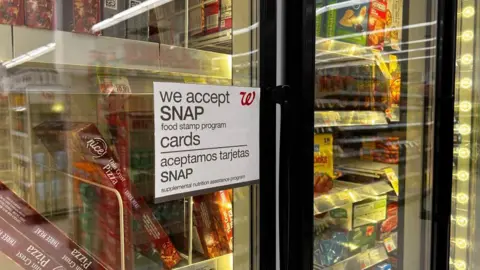
The Snap program works by giving people reloadable debit cards that they can use to buy essential groceries.
The U.S. Department of Agriculture (USDA) announced this week that it would not distribute food aid funds in November due to the shutdown, saying “the well has run dry.”
A family of four receives on average $715 (£540) per month, which works out to just under $6 (£4.50) per day per person.
States administer benefits using money from the federal government, which is no longer funded and has been closed since October 1.
Several states have pledged to use their own funds to cover any shortfall, but the federal government has warned they will not be reimbursed.
Half of US states have taken the Trump administration to court over its plan to cut off funding, hoping to force it to use an emergency contingency fund of around $6 billion (£4.5 billion) for Snap, also known as food stamps.
The Massachusetts judge said the administration must access emergency funding to pay benefits and has until Monday to let the court know whether it will authorize at least partial benefits for November.
Massachusetts District Judge Indira Talwani wrote in her ruling that states that sued will likely prevail in court, saying “Congress intended to fund SNAP benefits, at a reduced rate if necessary, when appropriated funds prove insufficient.”
Judge Talwani also wrote that the Trump administration “erred in concluding” that the law prevented the USDA from drawing on the contingency fund’s emergency reserves in the event of a failure of federal funding.
The USDA had said those reserves were insufficient to pay for the full benefits, which cost between $8.5 billion and $9 billion per month. Agriculture Secretary Brooke Rollins had said she would only use the fund in an emergency such as a natural disaster.
Even if the government did tap the contingency fund, it would only be able to cover about 60% of beneficiaries in a single month, according to the Center on Budget and Policy Priorities (CBPP), a think tank focused on policies to help low-income families.
Judge Talwani asked the administration to indicate Monday whether it would use the fund to pay reduced benefits or whether it would pay benefits in full for the month by transferring money from other programs, similar to the administration’s transfer of military research funds earlier this month to pay members of the armed forces.
Separately, in Rhode Island, a number of US cities and NGOs filed suit over what they called the “unlawful suspension” of the program.
“There is no question and it is indisputable that irreparable harm will begin to occur if the terror it has caused some people has not already occurred regarding the availability of funds to purchase food and for their families,” said U.S. District Judge John McConnell.
The White House and USDA have not commented on the decisions. The BBC has also contacted the Office of Management and Budget for comment.
At a news conference before the rulings were released, Rollins said “we’re looking at all options” when asked whether the administration would comply if the courts asked it to release funds.
On Friday, the group behind the Rhode Island lawsuit said in a statement that the ruling “is a lifeline for millions of families, seniors and veterans who rely on SNAP to put food on the table.”
“It reaffirms a fundamental principle: no administration can use hunger as a political weapon.”
Republicans and Democrats have shared blame for the federal government shutdown, which will soon enter its second month, and there has been no significant progress toward a deal.


