James Webb telescope reveals the blazing heart of an iconic galaxy — Space photo of the week


Quick facts
What is this : M82, a spiral star galaxy
Where it is: 12 million light years away, in the constellation Ursa Major
When it was shared: October 23, 2025
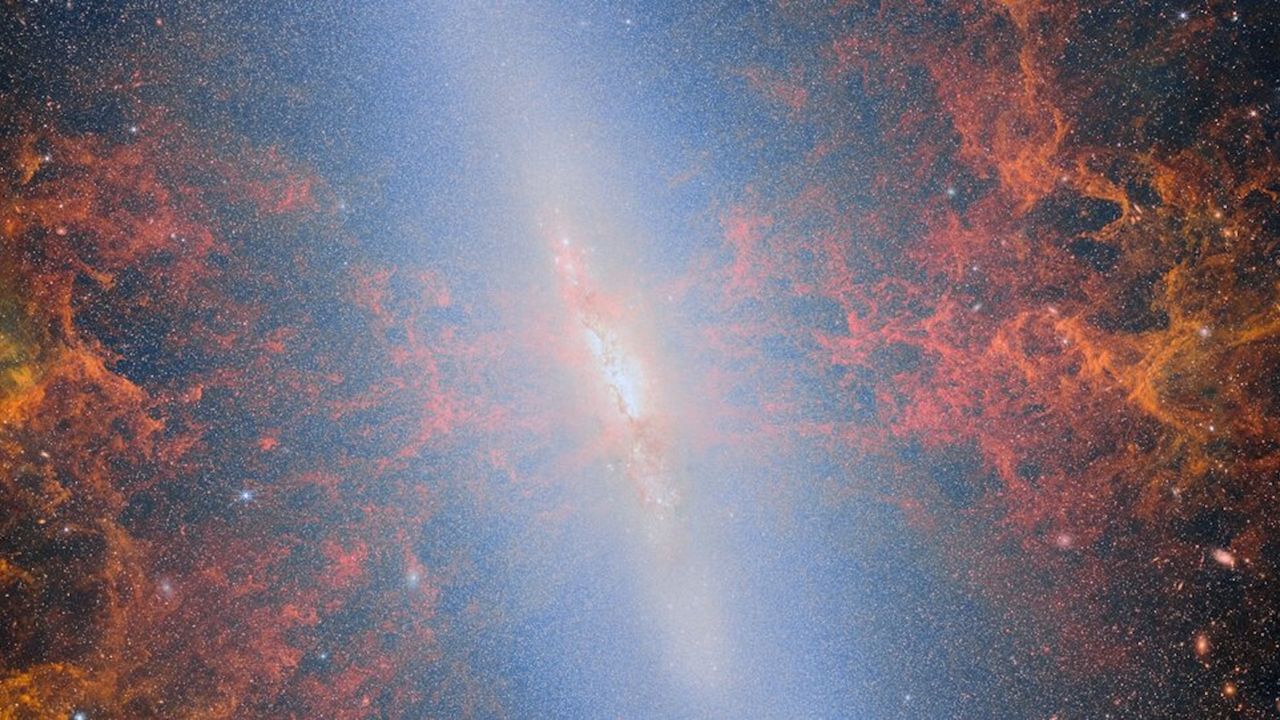
If you have a small backyard telescopechances are you’ve seen the Cigar Galaxy (M82) with your own eyes. Not only is it relatively close to the Milky Way and one of the brightest galaxies in the night sky, but it is visible next to the Bode Galaxy (M81). A spiral galaxy about four times smaller than the Milky Way, M82 shines five times brighter and forms stars at a rate 10 times faster, earning it the title of an explosion galaxy.
M82’s core is a busy place, containing more than 100 super star clusters, some of which are still born within dense gas clouds. Each super star cluster hosts hundreds of thousands of stars. The reason for M82’s star formation burst is likely its neighbor, M81, with which it likely interacted with gravity. As a result, gas from M81 forced its way toward the center of M82, causing an increase in star formation despite the galaxy’s small size.
Scientists can also see the glow of plumes of organic molecules in this image. The large plumes, which measure 160 light years across, are called polycyclic aromatic hydrocarbons (PAHs) and are blown away from the galactic disk by the powerful outflow winds produced by M82’s super star clusters.
For stargazers in the Northern Hemisphere, M81 and M82 provide a spectacular sight in the northern skies during fall and winter. Both galaxies can be spotted as small, diffuse patches of light northwest of Dubhe – the bright star marking the rim of the Big Dipper bowl. Using a small garden telescope, these two neighboring galaxies appear together in the same field of view.
For more sublime space images, check out our Archives of space photo of the week.


