Starmer warns ‘consensus is gone’ on fighting climate change


Esmée Stallard,Climate and science journalist, BBC News And
Matt McGrath,Environment Correspondent, BBC News

 Aaron Chown/Getty Images
President Trump came under attack Thursday as world leaders lined up to criticize his stance on climate change ahead of the COP30 global summit.
The US leader, absent from the rally in the Amazonian city of Belém, was called a liar for his rejection of climate science and for being “against humanity” for rolling back key climate policies.
British Prime Minister Sir Keir Starmer has acknowledged the weakening of political consensus on this issue. He said climate change was once about unity, but “today, unfortunately, that consensus has disappeared.”
Over the next two weeks, countries will attempt to negotiate a new deal on climate change, with a particular focus on directing more money to protect forests.
Many leaders of the world’s biggest nations – India, Russia, the United States and China – are notably absent from this year’s summit.
And even though President Trump is not attending this meeting in Belém, his views on climate change are certainly on the minds of many other leaders in attendance.
Speaking at the UN in September, the US president declared climate change “the greatest scam ever perpetrated on the world”.
Without naming the US leader, Brazilian President Luiz Inácio Lula da Silva warned of “extremist forces that manufacture fake news and condemn future generations to live on a planet forever changed by global warming.”
The leaders of Chile and Colombia went further, calling the US president a liar and asking other countries to ignore US efforts to move away from climate action.
But while Trump’s bashing has been well-received by the public, reaching agreement on new measures to combat global warming is proving much more difficult.
Only a few dozen leaders have come here to Belém, and a majority of countries have not presented new plans to reduce carbon emissions, the root cause of rising temperatures.
 Anderson Coelho/Getty Images
Although British Prime Minister Sir Keir Starmer acknowledged that global political support for the climate movement is waning, he told the audience: “My message is that the UK is all in. »
However, on Wednesday night, dealing a blow to hosts Brazil, the UK opted to withdraw from its flagship $125bn (£95bn) fund aimed at supporting the planet’s rainforests.
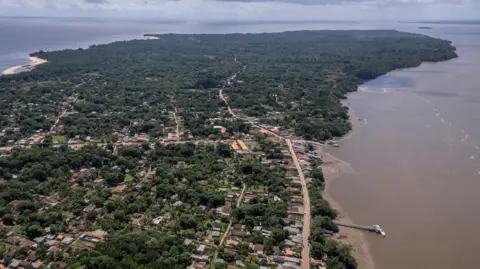
President Lula hoped that $25 billion could be raised for the Tropical Forests Forever Fund from public sources – mainly from developed countries like the United Kingdom – to support governments and communities that protect the world’s tropical rainforests like the Amazon and the Congo Basin.
The protection of these ecosystems is crucial to combat climate change: they cover only 6% of the planet’s land surface, yet store billions of tons of greenhouse gases and are home to half of the planet’s species.
The UK’s decision came as a surprise as it was heavily involved in the design of the fund and launched a global commitment for countries to end deforestation by 2030 when it hosted the COP summit in Glasgow in 2021.
Lord Zach Goldsmith, who worked on the issue when he was a former environment minister, told the BBC’s PM programme: “The assumption was that the UK would be a major participant and at the last minute the UK withdrew. This has caused real frustration, to put it mildly here in Brazil…the Brazilian government behind the scenes is furious. »
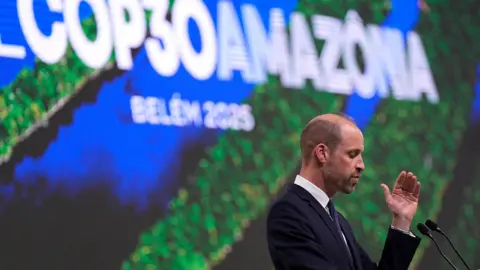
The decision also appears to contradict the position of the Prince of Wales. Also speaking to leaders on Thursday, he said the fund was “a visionary step towards promoting nature’s role in climate stability” and shortlisted it for his £1m Earthshot Prize.
 Ricardo Makyn/AFP/Getty Images
Prince William tried to encourage leaders to overcome their differences and take action.
“I have long believed in the power of urgent optimism: the conviction that, even in the face of daunting challenges, we have the ingenuity and determination to make a difference, and to do it now,” he said.
And he urged them to act for the good of their children and grandchildren.
“Let us approach this moment with the clarity that history demands of us. Let us be the generation that turned the tide – not for the applause, but for the silent gratitude of those yet unborn,” he said.
Starting Monday, countries will spend two weeks negotiating new measures against climate change – with crucial questions over how to raise previously promised funding for those already hit by the worst impacts of climate change.
The past few weeks have seen devastating extreme weather conditions on a global scale.
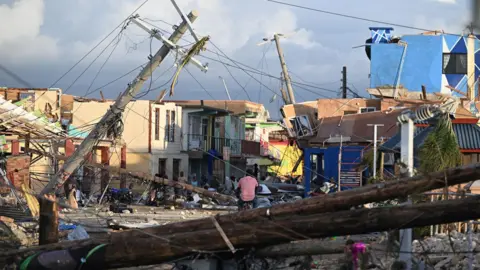
Hurricane Melissa, which hit the Caribbean last week, was one of the strongest the islands have ever experienced, killing more than 75 people.
A recent analysis from Imperial College suggested that climate change has increased extreme rainfall associated with the Category 5 hurricane by 16%.



