Residents turn to community patrols as illegal gold mining grows in Ghana

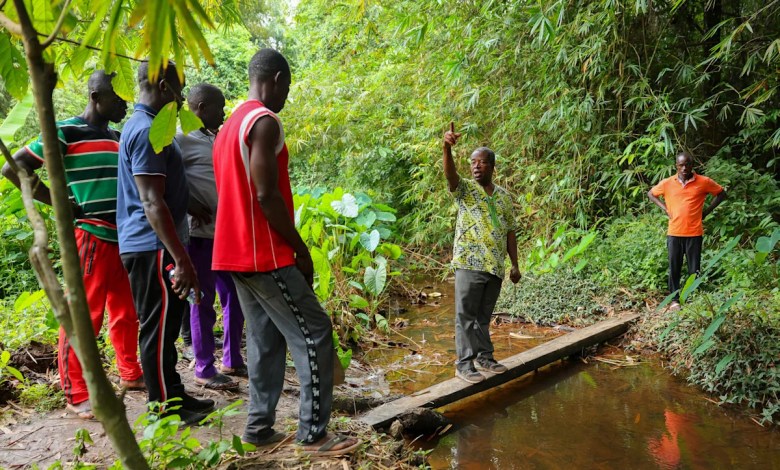
JEMA, Ghana (AP) — As day broke in a remote region of western Ghana, a priest, farmers and other residents searched the forests for signs of illegal gold mining.
They did so over the past year as part of a local task force created to combat mining that has poisoned the rivers of one of the world’s largest gold-producing countries.
The group is also motivated by the fact that Ghana’s unemployed youth are lured by illegal mining and the elusive promise of quick wealth. Meanwhile, the economy is suffering: Ghana has lost $11.4 billion over the past five years to gold smuggling, development nonprofit Swissaid said this year.
The 14 members of the task force call themselves Jema Anti-Galamsey Advocacy, and their arrests of suspected illegal miners have sparked debate in Ghana’s northwest region about their potential abuse of power.
Members cite the Jema region’s relatively clean water bodies, covering an area of 450 square kilometers (173 square miles), as proof of the effectiveness of their approach.
An economy in decline
Widespread illegal mining, or galamsey – local abbreviation for “gather and sell” – is a growing concern in the West African country, Africa’s top gold producer.
Ghana’s once-promising economy has collapsed under the strain of the COVID-19 pandemic. Inflation has reached a 21-year high of more than 50%. Nearly 39% of young people are unemployed, according to government data, pushing thousands to turn to illegal mining.
Illegal mining has contaminated significant parts of Ghana’s water bodies with cyanide and mercury, according to government authorities and environmental groups.
As of January 2024, illegal miners were present in 44 of the country’s 288 forest reserves, according to data from the Ministry of Land and Natural Resources. Nine of them were “completely captured by armed thugs.”
Information from villagers
Since 2015, the Jema community, which has around 15,000 inhabitants, has banned all mining on its land, under a law that grants local leaders the power to develop and enforce customary law. Chiefs and heads of clans and families serve as guardians of the lands.
The new task force usually patrols the water bodies and the Jema Forest Reserve, wielding sticks instead of guns, at least once a week, monitoring changes in the color of the water, a sign of mining activity upstream, and new clearings in the forests.
When she receives information from the villagers, she arrests the suspects and hands them over to the district police station. Such arrests are authorized by laws that grant citizens the power to make arrests in certain cases.
So far, the group has arrested two Niger nationals caught trying to mine gold in the forest. The trial is progressing slowly and the villagers are seeking to create special courts to try illegal miners.
Members of the task force say they are filling a void left by the government’s lack of enforcement of the law.
“All of our bodies of water that originate here are clean because of our strong resistance to galamsey,” said Joseph Blay, a Catholic priest and Jema resident who helped form the task force.
“If we stop fighting, we will lose everything,” he said.
Another member, Patrick Fome, said the local Ehole River was starting to turn a milky brown color, a sign that illegal miners appeared to be working upstream.
“We cannot go there now without adequate preparation,” Fome said, calling their work as unarmed patrols dangerous. “We sometimes receive death threats.”
A national repression
A year ago, Ghana saw nationwide protests against illegal mining. Thousands of people took to the streets to demand a crackdown from the government.
President John Mahama, who took office in January, inaugurated a national task force to combat the practice. But he rejected calls for a state of emergency, which would give more powers to the police and military to tackle the problem, saying his government has not exhausted all other approaches.
The government’s failure to crack down on illegal mining demonstrates a lack of political will, said Daryl Bosu, deputy national director of the conservation nonprofit A Rocha Ghana.
Although the Jema task force might have its advantages, operating without supervision from security forces could lead to human rights violations by its members, said Festus Kofi Aubyn, regional coordinator of the West African Peacebuilding Network, a civil society group.
“If the task force is not properly regulated by the state, it could have dangerous consequences, including ethnic targeting or stereotyping,” he said.
Tensions at home
Some Jema residents said they did not support the task force because they wanted to work with the illegal miners for financial gain.
A 27-year-old resident said he was willing to sell his land to miners, citing lack of profit in farming. Fertilizer prices have tripled since 2022. He spoke on condition of anonymity for fear of reprisals.
Local leaders acknowledged that declining agricultural incomes and limited employment opportunities could create divisions and weaken community enforcement of the mining ban. Residents have called for investment in further work to make illegal mining less attractive.
Father Blay proposed transforming the Jema forest reserve into a tourist park to create sustainable jobs.
“And if the government really wants to fight, we can use the Jema model to spread it to other communities as well,” he said.
——
To learn more about Africa and development: https://apnews.com/hub/africa-pulse
The Associated Press receives financial support from the Gates Foundation for global health and development coverage in Africa. The AP is solely responsible for all content. Find AP’s standards for working with philanthropic organizations, a list of supporters, and funded coverage areas at AP.org.


