AI Slop—How Every Media Revolution Breeds Rubbish and Art


November 8, 2025
4 min reading
The Slop Cycle: How Each Media Revolution Generates Waste and Art
The popularization of the term “slop” to refer to AI production follows an age-old pattern where new tools flood the area, the public adapts and some of tomorrow’s art emerges from today’s excesses.
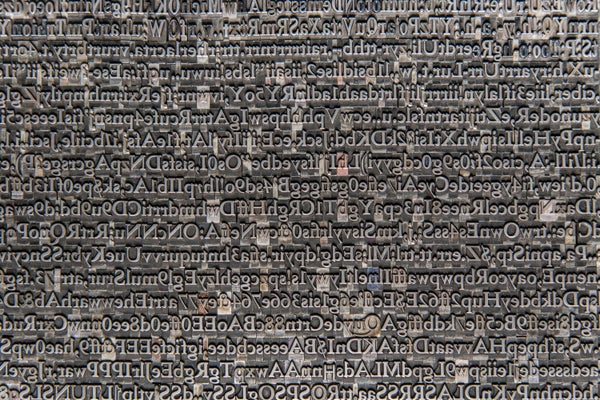
Old metal printing letters used for traditional typographic text printing.
Spam, fluff, clickbait, churnalism, kitsch—slop: these are all ways of describing mass-produced, low-quality content. The latter term is reserved for the most recent variety, resulting from artificial intelligence. Although references to AI slop date back to at least 2022, a poet and technologist who writes under the name “deepfates” popularized it two years later as “the term for spammy AI-generated content” in an article on X. Shortly after, developer Simon Willison shared the concept in a blog post: “Not all AI-generated content is slop,” he wrote. “But if it’s thoughtlessly generated and forced on someone who didn’t ask for it, slop is the perfect term.” Today, the pejorative tone of slop increasingly targets everything related to AI, treating it as an undeniable cultural pollutant. And most of it is, but by discarding them indiscriminately, we risk missing the minority of creations that are preserved.
Mass-produced culture has a long and complicated history. The biblical book of Ecclesiastes – believed to have been written between 300 and 200 BCE – laments: “There is no end to the making of many books. » This was in response to the flood of philosophical writings in the ancient Near East and the Hellenistic world. Since then, every time new communication tools have become available, someone has flooded the area with the fastest, most imitative material likely to attract attention. But over the years, some of this sediment incubated new art forms, and trash and treasure appeared in the same flow.
A notable misfire occurred after Johannes Gutenberg invented movable type printing in Europe. The device, the ChatGPT of the 1450s, enabled the mass production of cheap printed materials. Over the next 300 years, chapbooks and ballads became mainstays in Britain. Carrying news, satires, and stories to places where expensive books had rarely reached, they were sold for pennies, tacked to tavern walls, and sung aloud to the illiterate. Some of this material was certainly ridiculous, but much of it entertained and educated the masses. He also inspired authors ranging from William Shakespeare to Samuel Taylor Coleridge.
On supporting science journalism
If you enjoy this article, please consider supporting our award-winning journalism by subscription. By purchasing a subscription, you are helping to ensure the future of impactful stories about the discoveries and ideas shaping our world today.
In the early 1700s, growing readership and coffeehouse networks created a constant demand for text, giving rise to Grub Street, the trash generator of its day. The name belonged to an area of London with printing shops, booksellers and cheap housing where poor writers produced pamphlets, satires, political leaflets, sensational stories and bogus journalism – whatever sold. Samuel Johnson’s 1755 dictionary made “grubstreet” a synonym for “average production.” Elites stoked a now-familiar moral panic about commerce corrupting letters and mocked Grub Street even as its writers built the first modern independent economy and the first mass printing culture. Johnson himself got his start in the Grub Street scene, and other luminaries, such as Daniel Defoe, Eliza Haywood, and Jonathan Swift, all wrote for this burgeoning market.
The 20th century cinema boom followed a similar pattern. By 1908, about 8,000 nickelodeons – five-cent movie theaters – presented shows without interruption. The production demands produced a lot of waste, but the effort also expanded the film industry’s infrastructure while disseminating information and helping newly arrived immigrants learn English. Even in the 1960s and 1970s, B-movie studios produced films while training directors and actors who would reshape Hollywood, like Francis Ford Coppola, Martin Scorsese, Jack Nicholson and Robert De Niro.
In all these situations, it was not a question of creating masterpieces; it was about creating quickly and inexpensively. But the production of new types of waste broadens the pathways, allowing more people to participate – just as the Internet and social media have given rise to bunks, but also to new types of creators. Perhaps because much of mass culture has been forgotten, the original works stand out even more clearly against the background of similarity, and the public begins to demand more of them.
The current wave of AI-generated waste raises the stakes, as the cost to those who produce it has collapsed to near zero, while the cost to others is high in terms of cognitive load – doubting what we see and enduring the demands of our attention – not to mention the environmental cost of heavy computing. The onslaught of mass-produced content urgently demands that we identify and highlight what stands out in order to better discourage what doesn’t. The word “slop” helps us with this when used correctly.
Willison and Deepfates were careful to point out that not all AI content is botched. Many human-guided AI creations are original, surprising and touching. Some have been exhibited in museums. To say that everything is worthless is a misguided attempt to slow the flood rather than channel it.
If “culture is ordinary, in every society and in every mind,” as the Welsh cultural theorist Raymond Williams wrote in 1958, then the ordinary act of creating on a large scale will always include waste. But with work and luck, it will also produce the seeds of the next thing we decide to save.
It’s time to defend science
If you enjoyed this article, I would like to ask for your support. Scientific American has been defending science and industry for 180 years, and we are currently experiencing perhaps the most critical moment in these two centuries of history.
I was a Scientific American subscriber since the age of 12, and it helped shape the way I see the world. SciAm always educates and delights me, and inspires a sense of respect for our vast and beautiful universe. I hope this is the case for you too.
If you subscribe to Scientific Americanyou help ensure our coverage centers on meaningful research and discoveries; that we have the resources to account for decisions that threaten laboratories across the United States; and that we support budding and working scientists at a time when the value of science itself too often goes unrecognized.
In exchange, you receive essential information, captivating podcasts, brilliant infographics, newsletters not to be missed, unmissable videos, stimulating games and the best writings and reports from the scientific world. You can even offer a subscription to someone.
There has never been a more important time for us to stand up and show why science matters. I hope you will support us in this mission.


