Supreme Court rejects bid to overturn landmark same-sex marriage decision


Washington- The Supreme Court said Monday it would not reconsider its decision. historic decision which established the constitutional right to same-sex marriage, rejecting former Kentucky County Clerk Kim Davis’ attempt to overturn the decision.
Davis, who served as Rowan County clerk, gained national attention when she stopped issuing marriage licenses to same-sex and straight couples following the Supreme Court’s 2015 decision in Obergefell v. Hodges, who ruled that the 14th Amendment guaranteed same-sex couples the right to marry.
Shortly after the decision, then-Kentucky Governor Steve Beshear sent a letter to all Kentucky county clerks asking them to immediately permit and recognize marriages of same-sex couples. But Davis had said that putting his name on same-sex couples’ marriage licenses would violate his sincerely held religious belief that marriage is between a man and a woman.
Kentucky then enacted a law removing the names and signatures of clerks from its marriage licenses. But until then, Davis and his deputies had denied marriage licenses to several same-sex couples, including David Moore and David Ermold.
The couple applied for a marriage license through the Rowan County Clerk’s Office 10 days after the Supreme Court legalized same-sex marriage. But Davis refused to issue one, telling them instead that she was acting “under the authority of God” and advising them to go to another county to obtain a marriage license.
Moore and Ermold filed a lawsuit days later, alleging that Davis had violated their constitutional right to marry. They continued to return to the Rowan County Clerk’s office and were repeatedly denied a marriage license by Davis and his deputies. Moore and Ermold finally obtained a marriage license from a Rowan County deputy clerk in September 2015, when Davis was jailed for five days for refusing to issue marriage licenses in defiance of a court order.
Nonetheless, the couple sought damages as a result of Davis’ actions, and a jury awarded them $50,000 each.
Davis appealed the decision, arguing that because issuing Moore and Ermold a marriage license would have violated her constitutionally protected religious beliefs, she cannot be held responsible. But the 6th U.S. Circuit Court of Appeals disagreed and ruled that the First Amendment did not protect Davis from liability because she was acting in her capacity as a government official.
Ty Wright/Getty Images 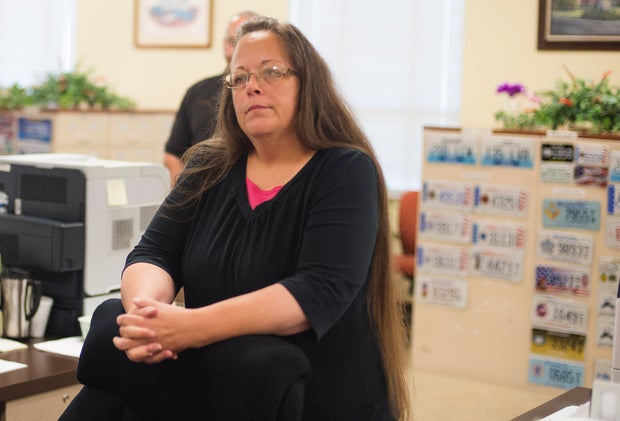
“In their ‘private lives,’ government officials are of course free to express their opinions and live by their faith. But when a public official exercises state power against private citizens, his conscience must yield to the Constitution,” Justice Helene White wrote for the court.
The 6th Circuit warned that if it accepted Davis’ argument, county clerks who consider interracial marriage sinful could refuse to issue licenses to interracial couples, or a zoning official opposed to Christianity could deny a permit for building a church.
“[W]“When a public official’s exercise of his duties according to his conscience violates the constitutional rights of citizens, the Constitution must prevail,” White wrote. “The Bill of Rights would serve no purpose if it could be freely ignored whenever an official’s conscience demands it.”
Davis appealed to the Supreme Court. In addition to asking the justices to review the 6th Circuit’s decision, his lawyers asked them to overturn Obergefell v. Hodges.
His petition raised concerns that the 10-year-old ruling could be in jeopardy, particularly given the Supreme Court’s decision. Roe v. Wade overturned in 2022. In a concurring opinion, Justice Clarence Thomas suggested the high court reconsider a number of its decisions based on due process, including the right to same-sex marriage and contraception.
No other justices joined Thomas’ opinion, and it was unclear whether four of the justices agreed that Obergefell should be reconsidered and five would vote to overturn it.


