Supreme Court dismisses long-shot challenge to right to marry for same-sex couples

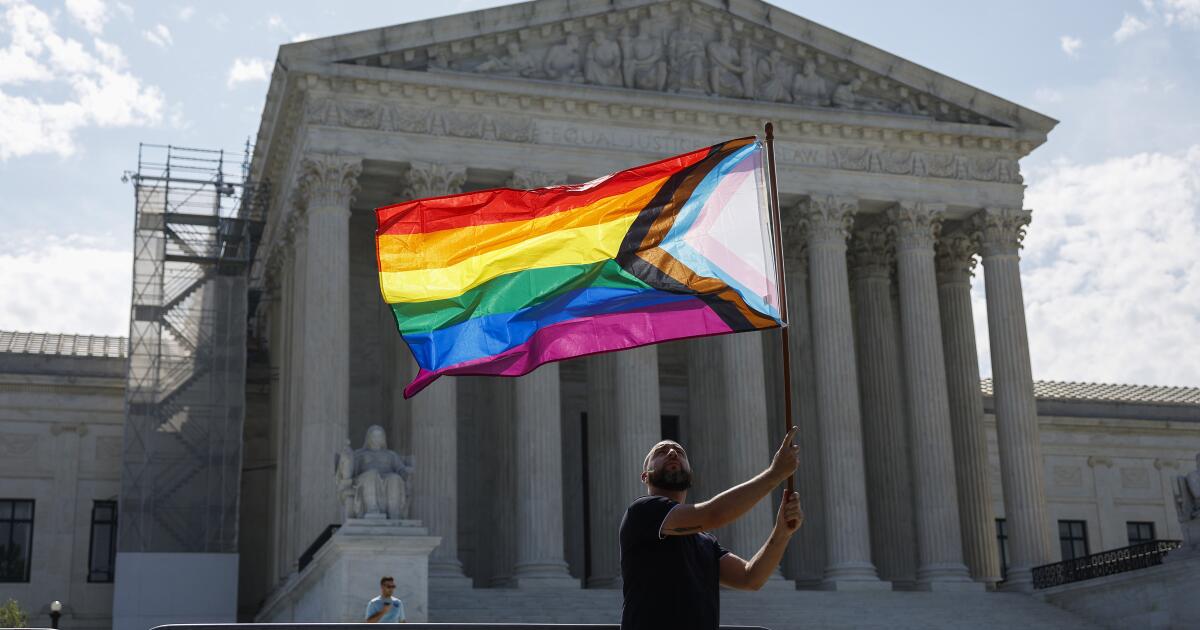
WASHINGTON- The Supreme Court on Monday rejected without comment a long-running challenge to the constitutional right to marriage for same-sex couples.
The justices rejected an appeal request from Kim Davis, a former Kentucky county clerk who defied the court’s landmark ruling in 2015 and repeatedly refused to issue marriage licenses to same-sex couples.
She appealed after a couple sued and won $100,000 in damages and attorney’s fees for their willful violation of their constitutional rights.
She argued that the court should hear her case to decide whether the free exercise of religion guaranteed by the 1st Amendment should have protected her from prosecution.
Her appeal also posed a separate question that she had not previously raised during her lengthy legal fight. She said the court should decide “whether Obergefell v. Hodges,” which established the right to same-sex marriage, “should be overturned.”
This late issue drew attention to his appeal, even though there was little or no chance of it being seriously considered by the High Court.
Some LGBTQ+ advocates were concerned, however, because the conservative court had overturned Roe v. Wade and the constitutional right to abortion in the 2022 Dobbs case.
Justice Clarence Thomas, writing for himself, then said that “we should reconsider all of this court’s significant due process precedents, including Griswold, Lawrence, and Obergefell,” referring to cases on contraceptive rights, private sexual conduct, and same-sex marriages.
But other conservative justices disagreed and said abortion was unique. “Rights regarding contraception and same-sex relations are inherently different from the right to abortion because the latter (as we have pointed out) involves only what Roe… called ‘potential life,'” Justice Samuel A. Alito Jr. wrote in his opinion for the court.
Justice Amy Coney Barrett, in her new book “Listening to the Law,” described the right to marry as a “fundamental right” protected by the Constitution.
“The complex moral debate over abortion stands in stark contrast to widespread American support for freedoms such as the right to marry, have sex, procreate, use contraception, and direct the upbringing of children,” she wrote.
In July, the Williams Institute at UCLA School of Law estimated that there were 823,000 same-sex married couples in the United States and they were raising nearly 300,000 children.
Davis had suffered a series of defeats in federal courts.
A federal judge in Kentucky and the 6th Circuit Court of Appeals in Cincinnati rejected his claims based on the free exercise of religion.

Former Rowan County Clerk Kim Davis speaks to reporters in Kentucky in 2015. The Supreme Court on Monday rejected her appeal to overturn the right to same-sex marriage.
(Timothy D. Easley / Associated Press)
These judges declared that government officials do not have free speech or a religious right to refuse to perform their public duties.
“This is not how the Constitution works. In their private lives, government officials are of course free to express their opinions and live by their faith. But when a public official exercises state power against private citizens, his conscience must yield to the Constitution,” Judge Helene White wrote for the 6th Circuit Court in March.
A decade ago, shortly after the court’s decision in Obergefell v. Hodges, the Kentucky governor, the county attorney and a federal judge all told Davis that she was legally required to issue a marriage license to same-sex couples who requested one.
She refused and said the county would not issue any marriage licenses until she obtained a special exemption.
David Moore and David Ermold were a couple for 19 years and took legal action after being denied a marriage license three times. Davis said she was acting “under the authority of God.”
A federal judge found her in contempt for refusing to comply with the law. While she was in prison, the couple finally obtained a marriage license from one of his deputies, but their trial continued.
The Kentucky Legislature revised the law to say that county clerks do not need to list their names on licenses issued by his office. Davis said the accommodation was sufficient and she attempted to have the lawsuit dismissed as moot.
The 6th Circuit declined because the damages claim was still valid and pending. The Supreme Court rejected one of his appeals in 2019.
A federal judge later ruled that she had violated Moore and Ermold’s rights, and a jury awarded each of them $50,000 in damages.
Mat Staver, founder of Liberty Counsel in Orlando, which advocates for religious freedom, appealed on its behalf.
His petition to the Supreme Court said the court should hear his case to decide whether the 1st Amendment’s protection for the free exercise of religion should protect a public official from being sued “in his individual capacity.”
The 6th Circuit Court denied that request in a 3-0 decision.
“The Bill of Rights would serve no purpose if it could be freely ignored whenever an official’s conscience demands it,” Justice White said.
“Indeed, it is not difficult to imagine the terrible possibilities that might ensue if Davis’ argument were accepted. A county clerk who considers interracial marriage a sin might refuse to issue licenses to interracial couples. An election official who believes women should not vote might refuse to count women’s ballots. A zoning official personally opposed to Christianity might refuse to permit the construction of a church,” she said.
Judge Chad Readler, a Trump appointee, said that while public officials have certain rights based on their religious views, “her conduct here exceeded the scope of any personal rights. … Rather than attempting to invoke a religious exemption for herself, Davis instead exercised the full authority of the Rowan County Clerk’s Office to promulgate an official policy denying marriage licenses to same-sex couples, a policy that all employees of the office were required to follow.”


