SwitchBot Smart Video Doorbell review: Monitor included


At a glance
Expert rating
Benefits
- The indoor video monitor is an excellent complement
- Exceptional battery life
- Reasonably priced considering it comes with a screen
Disadvantages
- We encountered some playback bugs
- The display has a very low resolution
- Subscription plan doesn’t add much
Our verdict
Pairing a small monitor with this video doorbell is a simple way to get the most out of what has become a basic device.
Price when reviewed
This value will display geotagged pricing text for the undefined product
Best price today
Best Prices Today: SwitchBot Smart Video Doorbell
$129.99
See the offer
Part of the problem with video doorbells is that you don’t always have your phone ready to see who’s ringing. If you’re in the kitchen when the bell rings, but you’ve left your phone in the bedroom, do you rush to your phone to see who’s there, or do you take your chance and just answer the door?
SwitchBot aims for this situation by pairing its doorbell with a standalone, battery-powered display that gives you an additional way to see who’s outside. If you’re part of the SwitchBot ecosystem (and even if you’re not), this is an affordable combo worth checking out.
Features
Not to be redundant, but there are two components in the box: the doorbell and the monitor/screen. I’m going to break down each one.
The SwitchBot Smart Video Doorbell can be installed in seconds if you use adhesive, and setup in the SwitchBot app is particularly quick.
The SwitchBot Smart Video Doorbell is a simple design, available only in silver and vaguely resembling an old cell phone. It measures 4.96 x 3.70 x 1.50 inches (126 x 94 x 38 mm) (HxWxD) and has an IP65 rating for protection against the elements. According to our IP codes guide, this means it’s impervious to particles and can withstand jets of water coming from any direction (except from a pressure washer, of course).
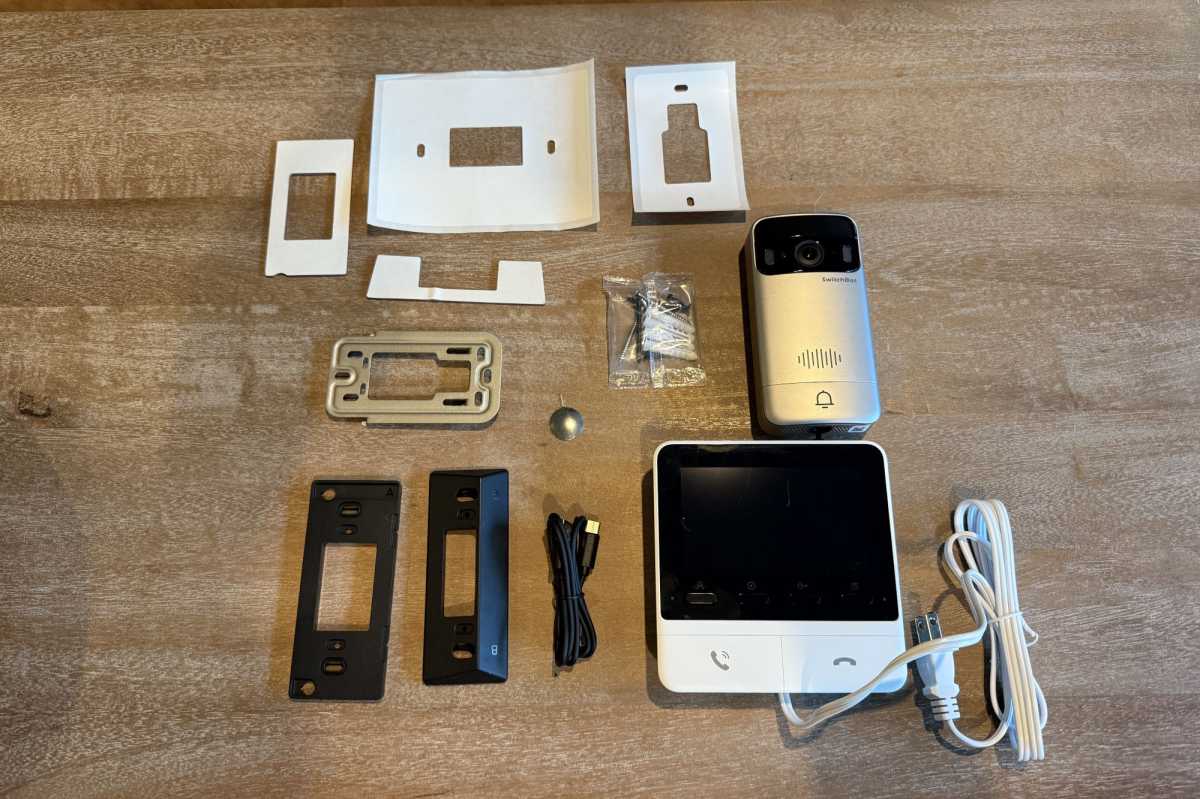
SwitchBot provides everything you need to set up the smart video doorbell, including corner wedges.
Christopher Null/Foundry
The doorbell is equipped with a 2K camera lens with a maximum resolution of 2304 x 1296 pixels and a field of view of 165 degrees. It records videos in 16:9 aspect ratio which promises to capture head-to-toe views of your visitors. There is also a built-in motion sensor and two small LED spots at the top of the device that activate on demand. A speaker and a buzzer button that lights up when motion is detected are located on the bottom of the doorbell. SwitchBot includes straight and angled mounting brackets in the box.
The doorbell is powered by an internal 5,000mAh battery which, according to SwitchBot, can last up to 19 months on a full charge. This battery can be charged three ways: with a 5V/2A power supply and a USB-C cable plugged into a port on the bottom of the device, charged in slow mode with a connection to a standard 24V doorbell transformer, or SwitchBot sells a solar panel as a $50 option specifically designed to keep the doorbell battery charged. (A pet peeve: the doorbell has no indicator to inform you When it is fully charged. A simple LED would be a nice addition for those who need to remove the doorbell to recharge it periodically.)
The display, a “next-generation super monitor,” according to the company, features a 4.3-inch screen with a resolution of just 480 x 272 pixels. A handful of physical controls let you accept or end video calls, manually check live view, and play recent videos. (These buttons have other functions when the video is broadcast live.)
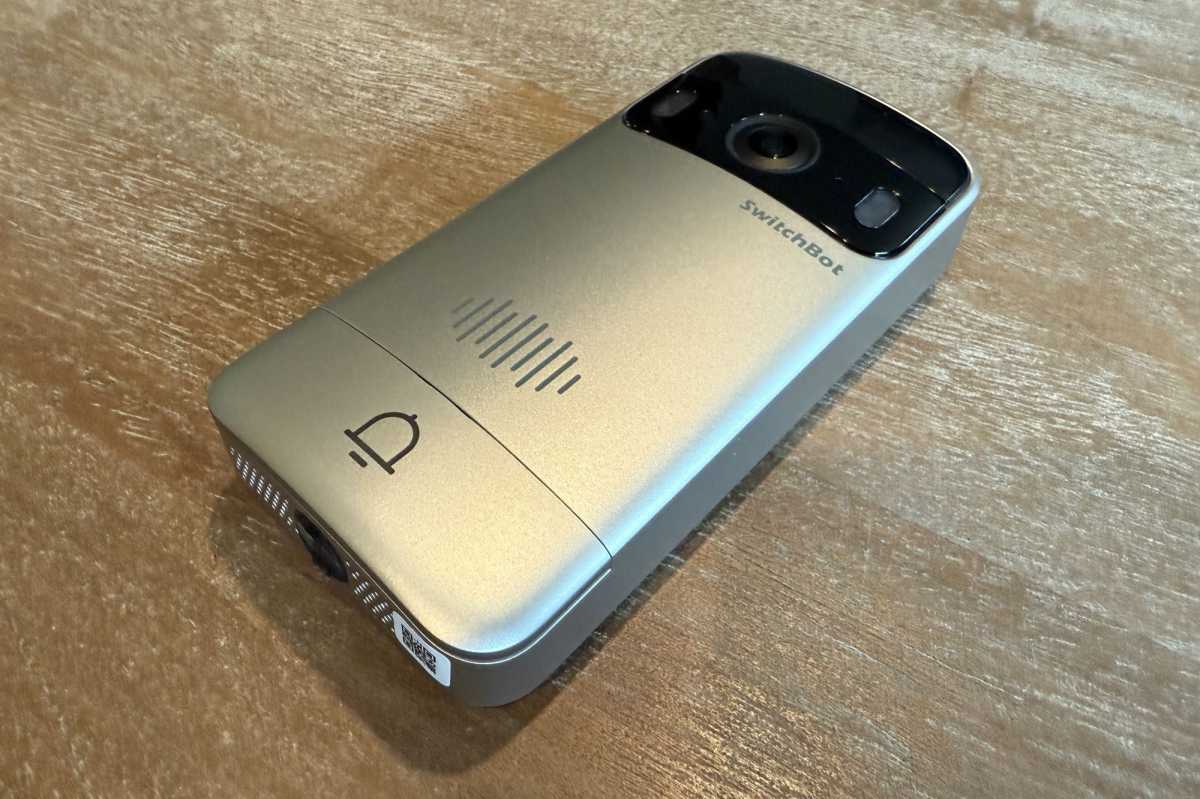
The SwitchBot Smart Video Doorbell isn’t what I’d call a cutting-edge smart home device.
Christopher Null/Foundry
The screen is dark by default unless you press the doorbell button, in which case it shows a live view of what’s happening outside. You can set the monitor to be always on, but it just shows the time (in 24 hour format) and date, and this cannot be adjusted. It is powered by a standard two-prong electrical outlet.
Videos can be stored on SwitchBot’s cloud service or on a microSD card inserted into the monitor. Cards up to 512 GB are supported, but SwitchBot offers a 4 GB card that you can use right away.
You can choose from five canned, quick responses (such as “Please leave the package at the door. Leave a message if you’d like.”) that conflict-averse types can provide upon request. These responses can be sent either by the application or by the monitor.
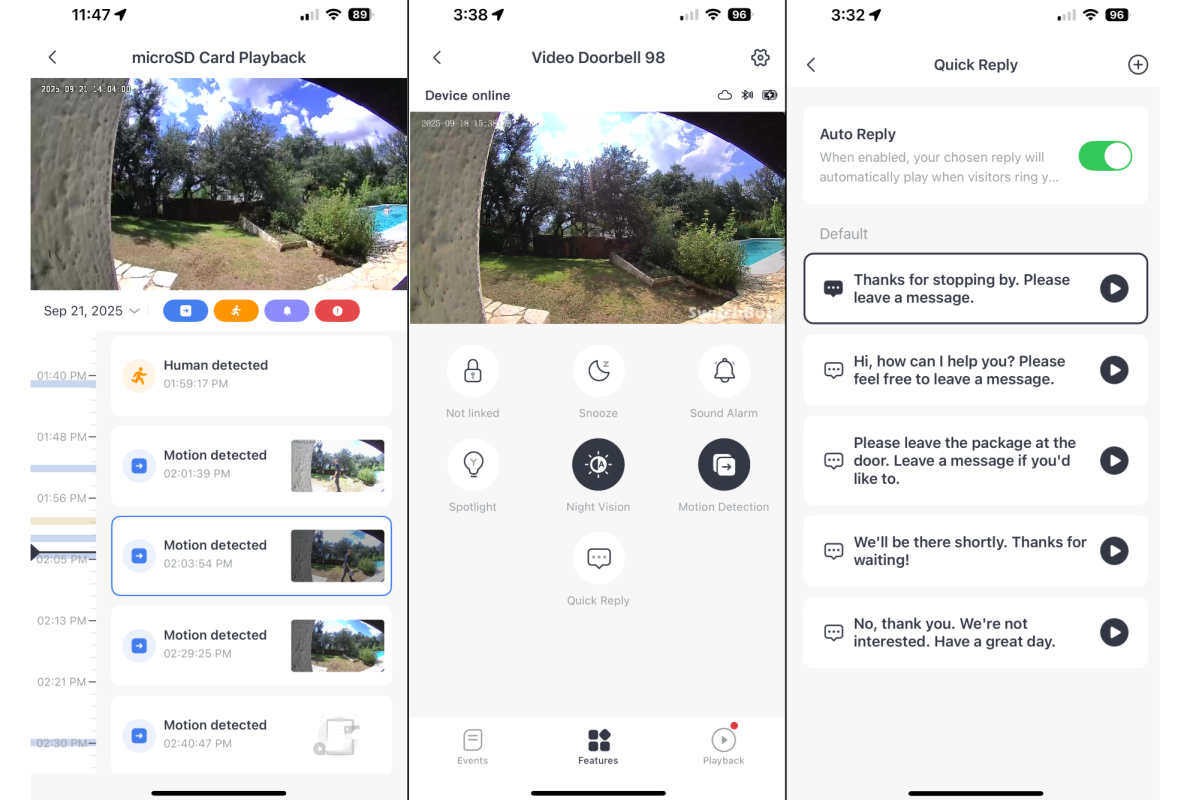
The SwitchBot app is pretty simple to use, but it’s odd that it doesn’t offer you any way to navigate a timeline when you’re watching a recorded event.
Christopher Null/Foundry
Both devices can be wall-mounted via the included screws or adhesive mounting options, and the monitor has a kickstand for placing on a table. The screen and the doorbell must be within 100 meters (in open air) to communicate with each other; any physical barrier between the two will of course quickly reduce this distance. And SwitchBot recommends a more realistic range of just 5 to 10 meters. The two devices communicate with each other (and with the web, through your router) via 2.4GHz Wi-Fi and Bluetooth.
Installation and configuration
Physical installation varies depending on which components you’re wall-mounting and how, but even screw-mounted options only require two screws for each device. Use adhesive and installation can be done in seconds.
Setup in the SwitchBot app is particularly quick, especially since it doesn’t require a SwitchBot hub to connect to Wi-Fi. In fact, the Video Doorbell includes its own version of a hub that allows it to work with SwitchBot Lock devices as well, allowing remote control of the lock through the doorbell interface, although it can’t serve as a hub for other SwitchBot equipment. To complete the setup in the app, the Video Doorbell is presented as a new device once powered on, and a few basic steps complete the connection to your Wi-Fi network.
Using the SwitchBot Smart Video Doorbell
The SwitchBot Video Doorbell works largely as expected. As the doorbell approaches, its ring button lights up softly. Pressing the button causes the bell to ring (very loud, by default), the monitor to ring, and a push notification to your phone. If the device is paired with Alexa (its only third-party support), Echo devices will also announce that the bell has rung.
Oddly, ringing the bell does it not make the monitor automatically display a video feed from the door. You need to press the “play” button on the monitor to start the video, after which the stream takes a few seconds to start.
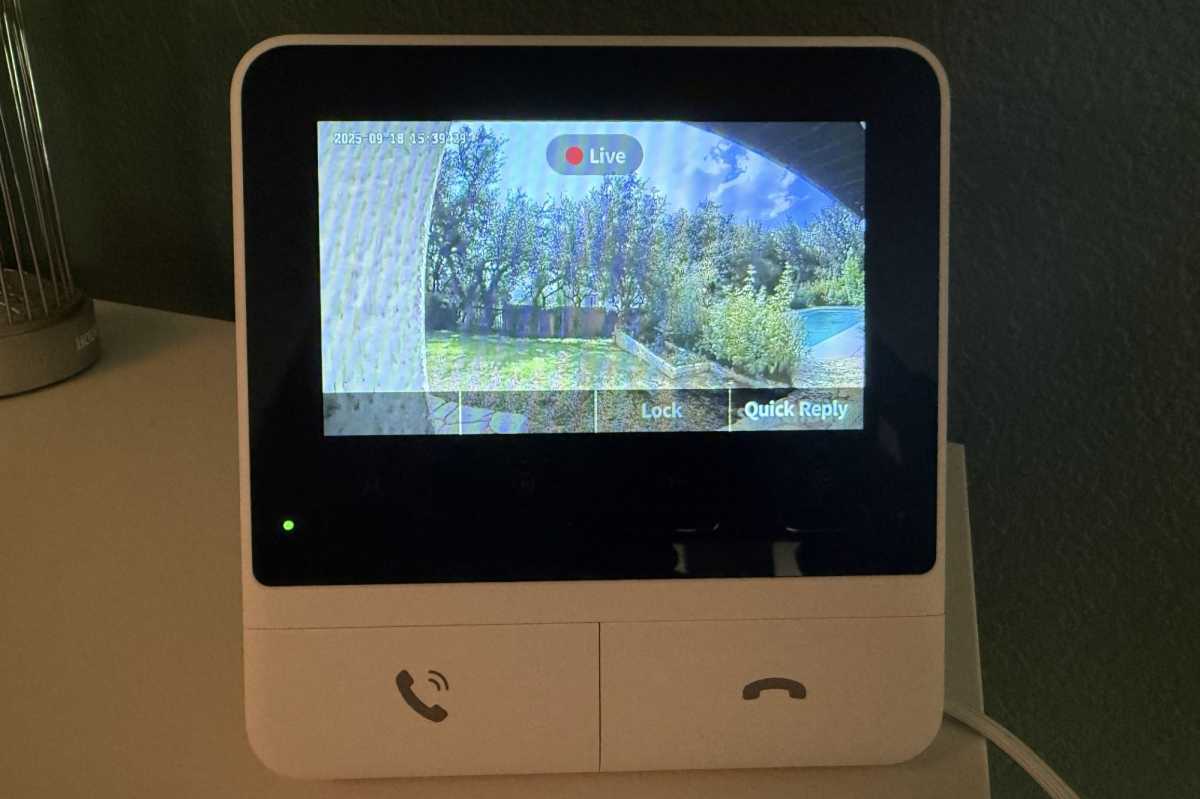
The screen that comes with the SwitchBot Smart Video Doorbell is a decidedly low-resolution affair.
Christopher Null/Foundry
It’s also worth noting that the monitor’s low resolution is immediately obvious. While the color representation looks okay, the grainy quality won’t win any awards and is only useful for quickly checking who’s outside.
Bell ringtones and motion detection trigger video to begin recording, stored by default on the monitor’s microSD card. Clips are limited to a maximum of 60 seconds, after which they are available in the SwitchBot app for playback for three months. The playback interface is separated by day, with thumbnails for each recorded event appearing chronologically. A few thumbnails were randomly missing in my testing, and I found that recent clips often wouldn’t load without force-closing and restarting the app. The app includes AI-based technology to categorize human movements and label them as such; it was a fluke during my testing.
Paying for a cloud storage subscription unlocks animal and vehicle tagging; plus, unlimited online storage space for 30 days of recordings. This plan costs $4/month or $35/year for a single device, with discounts for additional devices available. A one-month free trial is included with your purchase.
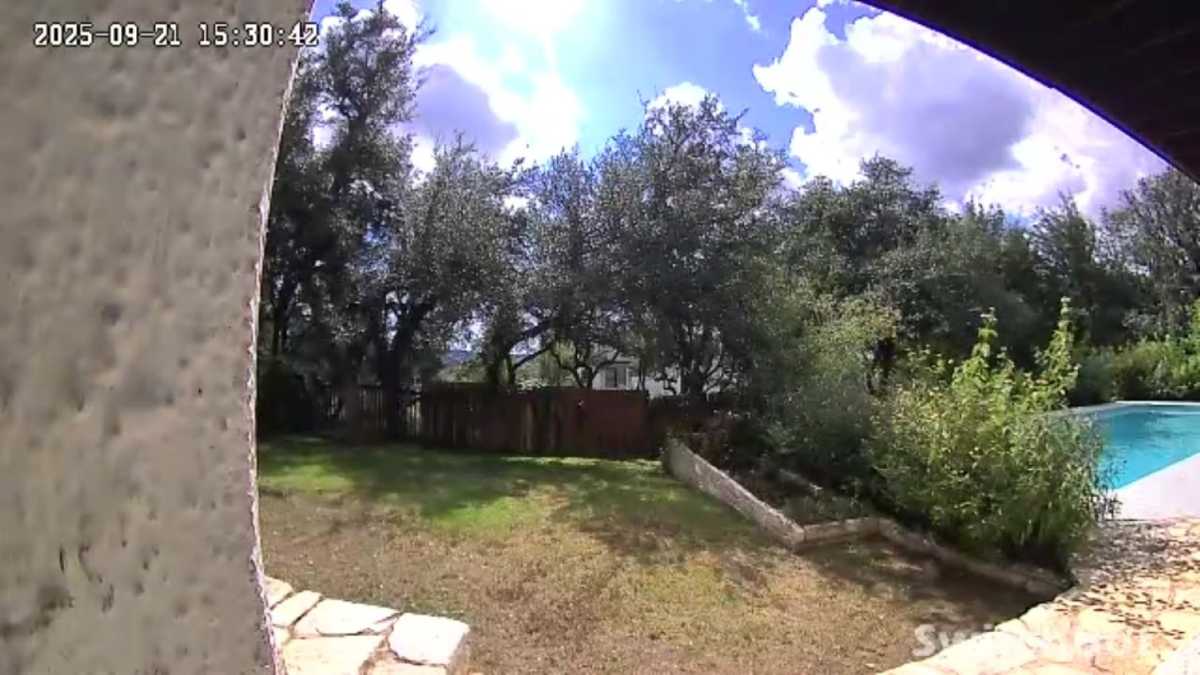
The lack of significant distortion was a pleasant surprise.
Christopher Null/Foundry
I found the device’s motion sensor to be extremely sensitive, and at the highest sensitivity it constantly reported activity, day and night, even marking a random flying bug as a “human” detected. Reducing the sensitivity helped a lot to avoid false positives.
The video looks good when played on your phone, especially during the day, and although the viewing angle is wide, it’s not too distorted. The infrared night vision mode seems decent, although its usable range is limited to around 15 feet, and although the device claims a “color night vision” mode, I found this completely unnecessary; all videos recorded at night with this mode active resulted in an almost completely black image.
One quirk about playback: There’s no way to rewind or fast-forward clips in the app, and even the pause button doesn’t work. If you want to carefully browse a clip, you’ll need to download it to your phone to view elsewhere. (Luckily, it’s easy to do.)
Should you buy the SwitchBot Smart Video Doorbell?
This doorbell costs $150 and I saw it for sale on Amazon for as low as $120. That’s less than many competing products, none of which come with a video monitor.
Since it’s not particularly tied to the SwitchBot ecosystem, there’s really nothing that should stop any smart home user from picking it up; although if you’re not interested in the monitor, a no-frills doorbell will be the cheapest and most effective solution.
This review is part of TechHive’s in-depth coverage of the best video doorbells.


